
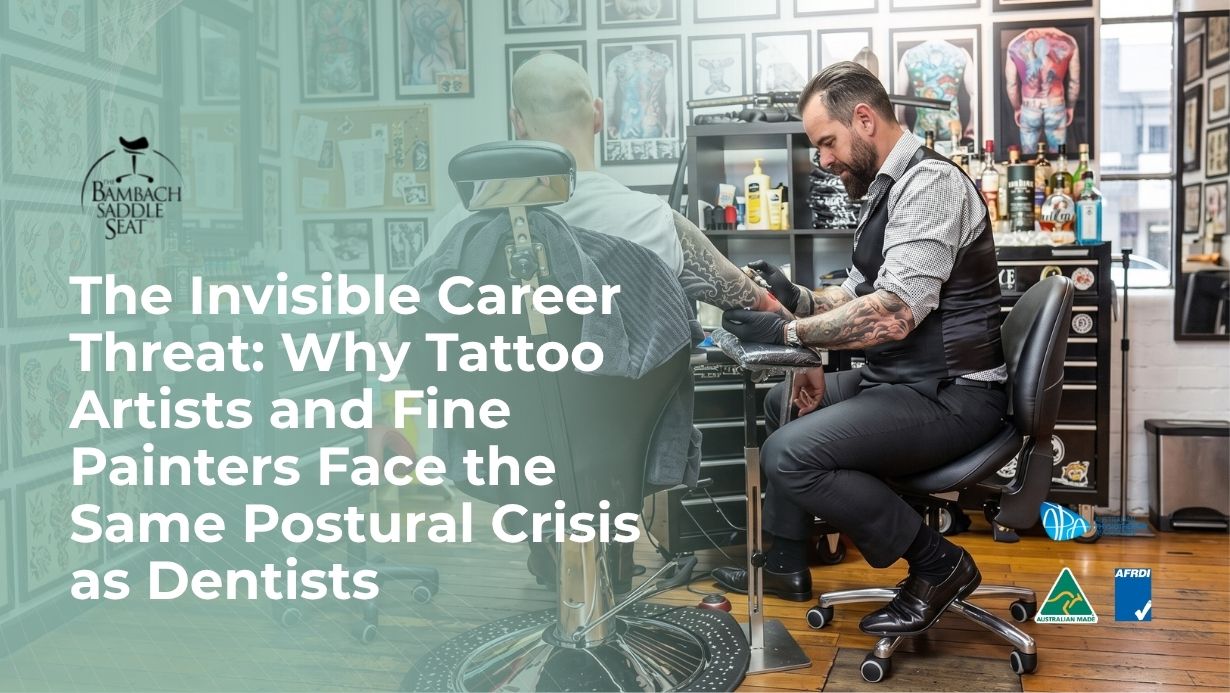
The Invisible Career Threat: Why Tattoo Artists and Fine Painters Face the Same Postural Crisis as Dentists
The Physical Demands of Creative Practice
The creative studio represents one of the most physically demanding work environments in Australia. For instance, whether spending six hours applying intricate line work to a client’s torso or leaning over an easel working on a large-scale canvas, tattoo artists and fine painters endure extreme physical stress to produce their art.
Unfortunately, despite their intense dedication, creative professionals frequently suffer from chronic, career-shortening back, neck, and shoulder pain.
Clinical Evidence: Musculoskeletal Breakdown in the Studio
For decades, occupational ergonomics focused heavily on office workers and dental surgeons. However, recent peer-reviewed research confirms that visual and tattoo artists face a musculoskeletal disorder (MSD) crisis equal to—and in some categories exceeding—dental professionals.
Specifically, a landmark study published in Occupational Medicine (Oxford University Press) directly compared the physical pain patterns of tattoo artists, dental workers, and office workers:
- Lower Back Pain: 72% of tattoo artists report chronic lower back pain, compared to 62% of dental workers.
- Neck Strain: 66% of tattooists suffer from severe neck strain caused by continuous cervical flexion.
- Upper Limb & Hand Fatigue: 55% experience upper limb and hand pain due to static arm positioning and machine vibration.
As a result, the researchers concluded that tattoo artists and dental workers share virtually identical pain profiles. Furthermore, clinical trials published in Applied Ergonomics highlight that tattooists spend up to 80% of their working day in extreme lumbar flexion without adequate pelvic support.
Why Standard Studio Stools Destroy Artist Posture
Conventional flat studio stools and domestic office chairs force the hips into a closed 90-degree angle. Consequently, this closed position tilts the pelvis backward, flattening the lumbar spine’s natural “S” curve into a slumped “C” shape.
The Biomechanical Hazards of the “Studio Slump”
When a tattoo artist or painter leans forward to execute fine detail work, this flattened posture creates several critical biomechanical hazards:
- Severe Disc Compression: For example, leaning forward on a flat seat multiplies pressure on the L4/L5 lumbar discs by up to 180%, accelerating spinal degeneration.
- Static Muscle Hypoxia: In addition, lower back and neck muscles must contract continuously to prevent the torso from collapsing forward. Consequently, this restricted blood flow causes rapid muscle fatigue.
- Unstable Fine-Motor Foundation: Moreover, slumping destabilises the shoulder girdle, forcing the arms and hands to overcompensate to keep needles or brushes steady.
Biomechanical Comparison: Standard Stool vs. Bambach Saddle Chair
| Postural Criteria | Standard Studio Stool | Bambach Ergonomic Saddle Chair |
| Hip Angle | Closed 90° Pinches hip flexors and tilts pelvis backward. | Open 135° Rotates pelvis forward into neutral anatomical balance. |
| Lumbar Curve | Flattened “C” Curve High spinal disc compression and slumping. | Natural “S” Curve Self-supporting, healthy spinal posture without a backrest. |
| Pelvic Stability | Unstable Flat Surface Sit bones slide, forcing lower back muscles to fatigue. | Continuous-Contour Lock Solid seat pan locks pelvis and sit bones securely in symmetry. |
| Arm Precision | Compromised Upper Body Shoulders tense up to offset lower core collapse. | Anchored Core Foundation Frees shoulders and arms for steady, fine-motor detail work. |
| Studio Durability | Domestic Grade Standard vinyl degrades when exposed to inks and solvents. | Medical-Grade Vinyl Seamless, fluid-resistant, and built for harsh studio sanitisation. |
| Commercial Testing | Basic / Uncertified Light domestic rating or uncertified imported components. | AFRDI Level 6 Certified Independently tested in Australia for severe commercial use. |
How the Bambach Saddle Seat Restores Posture for Artists
Designed in Sydney by Australian Occupational Therapist Mary Gale, the Bambach Saddle Seat was engineered to solve the biomechanical breakdown caused by flat seating.
1. The 135-Degree Open Hip Angle
By opening the hip stance to 135 degrees, the Bambach seat naturally rotates the pelvis forward. Consequently, this anatomical tilt aligns the spine into its natural, upright “S” curve without requiring a bulky backrest that restricts upper-body movement.
2. Continuous-Contour Pelvic Stability
Precision tattooing and painting require absolute physical stability. Therefore, unlike split-seat designs featuring two separate moving pads that shift under body weight, Bambach’s continuous, unbroken saddle contour provides a solid foundation. Specifically, this continuous lock holds the sit bones securely in symmetry, eliminating lateral wobble while operating vibrating tattoo machines or applying delicate glazing layers.
3. Compact Mobility Around Clients and Easels
Furthermore, tattoo beds, client chairs, and large canvases require close physical proximity. Fortunately, the narrow star base and compact footprint of the Bambach allow artists to roll close to their work surface without tripping over wide chair legs or bulky armrests.
4. Studio-Ready Sanitation & Australian Build Quality
Finally, tattoo studios and painting workshops are exceptionally tough on equipment. For this reason, Bambach seats are hand-upholstered in Marrickville, Sydney, using seamless, surgical-grade vinyl that withstands tattoo inks, stencil fluids, oil paints, solvents, and heavy hospital-grade disinfectants. In addition, every chair is independently certified to AFRDI (Furntech) Level 6 for severe commercial use and backed by a 5-year commercial warranty.
Extend Your Creative Career
In conclusion, protecting your spine guarantees your artistic longevity. Ignoring chronic back and neck strain can permanently compromise your motor precision and limit your studio hours.
Therefore, explore our full range of Ergonomic Studio Chairs or read our Australian Clinical Case Studies to discover how pelvic stability preserves your craft.
Both professions require prolonged static sitting combined with forward lean and extreme hand-eye precision. Research published in Occupational Medicine confirms that tattoo artists experience low back pain (72%) and neck pain (66%) at rates virtually identical to dental workers due to the lack of pelvic support on standard studio stools.
Precision tattooing requires a completely stable lower body. A continuous-contour seat pan provides an unbroken surface that locks the pelvis and sit bones firmly in place. Split-seat designs feature two separate moving pads that shift under body weight, creating micro-instability that can transfer tension into the shoulders, arms, and hands.
Yes. Fine painters frequently stoop over low canvases or reach up to high easels. Bambach offers custom gas-lift stem heights—including medium, high, and drafting options with adjustable footrings—allowing painters to work comfortably at elevated easels while maintaining a neutral lumbar curve.
Standard flat chairs hold the hips at 90 degrees, forcing the pelvis backward and flattening the lower spine into a slumped “C” curve. An open 135-degree hip angle rotates the pelvis forward, naturally restoring the spine’s healthy “S” curve. This takes pressure off spinal discs and reduces muscle spasm during multi-hour tattoo sessions.
Yes. Bambach studio chairs are upholstered in seamless, medical-grade vinyl engineered specifically for demanding environments. The material is non-porous, fluid-resistant, and easy to sanitize, preventing tattoo inks, stencil transfer, oil paint, and alcohol solvents from penetrating seams or damaging the seat.
AFRDI Level 6 is Australia’s highest independent structural testing standard for severe commercial seating. It verifies that the chair frame, gas lift, and base can withstand continuous, heavy-duty daily use and dynamic weight shifts without mechanical failure.