Category: Office Worker

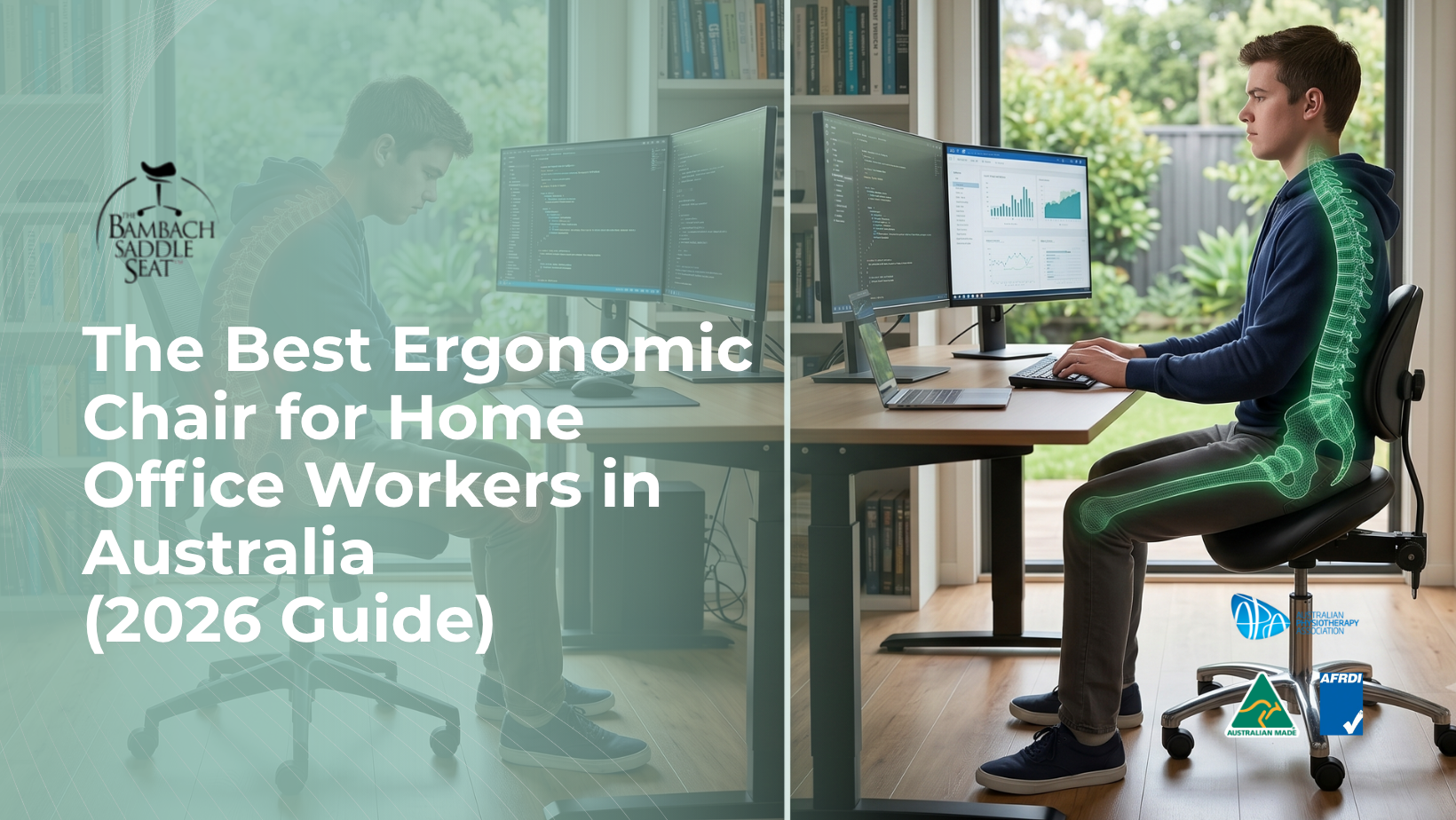
The Best Ergonomic Chair for Home Office Workers in Australia (2026 Guide)

The shift to remote work is no longer a temporary phase; it is the permanent reality for millions of Australians. But while our commutes have disappeared, a new epidemic has taken their place: severe, chronic musculoskeletal pain. If you are struggling with a work from home chair back pain, you are not alone.

The problem isn’t your work ethic, and it isn’t your body. The problem is your furniture.

For decades, the standard office chair has forced the human body into a “90-degree trap”—a flat-pan design that actively fights your natural anatomy, forcing your spine to collapse. At Bambach, we believe your furniture should work with your biology, not against it. In this comprehensive 2026 guide, we will unpack exactly why traditional seating fails, what criteria actually matter when upgrading your workspace, and why the original continuous-contour design makes the Bambach Saddle Seat the best home office chair Australia 2026 has to offer.

Read also : https://www.bambach.com.au/case-study/office-shoulder-neck-pain/

Why Your Current Home Office Chair is Causing Back Pain

To understand what makes the best ergonomic chair home office Australia professionals can buy, you first have to understand why standard chairs cause so much damage.

When you sit on a traditional, flat-seated office chair, your hips are locked at a 90-degree angle. This unnatural geometry forces your pelvis to tilt backward (a posterior tilt). The moment your pelvis rolls backward, the natural, healthy “S” curve of your lumbar spine is flattened into a weak, collapsed “C” shape.

This is the “sacral slump.”

Once the foundation collapses, a destructive whole-body chain reaction begins:

  • Lumbar Compression: Your lower spinal discs bear massive, asymmetrical weight, leading to herniations and sciatica.
  • Thoracic Restriction: Your chest caves in, physically restricting your diaphragm and reducing oxygen intake, which accelerates fatigue.
  • “Tech Neck”: To compensate for the slumped spine and still see your monitor, your neck juts forward, forcing your trapezius and shoulder muscles to work overtime.

Standard ergonomic chairs try to fix this by adding passive lumbar cushions and massive backrests. But treating a collapsed foundation by simply propping it up from behind is a flawed premise. You don’t need a better backrest; you need a better foundation.

5 Criteria for Choosing the Best Home Office Chair in Australia

When assessing the market for an ergonomic upgrade, cut through the marketing jargon and evaluate chairs based on biomechanical reality. Here are the five critical criteria you must consider:

1. Active Spinal Support (Pelvic Alignment)

Passive support (leaning back into a cushion) turns off your core and breeds weakness. Active support focuses on the pelvis. The ideal chair must naturally guide your pelvis into a neutral, upright position (anterior tilt). By stabilizing the pelvis, your spine effortlessly stacks into its natural architecture without requiring constant muscle tension.

2. Customisation and Fit

A chair built for a 160cm graphic designer will not biomechanically support a 190cm software engineer. True ergonomic seating requires precise customization. Look for seating solutions that offer variations in seat size, adjustable gas stems for height, and foot-support options to ensure your feet are perfectly anchored.

3. Clinical Certification and Endorsement

Do not rely on the word “ergonomic”—it is an unregulated marketing term. Look for chairs that are actively utilized in medical environments and hold genuine endorsements from credible bodies, such as the Australian Physiotherapy Association (APA). If a chair isn’t trusted by spine specialists, it doesn’t belong in your home office.

4. Durability & Build Quality

Your home office chair is the most heavily used piece of equipment you own. Cheap plastics, degraded foam, and flimsy castors will break down within a year. A premium chair should be manufactured locally with high-density, automotive-grade materials designed to withstand decades of heavy, daily use.

5. Warranty and Local Support

Investing in your spinal health is a significant decision. The best chairs in Australia are backed by robust, multi-year warranties and accessible local customer support teams who can assist with adjustments, parts, and personalized fitting advice.

Head-to-Head: The Biomechanical Comparison

How do the most popular WFH seating options actually stack up against each other? We break down the anatomical impact of four common choices.

Feature / Chair TypeStandard Ergonomic ChairKneeling ChairBalance BallThe Bambach Saddle Seat
Pelvic PositionSlumped backward (Posterior tilt)Tilted forward (but locks the knees)Unstable, requires constant micro-adjustmentsNeutral & upright (Anterior tilt)
Spine AlignmentUnnatural “C” shape collapse“S” curve, but transfers strain to shins“S” curve, but highly fatiguing over timeHealthy, natural “S” curve, sustained effortlessly
Hip AngleCompressed 90° angleCompressed, restrictive angleOpen, but lacks solid foundationOpen, dynamic 135° angle
Core Muscle UseDormant, leading to severe weaknessEngaged, but staticOver-engaged, leading to rapid exhaustionActive, stabilizing the torso without fatigue
Long-Term ComfortPoor (Pain develops over hours)Moderate (Shin and knee pain common)Poor (Not sustainable for 8-hour days)Excellent (Designed for all-day clinical use)


Why the Bambach is the Ultimate Home Office Solution

We don’t just change your chair. We restore your posture.

Over thirty-five years ago, an Australian occupational therapist revolutionized clinical seating by looking at the only posture where the human spine is perfectly balanced while seated: horseback riding. This insight led to the creation of the original, unbroken continuous-contour design that defines the Bambach Saddle Seat. (Read the History of Bambach)

Here is why we remain the benchmark for the best saddle chair Australia has to offer:

The Power of the 135-Degree Angle

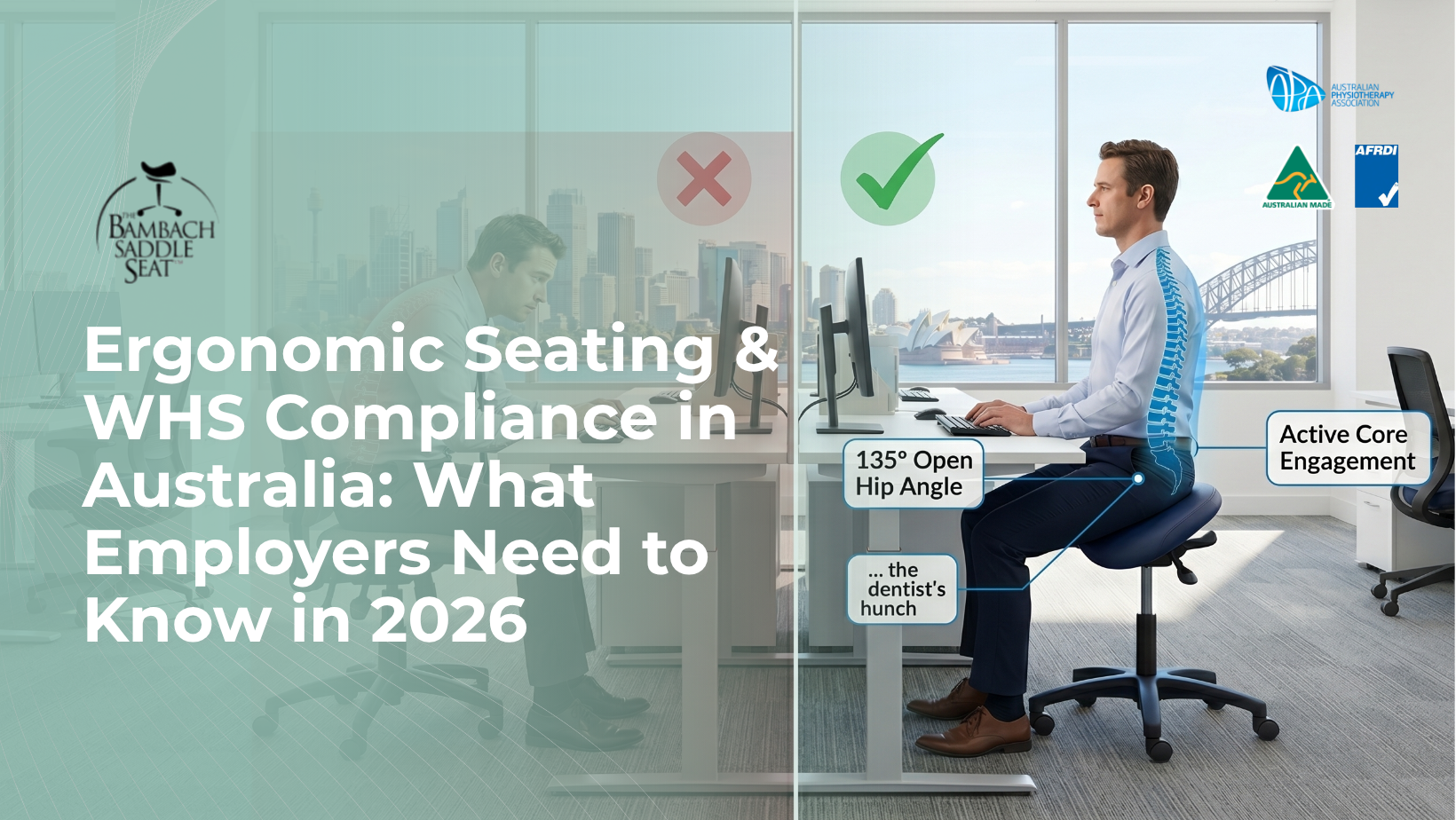
By dropping your thighs into a natural 135-degree angle, the Bambach naturally abducts your legs. This skeletal geometry locks your pelvis into the perfect upright position. You don’t have to try to sit up straight; the chair’s contour forces your anatomy into alignment.

Sit Unbroken

Unlike cheap copycats that use split or divided seat pans, Bambach utilizes a solid, continuous-contour seat. This unbroken design ensures uniform weight distribution across your sit bones without sacrificing the structural surface stability required to keep your pelvis anchored. We keep our seat unbroken so your spine can stay uncompromised.

Free Your Upper Body

Because your lower body is perfectly stabilized by the saddle’s pommel and cantle, your upper body is completely liberated. Your chest opens, improving breathing. Your shoulders drop, eliminating “tech neck.” You gain total freedom to reach, pivot, and type without putting hazardous twisting forces on your lower back.

Ready to Break the 90-Degree Trap?

Stop fighting your furniture. If you are serious about eliminating back pain and upgrading your workspace to a clinical standard, it is time to invest in the foundation of your health.

Explore our dedicated range designed specifically for modern remote professionals by visiting our Home Office Seating Solutions.

Because every body is unique, the perfect fit is crucial. Use our guide to Choose The Right Model and tailor your Bambach to your exact height, workstation setup, and professional needs. Join the thousands of Australians who have discovered the Best Saddle Chairs in Australia and sit the way your body was built to.


While a height-adjustable desk is an excellent addition to any home office, it is not strictly necessary. Because a saddle seat opens your hip angle to 135 degrees, you will sit slightly higher than you would in a standard office chair. We can customize the gas stem height of your Bambach to work perfectly with your existing desk, or you can pair it with desk risers for optimal monitor and keyboard height.

Because standard chairs allow your core muscles to go completely dormant, transitioning to active seating requires a brief adjustment period. Most users experience a "waking up" of their core and pelvic muscles during the first 1–2 weeks. We recommend building up your time in the Bambach gradually—starting with a few hours a day—until your body readapts to its natural, upright architecture.

Absolutely. Unlike balance balls or kneeling chairs, which cause rapid fatigue or transfer pressure to your shins, the Bambach is designed for all-day clinical and professional use. Once your core muscles have adjusted to active sitting, the solid, continuous contour of the saddle provides the long-term structural support needed to work an 8-hour day with zero postural fatigue.

Many generic online alternatives use a divided or split-seat design. These split pans fail to provide uniform weight distribution and lack the structural surface stability required to keep your pelvis firmly anchored. The Bambach Saddle Seat utilizes an original, continuous-contour design, manufactured locally in Australia to rigorous medical standards and endorsed by the Australian Physiotherapy Association. When it comes to the foundation of your spine, compromising on geometry means compromising on relief.
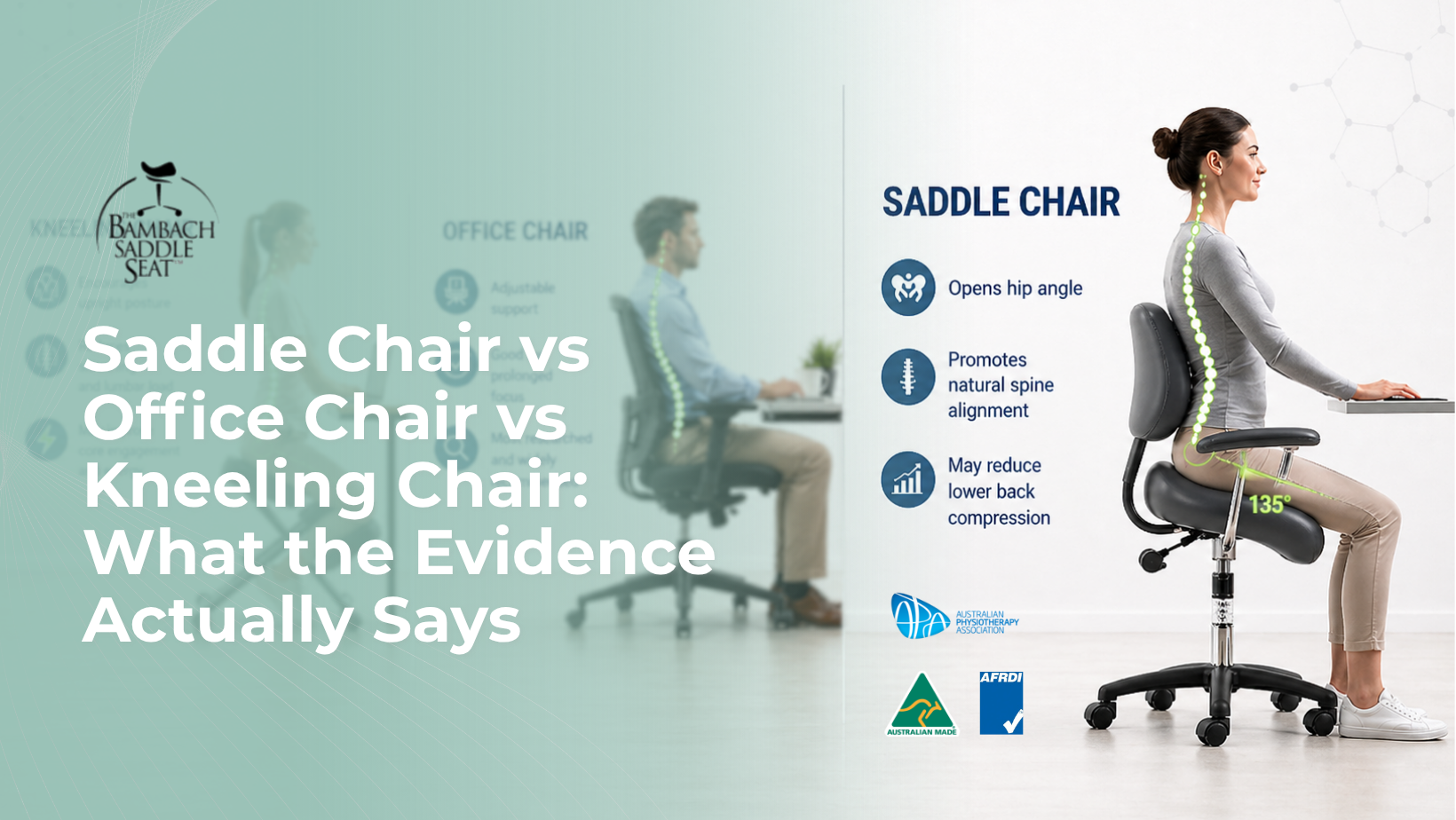
Saddle Chair vs Office Chair vs Kneeling Chair: What the Evidence Actually Says

For decades, the standard response to workplace back pain was simply to buy a “better” office chair. However, as our understanding of occupational biomechanics has evolved, it has become abundantly clear that standard 90-degree seating is fundamentally flawed for active, forward-leaning professions.

Today, health professionals, ergonomists, and practice owners are faced with three primary seating interventions: the traditional ergonomic office chair, the kneeling chair, and the saddle chair. But which one actually prevents musculoskeletal disorders (MSDs)?

In this comprehensive, evidence-based guide, we break down the clinical biomechanics of all three seating options, analyse what the peer-reviewed evidence actually says, and provide a definitive recommendation guide based on your specific profession and working style.

The Biomechanical Baseline: The Importance of Pelvic Tilt

To understand why different chairs yield different results, we must first understand the pelvis. The human spine is naturally shaped like an “S” (lumbar lordosis). When you stand, your pelvis is neutral, and this “S” curve is effortlessly maintained, distributing gravity evenly across your intervertebral discs.

When you sit down, the angle of your hips changes everything. If your hips are forced into a 90-degree angle, the pelvis mechanically rolls backwards. This is called a posterior pelvic tilt. This backward roll flattens the lumbar spine, turning the healthy “S” into a damaging “C” shape. This “C” slump dramatically increases anterior disc compression, stretches the posterior longitudinal ligament, and leads to chronic back pain.

The ultimate goal of ergonomic seating is to maintain an anterior pelvic tilt (forward roll) while seated, thereby preserving the spine’s natural standing curve. Let us examine how the three main chair types attempt to solve this problem.

1. The Traditional Ergonomic Office Chair

The traditional ergonomic office chair (featuring a flat seat pan, lumbar support dial, armrests, and a high back) is the standard fixture in 99% of corporate environments.

How It Works

These chairs operate on the principle of “passive sitting.” They assume the hips will be at a 90-degree angle and attempt to artificially push the lower back into a lordosis using a protruding lumbar support cushion.

The Evidence

Clinical evidence indicates that traditional office chairs are highly effective for reclined, passive tasks (such as taking a phone call or watching a presentation). When a user leans back to a 110-degree angle, the backrest effectively unloads the weight of the torso from the spine.

However, studies show that for active, forward-leaning tasks (typing, dentistry, drafting), traditional chairs fail completely. As soon as the user leans forward away from the backrest, the 90-degree hip angle forces the pelvis into a posterior tilt. The lumbar support becomes useless because the user’s back is no longer touching it, resulting in severe spinal compression.

Pros:

  • Excellent for passive, reclined resting.
  • Highly adjustable armrests and backrests for varied body types.

Cons:

  • Forces a 90-degree hip angle, leading to posterior pelvic tilt.
  • Useless for forward-leaning, precision tasks.
  • Promotes core muscle atrophy through passive support.

2. The Kneeling Chair

Popularised in the 1970s (often known as the Balans chair), the kneeling chair was the first mainstream attempt to break away from 90-degree seating.

How It Works

A kneeling chair drops the thighs to a downward angle (usually around 110 to 120 degrees) while the user’s shins rest on a padded knee/shin block to stop them from sliding forward off the angled seat.

The Evidence

By dropping the thighs, kneeling chairs successfully open the hip angle past 90 degrees. Biomechanically, this is a vast improvement over standard office chairs. Evidence shows that this open angle facilitates an anterior pelvic tilt, which helps maintain the spine’s natural “S” curve during forward-leaning tasks.

However, the clinical consensus has shifted regarding long-term use. The primary issue is weight distribution. Because gravity pulls the user down the angled seat pan, a significant portion of the body’s weight is transferred directly onto the shins and knees. Over an 8-hour workday, this static pressure restricts venous return (blood circulation) in the lower legs and can exacerbate patellofemoral pain. Furthermore, the shins are locked into place, drastically reducing the user’s mobility and preventing them from reaching or turning efficiently.

Pros:

  • Opens the hip angle, promoting a healthier spinal curve than flat chairs.
  • Good for short-duration tasks (1–2 hours).

Cons:

  • Transfers significant compressive load to the knees and shins.
  • Restricts lower-limb circulation during prolonged use.
  • Locks the user in a static position, reducing lateral mobility.

3. The Saddle Chair

Designed by an Australian Occupational Therapist, the authentic saddle chair (such as the Bambach Saddle Seat) represents the gold standard for active, precision professions.

How It Works

The user straddles the chair as if riding a horse. This unique contoured shape drops the thighs dramatically, creating a 135-degree open hip angle. The practitioner’s feet remain flat on the floor, bearing a portion of the weight and providing a wide, stable base of support.

The Evidence

Peer-reviewed clinical evidence strongly supports the 135-degree saddle posture. Because the hip angle is so wide, the pelvis naturally and effortlessly rotates into an anterior tilt.

Crucially, the saddle chair achieves this without transferring load to the knees (like a kneeling chair) and without requiring external lumbar bracing (like an office chair). The user’s skeletal structure perfectly balances the weight of the torso. Furthermore, the straddle stance allows for “active sitting.” The core stabiliser muscles remain engaged, the diaphragm opens for deeper breathing, and the user can easily propel themselves around the room using their legs.

Pros:

  • Achieves the optimal 135-degree hip angle for natural spinal alignment.
  • Eliminates pressure on the knees and shins.
  • Maximises mobility, allowing practitioners to work closer to patients/desks.
  • Encourages active core engagement.

Cons:

  • Requires a short (1-2 week) muscular acclimatisation period.
  • Requires a higher desk or working surface to accommodate the elevated seating position.

The Comparison Table

This table provides a definitive, scannable comparison of the biomechanical impacts of each seating intervention.

Feature / MetricTraditional Office ChairKneeling ChairAuthentic Saddle Chair
Hip Angle90° (Closed)110° – 120° (Partially Open)135° (Optimally Open)
Pelvic PositionPosterior Tilt (Slump)Anterior Tilt (Healthy)Anterior Tilt (Healthy)
Knee/Shin PressureNoneHigh (Restricts circulation)None (Feet flat on floor)
Core Muscle ActionPassive (Atrophy risk)Semi-ActiveActive (Strengthens core)
Mobility / ReachLow (Wheeling only)Very Low (Legs locked)Very High (Leg propelled)
Primary Use CaseReclined computer workShort-term typingActive, forward-leaning clinical work

Regulatory Standards: Navigating AHPRA, APA, and AFRDI in Australia

When purchasing ergonomic seating for a clinical or corporate environment in Australia, buyers are frequently misled by marketing terminology.

It is a common misconception that ergonomic chairs need to be “AHPRA Approved.” The Australian Health Practitioner Regulation Agency (AHPRA) strictly regulates individual healthcare practitioners (like dentists, doctors, and nurses); they do not approve, register, or regulate medical devices, furniture, or seating.

If you are looking for verifiable, clinical-grade seating, you must look for appropriate industry endorsements:

  1. Australian Physiotherapy Association (APA) Endorsement: This is the highest clinical trust signal. The Bambach Saddle Seat is the only seating solution in its class to earn APA endorsement for its evidence-based prevention of spinal injuries.
  2. AFRDI Level 6 Certification: This certification proves the chair has been independently tested to withstand severe, 24/7 commercial use without structural failure.
  3. TGA Registration: In some specific surgical contexts, seating may be listed with the Therapeutic Goods Administration, though this is not mandatory for standard ergonomic chairs.

Practical Recommendation Guide by Profession

Different professions have vastly different biomechanical demands. Here is the evidence-based recommendation for your working style:

For Dental Professionals & Surgeons

Recommendation: The Saddle Chair

Dentists, hygienists, and surgeons cannot lean back into a chair; they must lean forward over a patient. An office chair will destroy a dentist’s lower back, and a kneeling chair restricts the mobility needed to move around the operatory. The Bambach Saddle Chair allows the practitioner to straddle the seat, keeping knees clear of the patient, maintaining perfect spinal posture, and allowing for unrestricted mobility.

Learn more on our dedicated Ergonomic Dental Saddle Chairs page.

For Standard Corporate Office Workers

Recommendation: Traditional Office Chair (High-End) OR Hybrid Approach

If your job primarily involves looking straight ahead at a monitor, taking calls, and reading documents, a high-quality traditional office chair that allows you to recline to 110 degrees is highly effective. Many forward-thinking professionals now use a hybrid approach: using an office chair for passive reading, and switching to a saddle chair paired with a standing desk for active typing and focus work.

For Artists, Drafters, and Architects

Recommendation: Saddle Chair or Kneeling Chair

These professions require constant forward-leaning over a drafting table or canvas. A kneeling chair is a viable, affordable option for short bursts of work (1-2 hours). However, for full-time professionals working 8-hour days, the saddle chair is the only clinically viable option that prevents both back slumping and lower-limb circulation issues.

Conclusion

The evidence is clear: when it comes to active, forward-leaning work, the traditional 90-degree office chair is anatomically counterproductive. While the kneeling chair was a step in the right direction, it merely trades spinal pain for knee and shin pressure.

For professionals who rely on their bodies to perform precision work—particularly in dentistry and surgery—the authentic, 135-degree saddle chair remains the ultimate, clinically validated solution for preventing career-ending musculoskeletal disorders.


Frequently Asked Questions (FAQs)

Yes, in terms of spinal alignment. A kneeling chair prevents the lower back from slumping by opening the hip angle. However, evidence shows that kneeling chairs are not suitable for full-day use (8+ hours) because they transfer a heavy load to the shins and knees, which can restrict blood circulation and cause joint pain over time.

No medical furniture or equipment is "AHPRA approved," because AHPRA only regulates healthcare practitioners in Australia, not products. However, genuine clinical saddle chairs, like the Bambach, are endorsed by the Australian Physiotherapy Association (APA) and tested to severe commercial standards (AFRDI Level 6).

Yes. Because a saddle chair promotes "active sitting," you will be engaging core and postural muscles that have likely weakened from years of slumping in standard chairs. Users typically experience mild muscle fatigue for the first one to two weeks. This is a normal physiological adaptation period as your core strengthens to support your newly aligned spine.

Generally, no. Because a saddle chair drops your thighs and elevates your pelvis to achieve the 135-degree angle, you will be sitting significantly higher than you would in a standard chair. You will need a height-adjustable desk, a drafting table, or a clinical operatory setup to use a saddle chair properly without hunching your shoulders.

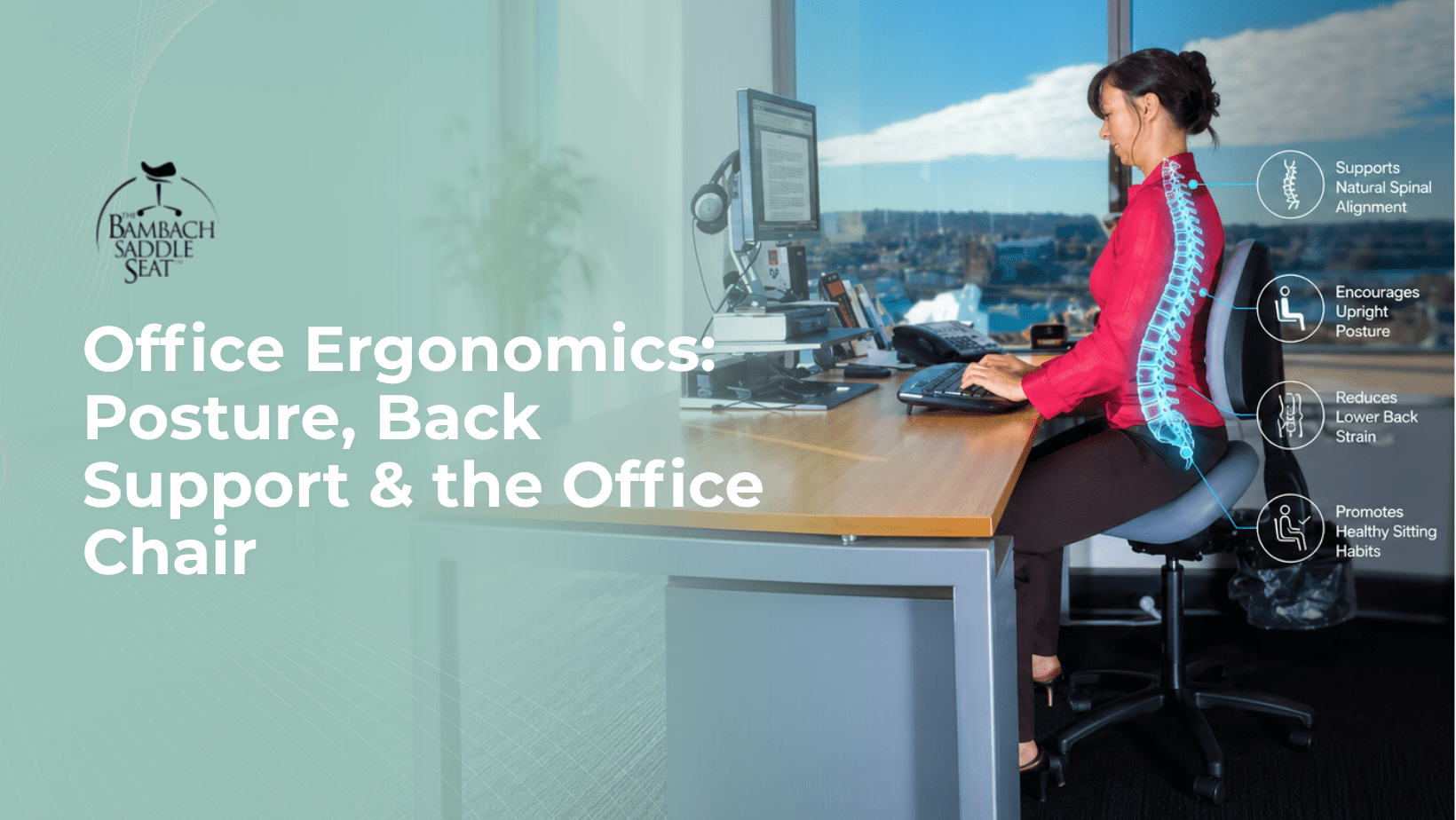
Office Ergonomics: Posture, Back Support & the Office Chair

In the modern workplace, people can spend up to 70% of their day sitting at their desk in front of a computer. This shift in the way we work has resulted in an increase in posture-related injuries, as well as a heightened awareness of the importance of ergonomics for office workers. The use of ergonomic office furniture, including an ergonomic office chair such as the Bambach Saddle Seat, is more important than ever before to maintain good health during our working lives. Whether you work in a corporate, SME or home office environment, poor ergonomics can impact on your productivity, quality of life and overall health, leaving you with mild to debilitating chronic pain.

This month, we discuss how to improve ergonomics in the office, including posture, back support and the best office chair for lower back pain:


Conventional vs Ergonomic Office Chairs

Ergonomic experts agree that although conventional office chairs are useful to relieve the fatigue of standing, they are a potential cause of back pain and trauma due to an increase in intradiscal pressure on the spine. This can in turn result in disc displacement, disc prolapse and damage to the sciatic nerve. When sitting on a conventional office chair for a long period of time we tend to slouch or hunch forwards, which overstretches the spinal ligaments, and strain the discs and surrounding structures of the spine. Over time, this can cause damage to the spine and significantly contribute to back, neck and shoulder pain. In comparison, an ergonomic office chair like the Bambach Saddle Seat supports the natural curve of the spine, improving your posture and reducing back pain.To learn more, see our post on the benefits of using ergonomic office chairs.


Body-Conscious Seat Design

It seems like common sense that people should not hold unnatural positions for long periods of time. The price of postural stress on the body is often paid for by not being able to perform activities that we want to do outside of work, like picking up a child, travelling, enjoying leisure activities or even just being able to relax watching TV. However, the majority of ergonomic office chairs available can actually end up increasing postural stress. Some ‘ergonomic’ chairs support the lumbar curve by pushing into your back, while alternative ergonomic seating such as kneeling chairs and bicycle seats can put sustained pressure on your joints and become uncomfortable to use over the working day. At Bambach, we are interested in body-conscious seat design. Our saddle seats are designed to improve the productivity, mobility and health of workers across a range of industries by creating the ideal sitting posture. 

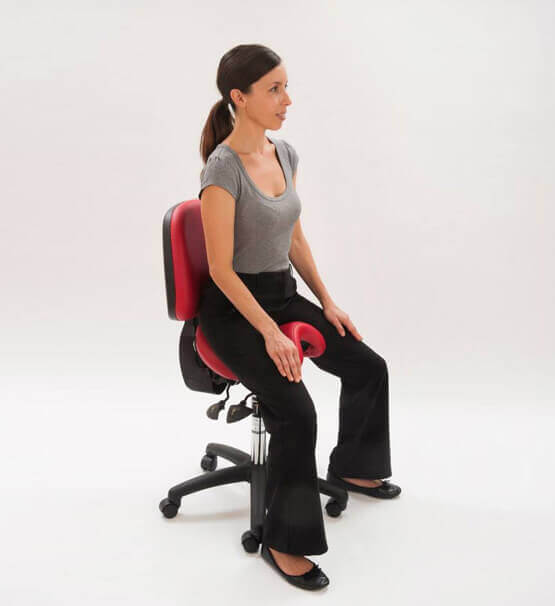
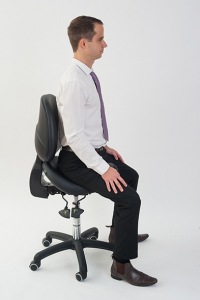
Bambach saddle seat for back support


Improving Seated Posture at Work

Although standing desks are becoming more popular across workplaces, there are a number of advantages to sitting down to work. Sitting relieves the joints of the lower limbs from load bearing, reduces energy consumption which in turn lowers demands on the respiratory and vascular systems, provides greater stability and a better range of movement, and prevents you from working in unnatural positions. The design of our saddle seat allows you to sit naturally and comfortably, while improving your seated posture and even enhancing muscle tone due to the active seating position. In a saddle stool, your spine maintains its natural ‘S’ shape, with all your major joints in a neutral, stress-free position. Our philosophy is to give people a sound ergonomic seating solution with the Bambach Saddle Seat, which encourages correct seating posture instead of the slouching and hunching caused by conventional office seating.


Avoiding Lower Back Pain

In the office, one of the worst things you can do is end up in a prolonged static posture. The body can only tolerate staying in the same position for a short amount of time before stress begins to build in the muscles, tendons and ligaments of the back, eventually turning into discomfort and then pain. Investing in an ergonomic office chair will help you avoid postural stress and back pain, as will adopting the habit of taking frequent breaks to stand, stretch, walk and change positions during your work day. The best chair for lower back pain is one which is customised for your individual use. Every saddle seat created by Bambach is tailored to its user, with multiple stem heights, four seat sizes and a range of accessories available. We ensure that your seat fits all your personal attributes and applications, including gender, height, occupation, environment and workstation. 

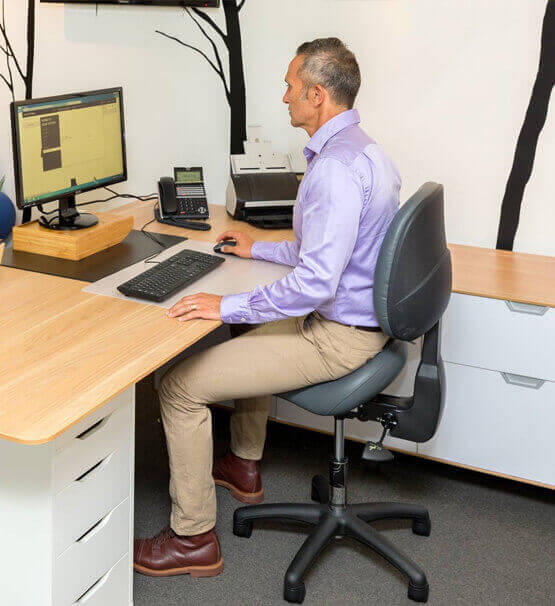
Bambach original saddle chair for corporate


Back Support and the Office Chair

When choosing an office chair, back support is another important consideration. Unlike other ergonomic chairs, the groundbreaking design of the Bambach Saddle Seat supports the lumbar curve of the spine through the straddle posture and open hip angle of the seat. Purpose-designed to position the pelvis in an upright, neutral position and keep it there, back support is provided by the saddle stool and your upright posture on the seat. Therefore for most work which involves sitting or leaning forward, you should not need a backrest. We supply saddle seats both with and without backs to accommodate different requirements. In order to get used to the new seating position, we recommend a period of a few weeks to adjust to using your saddle stool. You can also choose a saddle seat with a backrest, to use as a rest point during the day when thinking or in a meeting.   


Increasing Comfort and Productivity at Work

Improving the ergonomics of your office can have a range of benefits, including increasing your comfort, focus and productivity at work. Bambach Saddle Seats can help improve work performance in three significant ways. Firstly, using a saddle stool helps to reduce fatigue, opening up the chest to improve breathing and circulation. As a result of the muscles and joints being in balance, a saddle seat also helps increase dexterity for those undertaking task work or procedures requiring a high level of precision. Finally, our ergonomic office chairs improve your mobility and reach no matter what your profession is, ensuring free movement around your workspace while maintaining stability.

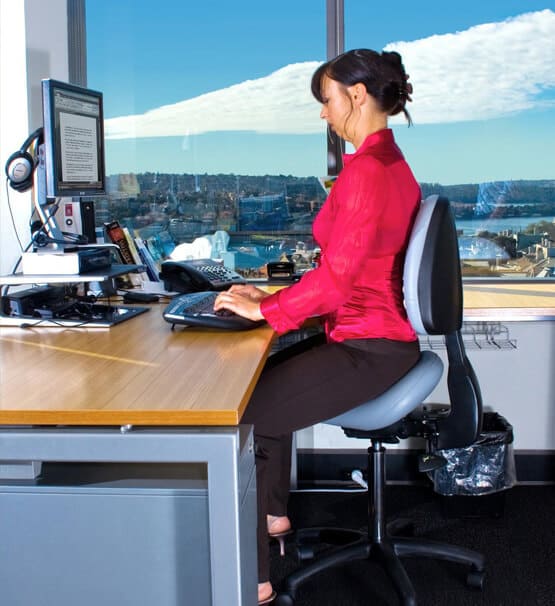
Bambach saddle chair with back support


The Bambach is the original saddle seat, designed and manufactured in Australia by occupational therapist Mary Gale. Our ergonomic office chairs are tested by AFRDI to the highest standards and are recommended by health professionals worldwide. To find the best saddle seat for you, use our online seat calculator to choose a chair model or Contact Us today.


The Bambach Saddle Seat directly counters postural collapse by allowing the knees to drop lower than the hips, establishing a highly stable and balanced pelvic position. This biomechanical shift naturally maintains the spine in its healthy, original "S" shape, keeping all major joints in a neutral, stress-free alignment. It prevents hunching and slouching. Furthermore, long-term use actively strengthens your back and core muscles. 

Discover exactly how this alignment works on our Office Seating Solutions page.

While passive, slumped sitting is detrimental, sitting with correct alignment provides critical ergonomic benefits.

  • It relieves the joints of the lower limbs from continuous, heavy load-bearing.
  • It prevents workers from having to adopt unnatural positions.
  • Sitting reduces overall energy consumption, which lowers the physical demands placed on the respiratory and vascular systems.
  • It provides the worker with far greater core stability and an improved range of movement for desk-based tasks.

Yes, every Bambach ergonomic office chair can be tailored to lead to a more productive and pain-free work environment. The seat is fully customized to suit the individual user by offering four different seat sizes alongside multiple stem heights. Whether you are outfitting a large corporate organisation, a small business, or a home setup, you can personalize the chair with hundreds of colours, varying fabric options, and a huge variety of accessories to suit your needs. 

Use our Choose The Right Model guide to build the exact chair your body and workspace require.

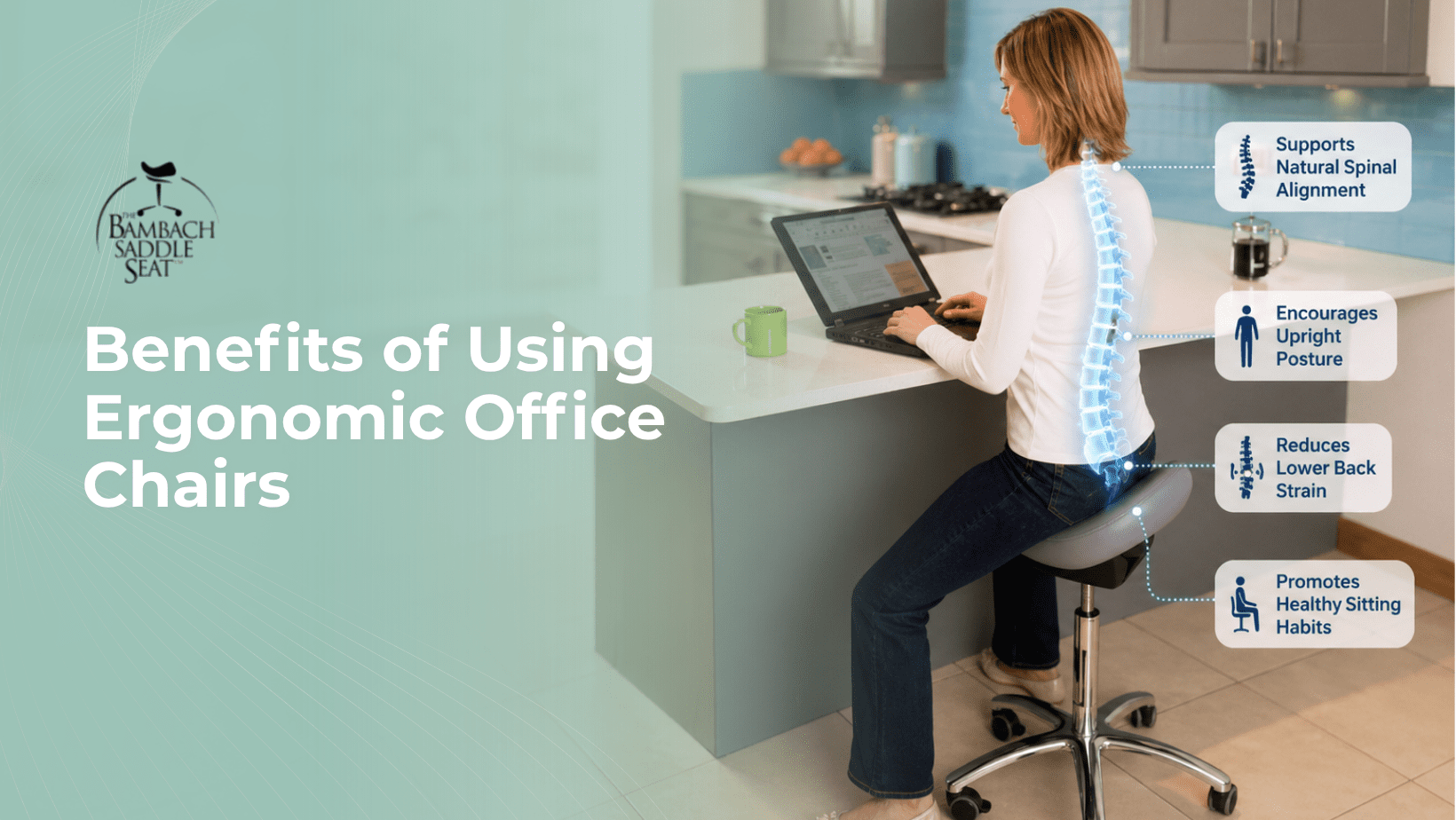
Benefits of Using Ergonomic Office Chairs

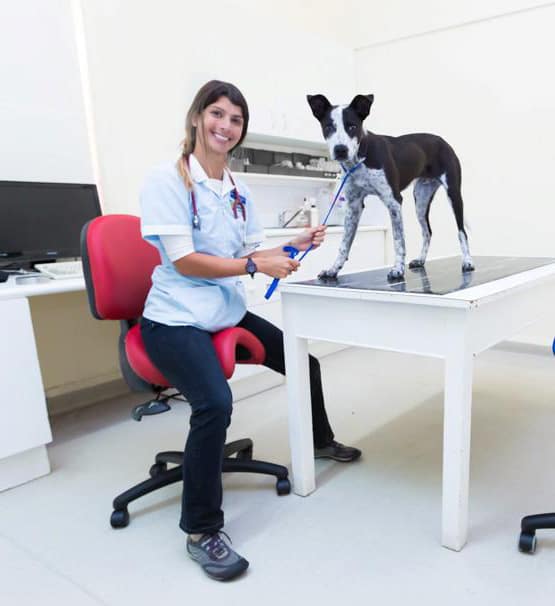
As our work lives become more sedentary, the importance of having a healthy, ergonomic work environment increases. At Bambach Saddle Seat, we strive to give our customers a sound ergonomic seating solution which supports and encourages correct seating posture. Our saddle seats are customised to suit the individual user, taking into account personal attributes such as height, gender, occupation, environment and workstation. Bambach chairs can be used in offices, dental surgeries, hospitals, veterinary clinics and art studios – basically anywhere where people need to sit down!

In our first blog post, we discuss the multiple benefits of using our ergonomic office chairs in the workplace:


Improves Posture

The first benefit of using a Bambach chair is that it helps improve your posture. Unlike traditional ‘ergonomic’ chairs which support the lumbar curve of your spine by pushing into your back, our saddle seats allow you to maintain optimum spinal function. Good task seating should position our centre of gravity over our seat bones, rotating the pelvis upright and allowing the spine to remain in its natural ‘S’ shape, rather than the crunched ‘C’ shape common in conventional seating. The Bambach Saddle Seat allows our joints to be in a neutral, stress-free position, while helping us maintain good posture throughout our work day. Our chairs can even help you build muscle tone, thanks to the active seating position.


Enhances Productivity

Another benefit which comes with using the Bambach Saddle Seat is enhanced productivity. Because the spine is held in a neutral position, breathing and circulation improves, reducing fatigue and allowing you to concentrate on your work. Our chairs also ensure that you can function optimally, with major joints at minimum stress enabling you to easily perform tasks. If your work involves a lot of reaching, varying work heights, long periods of standing, getting up and down from your seat or close work requiring accuracy and excellent hand-eye coordination, then you will especially benefit from our range of ergonomic office chairs.

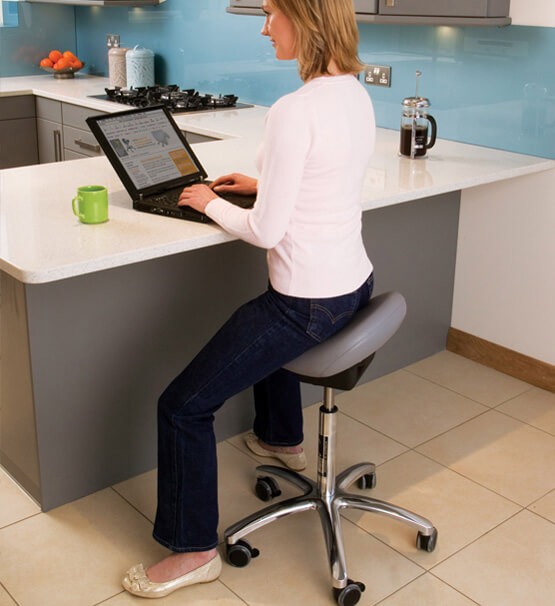
Bambach low saddle seat for SME


Reduces Back Pain

Most of us spend up to 70% of their day at work sitting, which has resulted in a large increase in posture-related injuries and more people requiring an office chair with back support. Our tendency to slouch or hunch over when sitting for long periods can cause damage to the spine over time. This poor posture also contributes to shoulder, neck and back pain, as well as impacting on our productivity, overall health and quality of life. If you are looking for the best office chair for lower back pain, then you could benefit from using the Bambach Saddle Seat. The ergonomic design of our saddle seats allows your body to sit naturally and comfortably, providing a solution to poor posture and back problems.


Increases Dexterity and Mobility

For a range of professionals including dentists, vets, opticians, radiologists, chiropractors, general practitioners, massage therapists and hospital workers, mobility and dexterity are crucial. The Bambach Saddle Seat is the best ergonomic office chair to help increase your dexterity and precision in the workplace, as a result of muscles and joints being in balance. Our chairs support and stabilise your body, freeing your hands and feet for work and movement. The straddle posture improves hand accuracy and power as well as improving sitting balance, making it easy to move about your workspace, reach equipment or operate a foot switch as needed.


Provides Greater Stability

Bambach chairs also provide you with greater stability compared to conventional office chairs. Although standing desks are currently popular, ergonomic experts argue that sitting down to work has a range of benefits including relieving the lower limb joints from load bearing, reducing energy consumption, providing a better range of movement and stability for the worker, and preventing you from working for an extended amount of time in unnatural positions. Unlike alternative ergonomic seating options such as kneeling chairs, which are difficult to use and put pressure on the knees, or bicycle seats which tilt the pelvis back into an unstable position, the Bambach Saddle Seat is an office chair which provides back support while keeping your legs stable, ensuring free movement as well as safe and easy reaching.

Tattooist using Bambach saddle seat


Customisable to Suit Your Workplace

The final benefit of using the Bambach Saddle Seat is its ability to be easily customised to suit your workplace.The contemporary design of our saddle seats can be easily integrated into any office and customised to suit innovative fit-outs. Bambach is the only saddle seat which is custom-made to suit your individual needs and requirements, available in four different sizes, seven different stem heights, and a wide variety of colours, fabrics and accessories. Whether you are looking for the best office chair for lower back pain, an ergonomic office chair which will improve your posture and productivity, or a saddle seat which will give you the dexterity and mobility you need in the workplace, there is a Bambach to suit you.

The Bambach is the original saddle seat, designed and manufactured in Australia by occupational therapist Mary Gale. Bambach chairs are tested by AFRDI to the highest standards and are recommended by health professionals worldwide. To find the best Bambach seating solution for you, use our online seat calculator to choose a chair model or Contact Us today!


  • Yes, enhanced productivity is a major benefit of the Bambach Saddle Seat.
  • By holding your spine in a neutral position, the chair naturally improves both breathing and circulation.
  • This reduces daily fatigue and allows you to concentrate fully on your tasks.
  • It is especially beneficial if your work involves a lot of reaching, varying work heights, or close tasks requiring accuracy and excellent hand-eye coordination.

  • Most office workers spend up to 70% of their day sitting, which often leads to slouching and long-term spinal damage.
  • This poor posture contributes significantly to shoulder, neck, and lower back pain.
  • The ergonomic design of the Bambach provides a direct solution to this by allowing the body to sit naturally and comfortably, making it one of the best choices for lower back pain relief. Discover our complete range of Office Seating Solutions.

  • By keeping your muscles and joints perfectly in balance, the chair supports your body while completely freeing your hands and feet for movement.
  • The unique straddle posture improves your overall sitting balance, as well as hand accuracy and power.
  • This makes it effortless to reach equipment, operate foot switches, and move about your workspace, which is crucial for professionals like dentists, vets, and massage therapists.

  • Absolutely. While standing desks are popular, sitting down to work relieves your lower limb joints from heavy load-bearing and reduces overall energy consumption.
  • Unlike kneeling chairs, which are notoriously difficult to use and put damaging pressure on the knees, the Bambach Saddle Seat provides incredible stability.
  • It also outperforms bicycle-style seats, which tend to tilt the pelvis backward into an unstable position. The Bambach provides full back support while keeping your legs grounded and stable. Use our Choose The Right Model guide to find the perfect fit for your body type.