
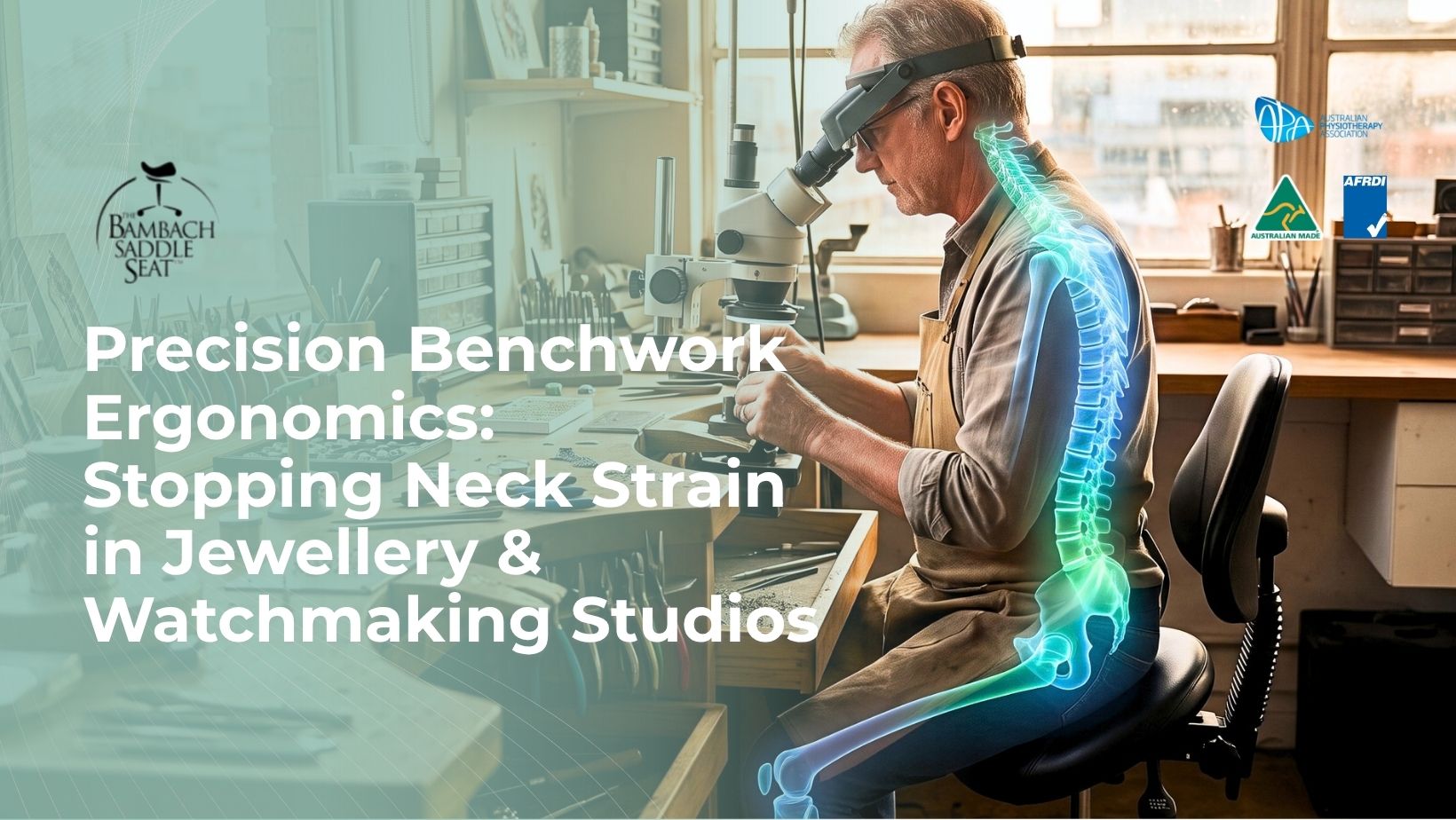
Precision Benchwork Ergonomics: Stopping Neck Strain in Jewellery & Watchmaking Studios
The Physical Demands of Fine Precision Benchwork
Fine jewellers, watchmakers, gem setters, and micro-machinists produce extraordinary artistic works. Creating detailed custom pieces requires intense physical endurance.
During the fourth-quarter retail rush, artisan studios operate at peak production to deliver custom holiday orders. Benchworkers spend 8 to 10 hours daily fixed over 39-inch bench pegs, soldering blocks, and stereo microscopes.
This kind of static strain is a known occupational hazard in the trade. Jewellers who work this way often develop chronic neck or back injuries over time, from the same forward-hunched posture repeated for years. Safe Work Australia classes prolonged static posture as a hazardous manual task for this reason.
Anatomical Causes of “Bench Strain” and “Corkscrew Posture”
Why does precision benchwork cause such physical strain? The answer lies in the visual focus required for microscopic handcraft.
To examine tiny gemstone facets or delicate watch movements, artisans lean forward over their bench pins. Sitting on conventional flat chairs forces artisans to twist and hunch their torso to maintain focal alignment. Ergonomists classify this posture as “corkscrew strain.”
Holding this static posture for hours creates several physical hazards:
- Extreme cervical flexion: leaning forward multiplies the structural weight of the head on the neck, causing muscle spasms.
- Shoulder girdle tension: slumping collapses the core, forcing shoulder and upper back muscles to contract continuously to stabilise the arms.
- Restricted blood circulation: static tension restricts oxygen delivery to muscle tissue, triggering fatigue and hand tremors.
For official Australian workplace guidelines on static posture and hazardous manual tasks, see Safe Work Australia.
Why Standard Studio Stools Work Against Artisan Posture
Most creative studios equip their workshops with standard flat stools or domestic office chairs. These chairs work against the spine rather than for it.
A flat seat pan forces the hips into a closed 90-degree angle. In this position, the thigh bones pull the pelvis backward into a posterior pelvic tilt.
That posterior tilt flattens the spine’s natural “S” curve into a slumped “C” shape. The lower back loses its natural support, placing load on the L4/L5 lumbar discs — the mechanism covered in more detail below.
Flat stools also keep jewellers further from the bench. Knees clash with the underside of the workbench, so artisans reach further forward, adding to spinal torque.
Industry members can explore trade ethics and studio safety resources via the Jewellers Association of Australia (JAA).
Biomechanical Comparison: Standard Stool vs. Bambach Saddle Chair
| Postural & Biomechanical Factor | Standard Flat Studio Stool | Bambach Continuous-Contour Saddle Chair |
| Hip stance & angle | Closed 90-degree angle. Forces thighs horizontal, pulling the pelvis backward into a slump. | Open 135-degree angle. Lowers thighs to rotate the pelvis forward into neutral balance. |
| Spinal alignment | Flattened “C” curve. Forward-leaning posture on a flat seat has been shown to increase lumbar disc pressure by over 100% compared to standing (Nachemson’s intradiscal pressure research). | Natural “S” curve. Restores natural lumbar lordosis without requiring conscious effort. |
| Microscope proximity | Restricted access. Knees collide with the bench, forcing forward head tilt and slouching. | Unrestricted access. Straddled legs point downward, sliding close under the bench peg. |
| Fine-motor stability | Unstable core foundation. Sit bones slide, forcing shoulders to tense to keep hands steady. | Solid pelvic anchor. Continuous-contour seat locks sit bones, freeing arms for delicate work. |
| Studio durability | Domestic-grade vinyl. Degrades rapidly when exposed to polishing compounds and solvents. | Medical-grade seamless vinyl. Resists chemicals, soldering fluxes, and harsh studio cleaning agents. |
Disc-pressure figure: A. Nachemson’s classic intradiscal pressure studies, widely cited in spinal biomechanics — measuring mechanical load, not pain directly.
The Science of Saddle Seating for Precision Benchwork
Australian occupational therapist Mary Gale developed the original Bambach Saddle Seat in 1988, after running a therapeutic horse-riding program and noticing that severely disabled riders could sit upright unaided on a saddle but not on an ordinary chair. Inspired by that equestrian posture, her design changes the mechanics of sitting.
An OT-designed saddle chair supports precision artisans through four mechanisms:
1. The 135-degree open hip stance. Dropping the knees below the hips creates an open 135-degree hip angle, rotating the pelvis forward into neutral anatomical balance.
2. Continuous-contour pelvic stability. Precision gem setting and watchmaking demand physical stability. Unlike split-seat stools that shift under body weight, Bambach’s continuous seat pan locks the sit bones in place, reducing lateral wobble during microscopic handwork.
3. Freedom for the shoulder girdle. By anchoring the pelvis, the chair takes load off the lower back, letting the shoulder girdle relax and freeing the arms and wrists for steady, precise strokes.
4. Close bench proximity. Because the legs straddle downward, the knees slide under high jeweller workbenches, keeping artisans close to stereo microscopes without curving the neck.
Buyer’s Checklist for Jewellery & Watchmaking Studio Seating
| Feature Category | What to Check | Direct Studio Benefit |
| Gas stem options | Standard, Medium, Low, or Drafting stem heights | Matches chair height to high jeweller workbenches |
| Anatomical seat sizing | Narrow, Small, Medium, or Executive seat sizes | Fits individual pelvic width without inner-thigh pressure |
| Chemical-resistant vinyl | Medical-grade, fluid-resistant upholstery | Withstands polishing compounds, fluxes, and solvents |
| Compact star base | Narrow footprint with smooth, friction-free castors | Glides between soldering stations, rolling mills, and bench pegs |
| Commercial certification | AFRDI Level 6 Blue Tick rating with 5-year warranty | Confirms strength for demanding commercial workshops |
Protect Your Body and Extend Your Artisan Career
Your hands and vision are your most valuable creative tools. Persistent neck strain and lower back pain can compromise precision and shorten a career.
An authentic, OT-designed Bambach Saddle Seat removes the slouching that standard stools cause and supports the spine instead.
Explore the full range of Ergonomic Studio Chairs or read the Australian Case Studies to see how pelvic support preserves artistic craftsmanship.
Ready to craft pain-free? Contact our Ergonomic Specialists today.
Precision artisans work fixed over high bench pegs and stereo microscopes for hours. Sitting on flat chairs flattens the lower back, forcing the neck into extreme forward flexion to maintain focal alignment.
The saddle design opens your hip angle to 135 degrees and tilts your pelvis forward. This maintains your spine’s natural upright “S” curve, keeping your head and torso balanced over your hips without twisting.
Yes. Bambach offers custom high-reach gas stems engineered specifically for elevated workbenches, allowing you to work at bench-peg level while keeping your feet planted stably.
Split-seat chairs feature separate moving pads that shift under body weight. Bambach’s continuous, unbroken seat pan locks your sit bones in symmetry, eliminating lateral movement during delicate microscopic work.
Yes. Bambach chairs are hand-upholstered in seamless, medical-grade vinyl designed to resist exposure to studio chemicals, fluxes, metal dust, and heavy cleaning products.