
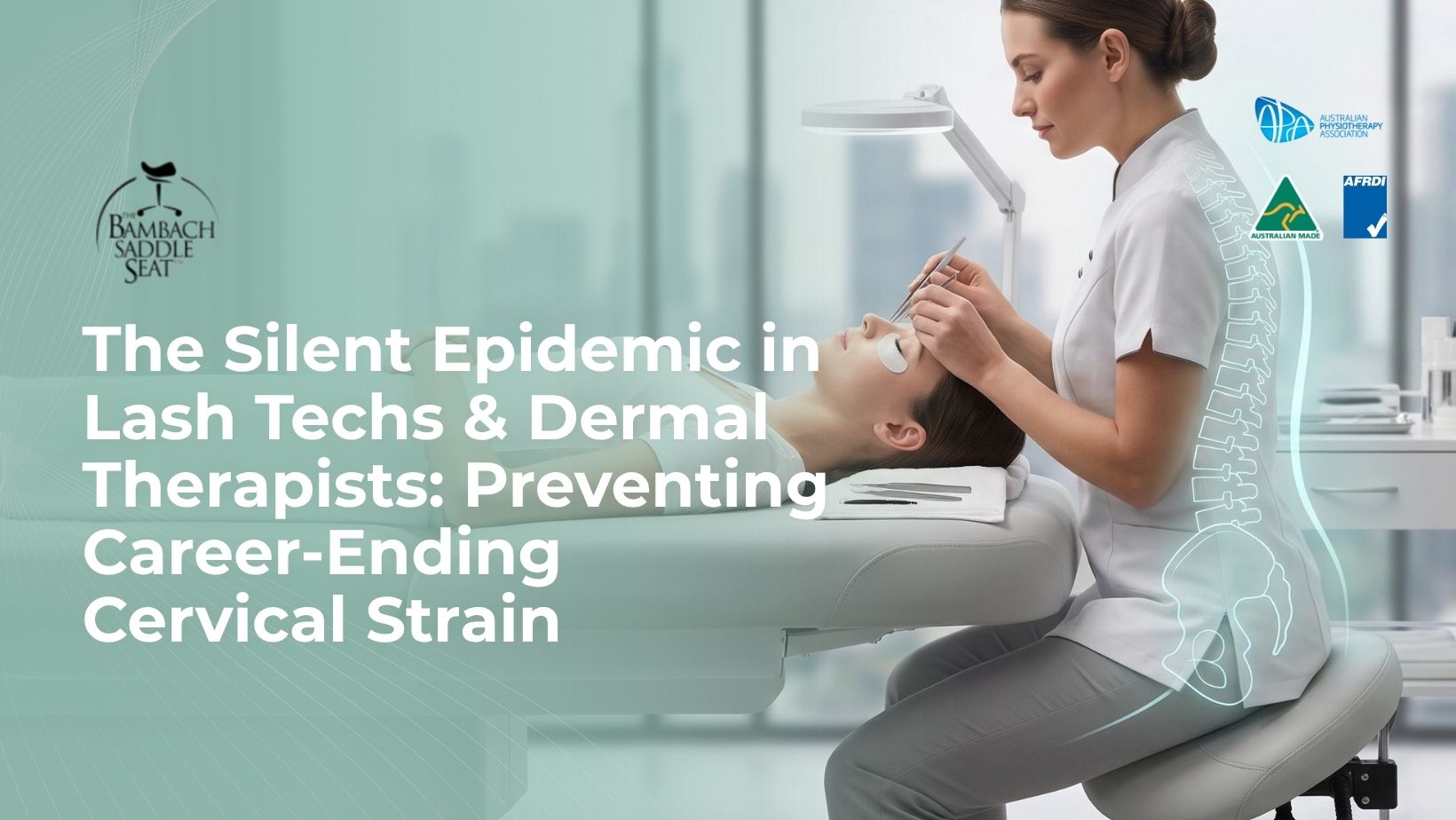
The Silent Epidemic in Lash Techs & Dermal Therapists: Preventing Career-Ending Cervical Strain
The Hidden Cost of Precision in Aesthetic Practice
Australia’s cosmetic and beauty therapy industry is experiencing unprecedented growth. Every day, lash technicians, dermal clinicians, estheticians, and cosmetic injectors perform intricate procedures requiring extreme physical precision.
However, this precision comes at a severe personal cost. Occupational health studies reveal that 100% of surveyed beauty service workers suffer from lower back pain. Furthermore, over 70% experience severe chronic neck pain.
Practitioners frequently ignore early warning signs like shoulder stiffness and lower back soreness. Consequently, uncorrected postural stress often leads to chronic spinal degeneration. Ultimately, these physical demands force talented aesthetic professionals into early career retirement.
Anatomical Causes of Pain: The “Lash Hunch” and “Dermal Slump”
Why is aesthetic therapy so physically demanding? The answer lies in the intense visual demands of the work.
Lash technicians sit bent over client faces for three to six hours daily. Similarly, dermal therapists maintain static positions while operating laser equipment or executing skin treatments.
To achieve a clear view, practitioners repeatedly tilt their head forward and slump their shoulders. Biomechanically, every centimetre of forward head posture dramatically increases the effective weight of the head on the cervical spine.
As a result, this static forward strain creates severe anatomical stress:
- Cervical Disc Compression: Forward tilting compresses the cervical vertebrae, triggering chronic neck spasms and tension headaches.
- Thoracic Muscle Fatigue: Continuous leaning stretches upper back muscles beyond their natural threshold, causing micro-trauma.
- Restricted Blood Flow: Holding static muscle tension restricts oxygen delivery, resulting in rapid physical fatigue.
Why Standard Beauty Stools Cause Chronic Spinal Harm
Most beauty salons and cosmetic clinics rely on basic, flat-surfaced task stools. Unfortunately, these standard stools actively accelerate spinal damage.
A flat seat pan forces a 90-degree angle between the torso and thighs. In this position, the thigh bones act as levers that pull the pelvis backward. Ergonomists classify this movement as a posterior pelvic tilt.
Consequently, posterior tilting flattens the natural curve of the lower back. The entire spine collapses into an unhealthy “C” shape.
Furthermore, flat stools prevent clinicians from getting close to the treatment couch. Because your knees hit the side of the bed, you must lean even further forward. Thus, cheap import stools actively drive occupational injury.
To review official workplace safety guidelines regarding manual handling and static posture risks, visit Safe Work Australia.
The Science of Saddle Seating: Protecting Aesthetic Practitioners
Fortunately, Australian Occupational Therapist Mary Gale developed a proven solution: the original Bambach Saddle Seat. Inspired by equestrian biomechanics, her design completely transforms sitting posture.
Specifically, a medical-grade saddle chair protects your body through five key physical mechanisms:
- The 135-Degree Open Hip Stance: The saddle design lowers your thighs to create an open 135-degree hip angle. This stance aligns with the body’s natural resting position.
- Restoration of the “S” Curve: Lowering the knees below the hips rotates the pelvis forward. Consequently, this tilt automatically stacks your vertebrae into their natural, upright “S” curve.
- Unloaded Lumbar Discs: The “S” curve distributes upper body weight evenly across the sit bones. As a result, this alignment eliminates peak compression on lower back discs.
- Close Treatment Access: Because your legs straddle downward, your knees slide effortlessly under the treatment couch. Therefore, you work close to the client without hunching your shoulders.
- Active Core Engagement: Saddle seating naturally engages deep abdominal stabilizing muscles. In addition, this posture opens the chest, improving breathing and daily energy levels.
For detailed clinical research on postural health, consult the Australian Physiotherapy Association and international studies indexed in the Journal of Physical Therapy Science.
Biomechanical Comparison: Standard Beauty Stool vs. Bambach Saddle Seat
| Postural & Biomechanical Factor | Standard Flat Beauty Stool | Bambach Continuous-Contour Saddle Seat |
| Hip Angle & Stance | Closed 90-Degree Angle Forces thighs parallel to the floor, pulling the pelvis backward. | Open 135-Degree Angle Lowers knees below hips into a natural zero-gravity position. |
| Pelvic & Spinal Shape | Posterior Pelvic Tilt (“C” Curve) Flattens lumbar lordosis and compresses L4/L5 spinal discs. | Anterior Pelvic Tilt (“S” Curve) Rotates pelvis forward, preserving natural upright spine alignment. |
| Cervical & Neck Load | Severe Forward Head Strain Multiplies structural weight on cervical vertebrae during lash application. | Neutral Head Alignment Positions neck and shoulders in neutral balance over the torso. |
| Proximity to Client Bed | Restricted by Knee Clashing Knees collide with the treatment couch, forcing forward hunching. | Unrestricted Close Access Straddled legs point downward, allowing effortless close access. |
| Clinical Durability | Uncertified Cheap Materials Prone to rapid foam collapse and surface degradation from disinfectants. | AFRDI Level 6 Certified Built for severe commercial use with seamless medical-grade vinyl. |
Essential Features for Clinical Beauty Seating
When selecting an ergonomic stool for your lash studio or dermal clinic, avoid generic cheap imitations. Instead, look for these critical clinical standards:
- Anatomical Seat Sizing: Pelvic structures vary significantly. Bambach offers specialized sizes, including the Cutaway model designed specifically for slender practitioners or those wearing skirts.
- Medical-Grade Seamless Vinyl: Clinical hygiene is vital. Choose fluid-resistant upholstery that withstands daily wiping with hospital-grade disinfectants without cracking.
- Custom Height & Tilt Mechanics: Ensure the seat features adjustable gas stems and seat tilt controls to fine-tune your pelvic angle.
- AFRDI Level 6 Certification: Demanding clinical environments require proven durability. Verify official certification from AFRDI (Furntech).
Buyer’s Checklist for Beauty & Aesthetic Stools
| Feature Category | Critical Evaluation Standard | Practical Studio Benefit |
| Anatomical Sizing | Cutaway or Small continuous contour options | Prevents inner thigh pressure while allowing close leg positioning. |
| Infection Control | Medical-grade, fluid-resistant Naugahyde or vinyl | Resists clinical disinfectants and maintains strict hygiene standards. |
| Custom Adjustability | Independent seat height and forward tilt controls | Allows practitioners of any height to achieve the 135° open hip angle. |
| Manoeuvrability | Compact star base with smooth, friction-free castors | Allows effortless gliding around client treatment beds without twisting. |
| Quality Guarantee | AFRDI Level 6 Blue Tick certification with 5-year warranty | Protects your business investment with commercial-grade strength. |
Safeguard Your Health and Extend Your Studio Career
Your body is your most valuable business asset. Ignoring persistent neck and back pain can compromise both your treatment precision and your long-term career.
By upgrading to an authentic, OT-designed Bambach Saddle Seat, you eliminate destructive pelvic slumping and protect your spine.
Explore our complete range of Beauty & Dermal Ergonomic Chairs or read our Australian Clinical Case Studies to see how custom pelvic support extends career longevity.
Ready to work pain-free? Contact our Ergonomic Specialists today!
Lash technicians hold static, forward-leaning postures over client faces for hours. This position multiplies structural weight on cervical vertebrae, causing extreme neck, shoulder, and lower back strain.
The saddle design lowers your knees below your hips, opening your hip angle to 135 degrees. This stance tilts your pelvis forward, automatically restoring your spine’s natural upright “S” curve without conscious slumping.
Yes. Because your legs straddle downward on a saddle seat, your knees slide effortlessly under the treatment couch. This allows you to sit close to the client without leaning forward.
The Bambach Cutaway model features a narrower front curvature designed specifically for slender practitioners or those wearing skirts. It provides full sit-bone support without causing inner thigh pressure.
Yes. Bambach chairs are upholstered in medical-grade, fluid-resistant vinyl engineered to withstand frequent wiping with hospital-grade disinfectants without degrading.
Yes. Bambach saddle chairs hold official AFRDI Level 6 Blue Tick certification, guaranteeing severe commercial strength and long-term durability in professional studio environments.