NDIS Funding for Postural Seating: What the 2026 Changes Mean
Current as at 31 August 2026. NDIS reform is being rolled out in stages between 2026 and 2030, and further rules are still being developed. Check the NDIA website for the latest position before making funding decisions.
If you prescribe postural seating as an occupational therapist, physiotherapist, support coordinator, or family member, the NDIS landscape is evolving. Specifically, new NDIS legislation received Royal Assent on 20 August 2026. Consequently, the first regulatory updates took effect on 27 August 2026, while remaining amendments will roll out progressively through 2030.
Quick Executive Summary
Crucially, the NDIS continues to fund postural seating as Assistive Technology under the Capital Supports budget. Furthermore, the two budget reductions announced for October 2026 target social participation and capacity-building categories, actively excluding assistive technology. However, three key policy changes will directly impact seating prescriptions:
The 90-Day Claim Deadline: Effective 1 December 2026, providers must submit claims within 90 days of delivery.
End of Rollover Funding: Beginning 1 February 2027, leftover plan funds will no longer carry forward into renewed plans.
New Framework Planning: Starting 1 April 2027, the NDIA will implement support needs assessments to establish participant budgets.
What Has Not Changed for Assistive Technology
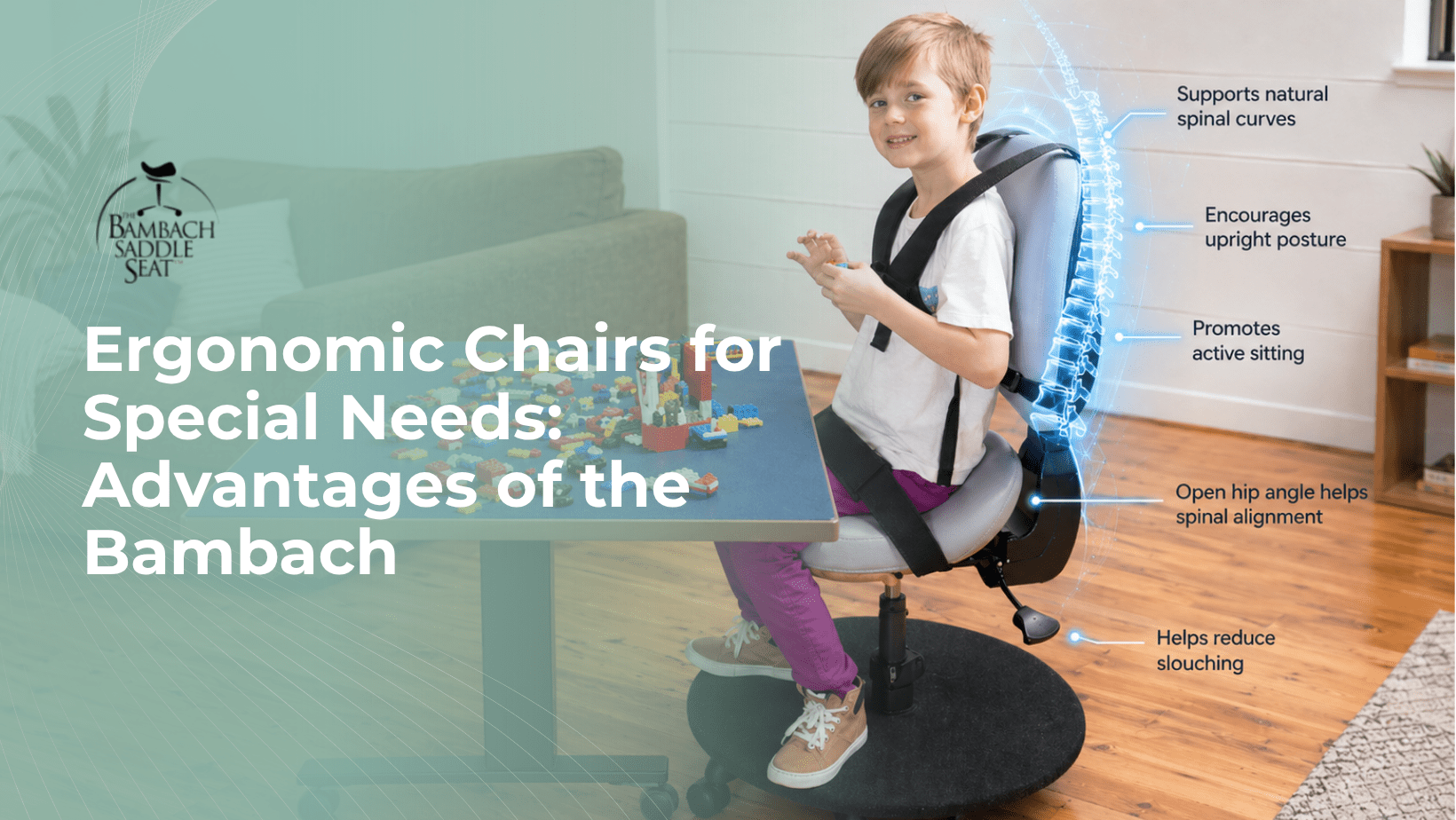
First and foremost, the NDIS continues to fund postural seating without interruption. When an Allied Health practitioner prescribes a saddle seat to stabilise the pelvis, open the hip angle, and unlock functional goals, the NDIA classifies the equipment as Assistive Technology. Because Assistive Technology remains a core funded category, participants can access crucial postural supports.
In addition, the Australian Government confirmed that the October 2026 budget reductions will not touch critical support categories. Specifically, these protected categories include:
Home and vehicle modifications
Personal mobility equipment and transport
Daily consumable products
Specialist Disability Accommodation (SDA)
In-home care supports
Furthermore, recent legislative amendments explicitly protect employment supports, disability-related health care, high-intensity care, complex behavior supports, and customized wearable technology.
Therefore, People with Disability Australia (PWDA) advises that participants do not need to alter their current routines. Existing plans continue as normal, and the NDIA will notify participants well before introducing any changes that affect their specific budgets.
Legislative Timeline & Operational Impact
The following structured breakdown outlines key legislative milestones and their direct operational impact on prescribing seating equipment:
| Effective Date | Legislative Change | Impact on Postural Seating Prescriptions |
| 27 Aug 2026 | Only participants, plan nominees, or child representatives can request unscheduled plan reassessments. | External therapists and equipment suppliers can no longer lodge reassessment requests on behalf of a participant. |
| 27 Aug 2026 | Strict record-keeping requirements take effect: 3 years for participants/managers, 5 years for nominees, and 7 years for registered providers. | Therapists and suppliers must archive equipment quotes, clinical assessment reports, and delivery invoices for the full statutory period. |
| 1 Oct 2026 | Budget reductions begin across two support categories as the NDIA reassesses or renews individual plans. | Assistive Technology remains fully protected, so postural seating budgets face no category-wide reductions. |
| 1 Dec 2026 | Participants and providers must submit funding claims within 90 days of equipment delivery. | Late invoicing for delivered chairs risks claim rejection, making prompt submission essential. |
| 1 Feb 2027 | Plan renewals begin, and leftover funds no longer carry over into renewed participant plans. | Unspent Assistive Technology funding will expire at plan end rather than rolling over into the new cycle. |
| 1 Feb 2027 | Decision-makers must evaluate reasonable and necessary criteria alongside Scheme equity and sustainability. | Clinical reports must provide robust, objective evidence linking postural seating directly to functional independence. |
| 1 Apr 2027 | New framework planning begins, utilizing standardized support needs assessments to set participant budgets through 2030. | Participants will receive detailed evaluation reports explaining exactly how the NDIA calculated their funding allocations. |
Three Critical NDIS Policy Changes Requiring Immediate Action
Although many legislative updates remain in development, three upcoming operational shifts require immediate procedural adjustments from prescribers and providers.
1. The Strict 90-Day Claim Window
Starting 1 December 2026, participants and plan managers must submit all funding claims within 90 days of support delivery. Custom postural seating naturally involves extended manufacturing lead times. Consequently, a chair ordered in one quarter and delivered in the next can easily exceed the 90-day window if paperwork stalls.
To avoid unpaid invoices, clinical teams should establish clear administrative protocols at the point of order. Specifically, identify who will submit the claim and schedule reminders based on the expected delivery date rather than the initial order date.
2. The Elimination of Rollover Funding
Beginning 1 February 2027, the NDIA will issue renewed plans upon reassessment dates rather than building entirely new funding packages. While a renewed plan maintains previous support levels adjusted for inflation, leftover money from the preceding plan will automatically expire.
Therefore, unused funding will no longer roll forward into subsequent plan cycles. If a participant has approved Assistive Technology funding for a completed seating assessment, teams must utilize those funds before the plan cycle ends.
3. Heightened Evidence Standards for Reasonable & Necessary Approval
From February 2027, the NDIA must evaluate all reasonable and necessary funding requests against Scheme sustainability, participant equity, and cohort benchmarks.
Consequently, decision-makers will scrutinize clinical justification reports far more rigorously. While the NDIA will not automatically reject postural seating, reports framing equipment as a “comfort upgrade” will fail. Instead, therapists must articulate three core elements:
What specific functional tasks the participant cannot currently perform.
How the seating geometry mechanically corrects the postural deficit.
What measurable functional goals the equipment unlocks for the participant.
Case Studies: Translating Clinical Mechanics into Fundable Outcomes
To illustrate successful evidence framing, consider two clinical case studies from our Australian special needs practice.
Case Study 1: Ruby (Pediatric Classroom Engagement)
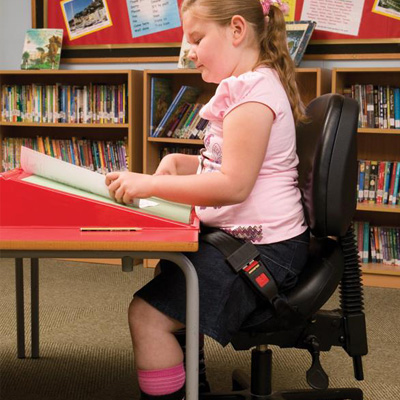
Ruby, a student living with muscular atrophy, previously collapsed into severe posterior pelvic tilt while sitting in standard classroom chairs. Consequently, her spine rounded and her neck extended awkwardly to view her desk, causing rapid physical exhaustion.
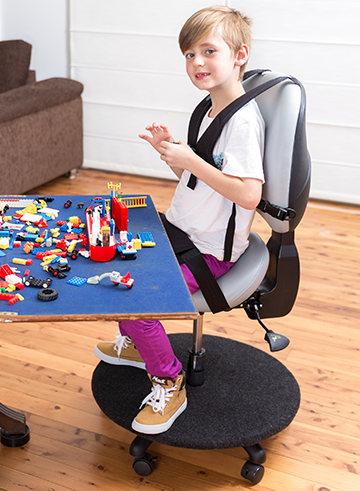
To address these structural issues, her occupational therapist trialled a Small Adaptive Saddle Chair equipped with a reduced abduction seat, standard backrest, 80 mm drop-through gas lift, and locking castors.
Mechanical Correction: The saddle seat rotated her pelvis forward and supported her lumbar spine.
Functional Outcome: By stabilizing her core, the seating freed her arms from constantly bracing her torso. As a result, Ruby engaged in classroom activities for extended periods without fatigue.
Crucially, the report succeeded because it detailed a specific biomechanical deficit, justified every chair accessory, and demonstrated a measurable educational gain rather than subjective comfort.
Case Study 2: David (Adult Mobility & Independence)
David, an adult participant with cerebral palsy and high adductor muscle tone, relied almost entirely on a manual wheelchair for daily mobility.
During trial testing, an adaptive saddle chair held his hips in controlled abduction and extension while establishing full foot-to-floor contact.
Mechanical Correction: The open hip angle stabilized his pelvis and lowered lower-limb spasticity.
Functional Outcome: David began actively propelling the saddle chair using his feet. Ultimately, he expanded his independent mobility and reduced his daily reliance on his primary wheelchair.
Again, the clinical report secured approval because it proved increased physical independence and reduced equipment reliance rather than mere seating comfort. Although therapists documented both cases prior to the 2026 legislative updates, these examples provide an ideal framework for contemporary NDIS submissions.
Essential Components of a Robust Clinical Seating Prescription
To maximize funding approval under revised NDIS guidelines, prescribers must include comprehensive clinical detail. Specifically, high-quality assessment reports should incorporate the following seven structural elements:
Participant-Centered Functional Goals: Document the participant’s specific aspirations using their own words whenever possible.
Objective Trial Records: Detail the exact equipment trialled, comparing baseline postural breakdown against post-intervention functional improvements.
Itemized Equipment Configurations: Specify seat pan size, gas stem height, base width, and accessories, providing explicit clinical justification for each component.
Biomechanical Reasoning: Connect the mechanical intervention (such as pelvic stabilization or open hip angles) directly to functional goal achievement.
Individualized Sizing Justification: Explain why the trialled seat width matches the participant’s unique pelvic dimensions, as generic product requests carry little weight.
Independent Quality Certifications: Highlight recognized commercial testing standards, such as AFRDI Level 6 certification for severe commercial durability.
Extended Supplier Quotes: Ensure equipment quotes remain valid for an extended timeframe to survive NDIA administrative review cycles.
Ongoing Legislative Implementation & Next Steps
Currently, the Australian Government continues to refine operational rules, administrative policies, and assessment frameworks under the new legislation. Specifically, key policy areas under active development include:
The formal design of new participant access assessments.
Operational protocols for support needs evaluations and budget determinations.
Standardized provider registration frameworks and record-keeping rules.
Therefore, while the funding pathway for Assistive Technology remains fully intact, timing constraints have tightened and evidence standards have risen.
Navigating Decision Reviews & Advocacy Support
If the NDIA issues an unfavorable funding decision regarding a postural seating prescription, participants can request a formal internal review. However, applicants must lodge review requests within three months of receiving written notification.
The Department of Health, Disability and Ageing maintains a page on the NDIS legislation changes, and PWDA is collecting participant experiences as the changes roll out.
When do the NDIS changes actually start?
The laws received Royal Assent on 20 August 2026 and the first changes started 27 August 2026. Further changes begin on 1 October 2026, 1 December 2026, 1 February 2027, 1 April 2027, 1 July 2027, 1 October 2027, 1 January 2028 and 1 July 2028, with some transition arrangements continuing to the end of 2030.
What is the 90-day claim rule?
From 1 December 2026, participants and plan managers must make claims within 90 days of the support being delivered. For custom-made equipment with a manufacturing lead time, the claim window runs from delivery, so it is worth agreeing who lodges the claim before the order is placed.
Will leftover assistive technology funding roll over into my next plan?
Not under a plan renewal. From 1 February 2027, when a plan is renewed rather than reassessed, money left over in the previous plan does not carry into the renewed plan.
Who can request a plan reassessment now?
From 27 August 2026, only the participant, their plan nominee or a child representative can ask the NDIA for an unscheduled plan reassessment. A request can still be made where there has been a significant and ongoing change to functional capacity and support needs, living arrangements, education, work, or informal supports. If the NDIA does not decide within 90 days, the request is treated as refused, which opens up review rights.
What is new framework planning and when does it affect me?
New framework planning uses a support needs assessment, conducted through a semi-structured interview with a trained NDIS assessor, to help determine a participant's budget. Participants receive a report explaining how their budget was decided. The rollout begins 1 April 2027 and runs progressively to 31 December 2030, so it will not affect everyone at once.
How long do I need to keep records of an assistive technology purchase?
Participants and plan managers need to keep records about NDIS support payments for three years. Nominees keep them for five years, and providers for seven years. Detailed rules about exactly which records are required are still being finalised.
Does a Bambach Saddle Seat need to be certified to be funded?
Certification is not a funding requirement in itself, but independent structural certification such as AFRDI Level 6 supports the case that the equipment is fit for sustained daily use. For a participant who will use the chair every day for years, durability evidence strengthens a reasonable and necessary argument.
What does a funded seating outcome look like in practice?
In Bambach's documented Australian case studies, the outcomes were functional rather than comfort-based. For a school student with muscular atrophy, stabilising the pelvis freed her arms from bracing her torso so she could work longer without fatigue. For an adult with cerebral palsy, the open hip position restored full foot contact with the floor, allowing him to propel his own chair and walk further independently. Individual results vary, and neither case guarantees a funding outcome for another participant.
Bambach has designed saddle seats in Australia since 1989, and they are prescribed by occupational therapists and physiotherapists for participants who need pelvic stability and an open hip angle. See the special needs and adaptive seating range, read the full Australian case studies, or browse the complete range. To discuss a configuration for a specific participant, call +61 2 8966 4800.
This article is general information about NDIS funding processes. It is not financial, legal or clinical advice, and it is not affiliated with or endorsed by the NDIA. Funding decisions depend on individual circumstances.