
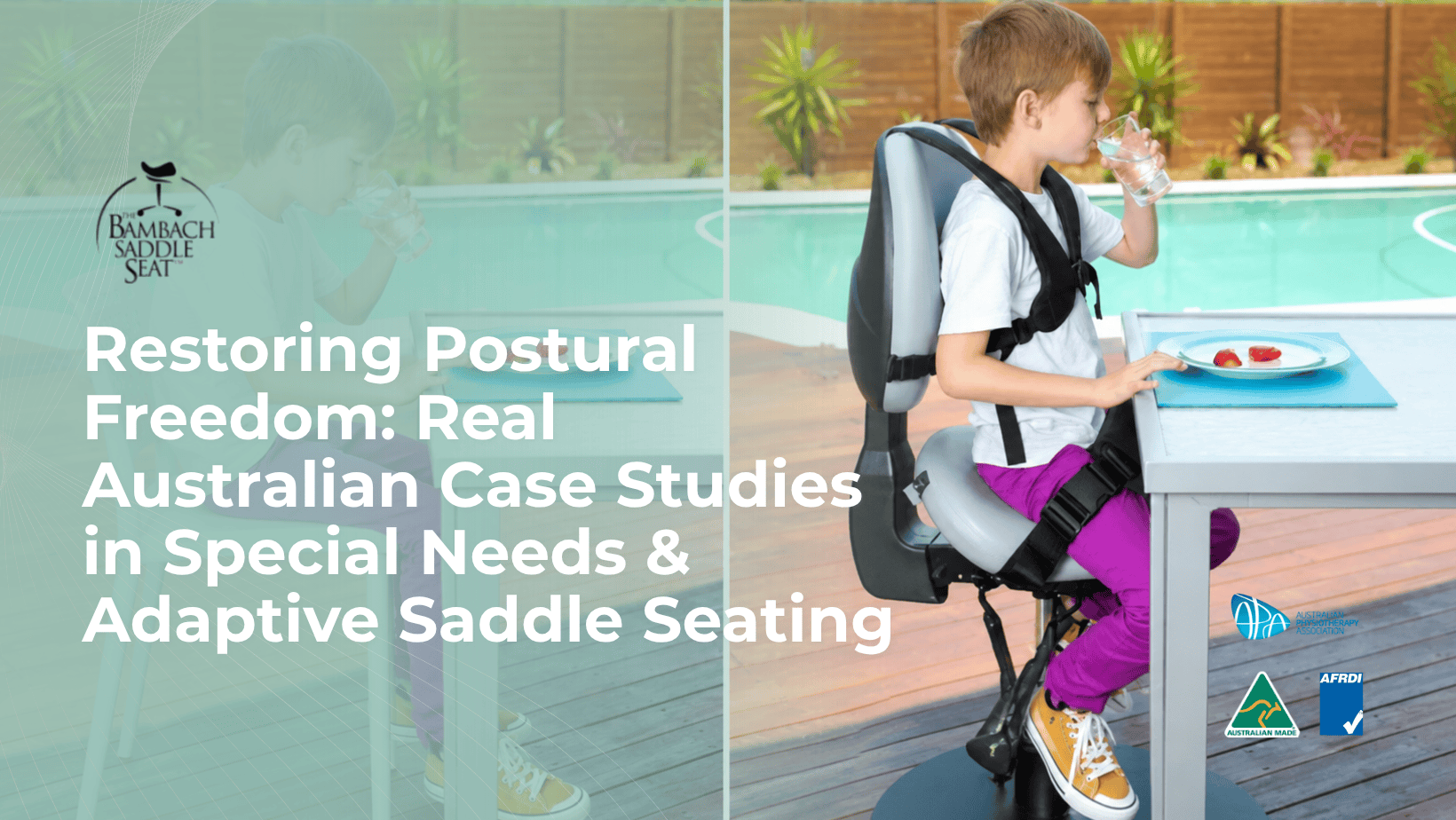
When sitting on a conventional flat chair or static wheelchair, individuals with physical disabilities and neurological conditions often face severe biomechanical challenges. Without stable pelvic support, the torso collapses, the spine curves into a slumped “C” shape, and upper-limb movement becomes heavily compromised.
The concept of adaptive saddle seating originated in Australia in 1988. Mary Gale, a qualified Australian Occupational Therapist at Hornsby Hospital in Sydney, noticed a remarkable physiological phenomenon: patients with severe physical trauma and neurological impairments who could not sit unsupported on a standard seat could sit upright, with balance and symmetry, when mounted on horseback.
By replicating the natural rider’s saddle position, the Bambach Saddle Seat was engineered to stabilize the pelvis in a neutral position, open the hip angle to 135°, and restore the natural “S” curve of the spine. Today, Bambach posture chairs are prescribed across Australia by Occupational Therapists (OTs) and Physiotherapists as clinically validated assistive technology.
Real Australian Case Studies: Transforming Special Needs Posture
Case Study 1: Ruby – Managing Muscular Atrophy & Classroom Fatigue
- Clinical Background: Ruby was diagnosed with muscular atrophy, a condition causing progressive muscle weakness and difficulty maintaining upright posture over extended periods.
- The Postural Problem: In a standard classroom chair, Ruby suffered severe postural collapse. Her pelvis tilted backward (posterior pelvic tilt), collapsing her spine into a flattened lumbar “C” curve with hunched shoulders and forward head projection. To view her work, she hyperextended her cervical spine and protruded her chin, leading to rapid physical exhaustion, thoracic compression, and an elevated risk of progressive spinal deformities.
- The Bambach Intervention: Ruby’s Occupational Therapist recommended trialling a Bambach Small Adaptive Saddle Chair fitted with a reduced abduction seat, standard backrest, an 80 mm drop-through gas lift, and locking castors.
- Clinical Outcome:
- Neutral Pelvic Alignment: Opening Ruby’s hip angle naturally rotated her pelvis into a neutral upright position, eliminating the slumped “C” curve.
- Upper Limb Independence: With her core and lower body stabilized, her head and shoulders returned to a comfortable, neutral position. This freed her arms from bracing, allowing her to focus on fine motor tasks and schoolwork without premature fatigue.
- Optimized Respiration: Restoring natural lumbar lordosis expanded her thoracic cavity, reducing abdominal compression and supporting overall respiratory function.
“With her pelvis now in its neutral position, Ruby can assume and maintain a correct posture, which greatly improves her ability to perform functional tasks as well as working longer without fatigue.” — Bambach Clinical Case Report
Case Study 2: David – Adult Cerebral Palsy & Functional Mobility
- Clinical Background: David lives with Cerebral Palsy characterized by increased adductor muscle tone, predominantly on his right side.
- The Postural Problem: David’s tight hip adductors made walking difficult, confining him largely to a wheelchair. When seated sacrally in his wheelchair or on flat chairs, his shoulders hunched, his shoulder blades winged, his chin protruded, and his pelvis pulled obliquely to the right.
- The Bambach Intervention: David trialled a Bambach Saddle Seat adjusted to accommodate his frame and computer workstation.
- Clinical Outcome:
- Inhibition of Abnormal Tone: The saddle seat’s contoured design held David’s hips abducted and extended at a 45° angle, inhibiting abnormal muscle tone and restoring symmetrical alignment.
- Active Weight Bearing & Mobility: Rather than remaining passive, David’s legs and feet achieved full plantar contact with the floor. He began actively using his legs to push, pull, and propel his chair around the room.
- Gait and Functional Gains: Activating his postural core and back muscles significantly improved his spinal strength. David reported walking greater distances independently, reducing his reliance on his wheelchair during daily outings.
“My back is a lot straighter and it has helped my walking, as I can now walk straighter and have more strength in my back.” — David, Bambach User
Biomechanical Comparison: Conventional Seating vs. Bambach Adaptive Saddle Seating
| Biomechanical Metric | Standard Wheelchair / Flat Chair | Bambach Adaptive Saddle Chair |
| Pelvic Orientation | Posterior tilt (sacral sitting) | Neutral forward tilt (upright ischial tuberosity support) |
| Spinal Profile | Flattened “C” curve (slumped kyphosis) | Natural “S” curve (preserved lumbar lordosis) |
| Hip Angle | Restricted 90° angle | Open 135° open hip angle |
| Upper Limb Mobility | Arms forced to brace torso for balance | Arms completely free for fine motor tasks & learning |
| Lower Limb Engagement | Passive, unweighted positioning | Active plantar contact & sensory proprioceptive feedback |
| Respiratory Cavity | Compressed thoracic & abdominal space | Open thoracic cavity for maximum lung capacity |
Tested Strength & Trust: AFRDI Level 6 Certification & NDIS Approval
When prescribing adaptive seating for special needs users, durability, structural integrity, and clinical safety are paramount.
| Certification Standard | Structural & Clinical Impact |
| AFRDI Level 6 TestedCertified for Severe Commercial & Heavy Clinical Use | Heavy Structural LoadsEngineered to withstand extreme daily wear, dynamic spasticity, and high impact forces. |
| NDIS Assistive TechnologyApproved Adaptive Equipment | Clinical Funding & SafetyFully approved under Australian NDIS funding for specialized adaptive seating equipment. |
- AFRDI Level 6 Certification: The Bambach Saddle Seat is certified to AFRDI Level 6 (Severe Commercial Use) by the Australasian Furnishing Research and Development Institute. This certification guarantees that the chair can withstand intense dynamic loads, sudden movements caused by spasticity, and continuous heavy-duty use in schools, clinics, and homes.
- Australian Physiotherapy Association (APA) Endorsed: Recognised by clinical bodies across Australia for its proven anatomical benefits.
- NDIS Assistive Technology Funding: As a clinically validated posture device, the Bambach Saddle Seat is regularly funded under the National Disability Insurance Scheme (NDIS) under Capital Supports / Assistive Technology.
Explore our complete range of Special Needs Adaptive Saddle Chairs or read more real-world results in our Australian Clinical Case Studies Archive. For paediatric requirements, view the Bambach Small Adaptive Chair Range.
Can I get NDIS funding for a Bambach Saddle Seat in Australia?
Yes. The Bambach Saddle Seat is classified as clinically prescribed Assistive Technology. NDIS participants can work alongside their registered Occupational Therapist or Physiotherapist to conduct a seating trial, document functional goals (such as increased independence, improved posture, or upper-limb control), and submit an Assistive Technology assessment report for funding approval.
Why is AFRDI Level 6 certification important for special needs seating?
AFRDI Level 6 certification ensures that the chair has undergone rigorous testing for extreme durability, stability, and structural strength under severe commercial conditions. For individuals with neurological conditions who experience involuntary movements, high muscle tone, or sudden spasms, AFRDI Level 6 approval provides assurance that the seating frame will remain safe and stable.
How does adaptive saddle seating improve speech, swallowing, and breathing?
When a person slumps in a conventional chair, the torso compresses, crowding the lungs, diaphragm, and digestive organs while forcing the head forward. By holding the spine in its natural "S" curve, the Bambach opens the thoracic and abdominal cavities. This alignment expands lung volume and positions the head and neck neutrally over the shoulders, facilitating smoother swallowing and improved vocal control.
Is a saddle chair suitable for individuals with low core stability?
Yes. By positioning the pelvis upright and enabling full foot contact on the floor or footring, the Bambach provides a wide, stable base of support. This triggers natural postural righting reactions and engages dormant core muscles safely, rather than allowing the torso to collapse into passive slumping. Optional accessories—such as adjustable backrests, trunk supports, and side harness systems—can also be integrated for additional support.