Tag: Special Needs

How to Choose a Saddle Seat: An Evidence-Based Buyer’s Comparison Guide

Saddle Seats are no longer a niche clinical product. Search for one today and you’ll find dozens of options — split-seat designs, single-contour designs, budget imports, and premium clinically certified models — all claiming to fix your posture. They are not interchangeable, and the differences between them have real consequences for your spine, your comfort, and how long the chair lasts.

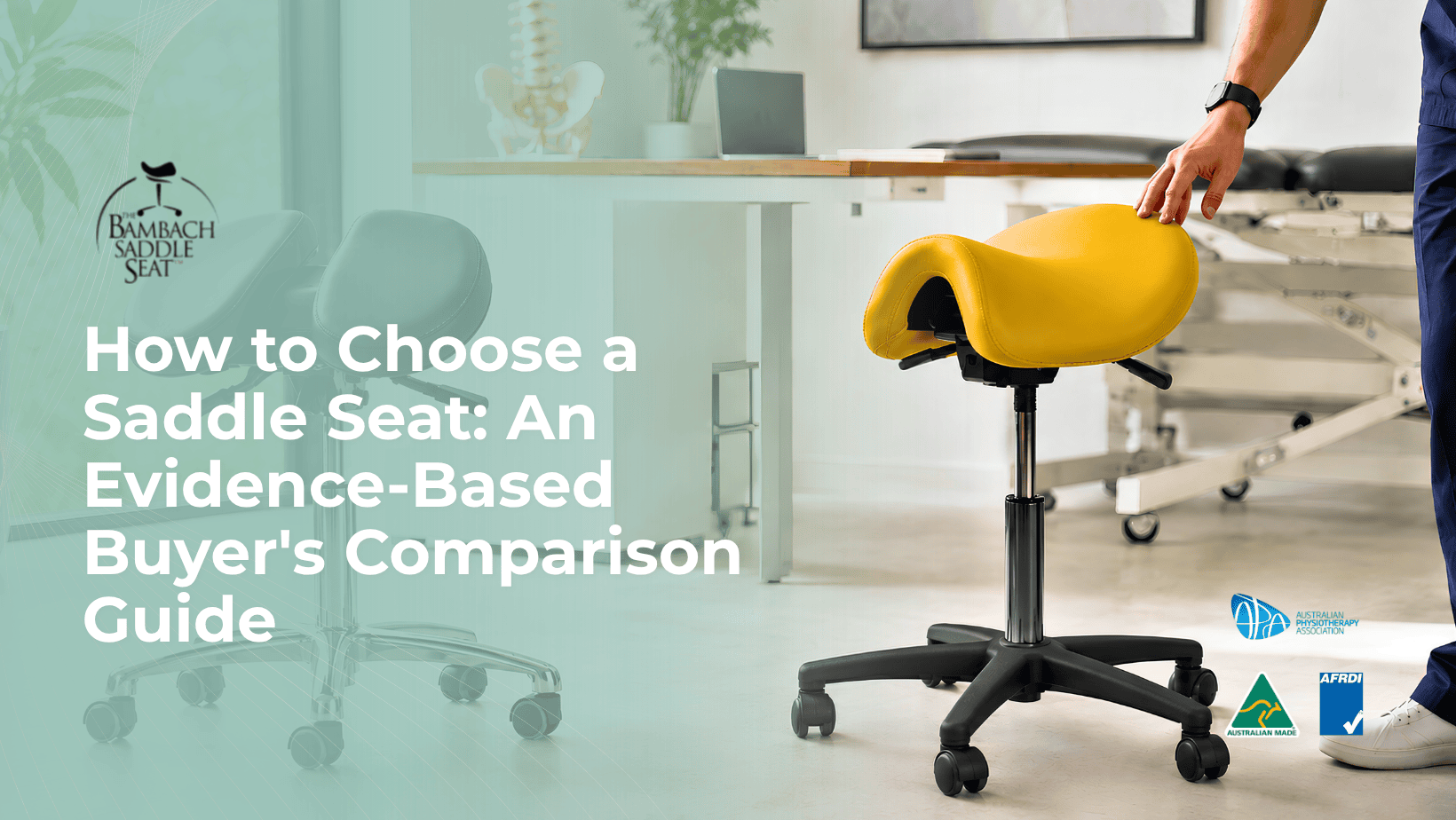
A genuine saddle seat opens the hip angle to roughly 135 degrees, tilting the pelvis forward and letting the lumbar spine hold its natural “S” curve without a backrest. Beyond that shared principle, saddle seats diverge sharply in seat geometry (continuous-contour vs. split-seat), sizing options, certification, and country of design and manufacture — and those differences are what actually determine whether a chair helps your posture or just looks like it should.

This guide breaks down exactly what to evaluate before you buy, using the same criteria a physiotherapist, occupational therapist, or workplace health and safety (WHS) manager would use to assess clinical seating.

Why Not All Saddle Seats Are Built the Same

The term “saddle seat” describes a category, not a single design. Two chairs can both be called saddle seats and behave completely differently under your body.

The most consequential design fork in the category is seat geometry: whether the seat pan is a single, unbroken contour or is split into two separate pads.

Continuous-Contour Seats vs. Split-Seat Designs

FeatureContinuous-Contour SeatSplit-Seat Design
Pelvic stabilityLocks the pelvis with one uniform, uninterrupted surfaceTwo separate pads can shift independently, reducing lateral stability
Weight distributionEven distribution across both sit bones (ischial tuberosities)Can concentrate pressure unevenly if pads aren’t perfectly aligned to the user
Mobility & rotationFree rotation and side-to-side movement across one surfaceMovement can be restricted by the gap between pads
Best suited forClinical, surgical, dental, and precision tasks requiring a stable baseUsers who specifically want a divided seat for personal comfort reasons

Neither geometry is inherently “wrong” — but they solve different problems, and a chair built for one purpose won’t necessarily suit another. If your priority is a rock-stable base for precision clinical work (dentistry, surgery, veterinary procedures, fine motor tasks), a continuous, unbroken saddle contour designed specifically for that purpose is the evidence-backed choice.

Read also : https://www.bambach.com.au/about-us/case-studies/

5 Criteria for Evaluating Any Saddle Seat

Cut through the marketing claims and assess a saddle seat against these five factors. This is the same framework a workplace health and safety manager or referring clinician would use.

1. Country of Design vs. Country of Manufacture

Ask two separate questions: who designed this chair, and who makes it? Many saddle chairs sold in Australia are designed overseas and imported by a local distributor. That’s not automatically a problem — but it does mean the clinical credibility behind the design, the supply chain for parts and warranty claims, and the speed of local support can vary significantly. A chair designed and manufactured in Australia by the original clinical inventor offers a shorter, more accountable chain between the person who understood the biomechanical problem and the product in your workplace.

2. Clinical Origin and Endorsement

Look for a genuine clinical originator — ideally a named occupational therapist, physiotherapist, or other allied health professional credited with the design — rather than a general “ergonomic” claim. Also check for third-party endorsement from a recognised professional body (in Australia, the Australian Physiotherapy Association is the relevant benchmark), not just self-description marketing language. “Ergonomic” is an unregulated term in Australia; anyone can put it on a product listing.

3. Independent Structural Certification

For commercial or clinical environments, structural certification matters more than most buyers realise. In Australia and New Zealand, AFRDI Level 6 is the relevant independent testing standard for severe commercial use — it verifies the chair can withstand extreme daily loads, sudden movement, and continuous heavy use in clinics and offices. If a chair doesn’t disclose an independent certification, ask for it directly before buying for a commercial or multi-user setting.

4. Sizing and Custom Fit

Pelvic width varies significantly between individuals, and a single “one-size-fits-all” saddle seat will not properly support every body. Multiple seat sizes, adjustable gas-lift heights, and stem height options are what allow a saddle chair to genuinely fit an individual rather than approximate a fit. A wide range of sizing options is a strong signal that the manufacturer understands the anatomy they’re designing for.

5. Warranty, Stock Availability, and Local Support

A saddle chair is a multi-year investment, not a disposable purchase. Check the warranty length (five years or more is the benchmark for commercial-grade seating), whether the model you want is actually in stock and ready to ship, and whether local fitting or adjustment support is available if the chair doesn’t feel right initially. A long warranty paired with a genuine money-back trial period signals a manufacturer confident in their product’s fit.

Comparison Checklist: What to Ask Before You Buy

Use this as a direct checklist when comparing saddle chair options:

  • Is the seat a continuous contour, or a split/divided design?
  • Where was this chair designed, and by whom?
  • Where is it manufactured?
  • Is it endorsed by a recognised clinical body (e.g. the Australian Physiotherapy Association)?
  • Is it independently certified for commercial use (e.g. AFRDI Level 6)?
  • How many seat sizes are available, and how is the right size determined?
  • What is the warranty length, and does it cover the frame, gas lift, and upholstery?
  • Is the model in stock, or is it on backorder/preorder?
  • Is there a money-back trial period if the fit isn’t right?
  • Is the upholstery available in surgical-grade or infection-control vinyl if needed for a clinical setting?

The Original, Australian-Designed Saddle Seat

The Bambach Saddle Seat was designed in 1989 by Mary Gale, an Australian occupational therapist, after observing that patients who could not sit upright unsupported on a standard chair could sit balanced and symmetrical on horseback. That clinical observation became the original contoured saddle seat — a single, unbroken contour engineered to open the hip angle to 135 degrees and let the spine self-support in its natural curve.

Nearly 36 years on, Bambach remains designed, manufactured, and hand-upholstered in Marrickville, Sydney — not imported and repackaged. It is endorsed by the Australian Physiotherapy Association, independently tested to AFRDI Level 6 for severe commercial use, and available in multiple seat sizes and stem heights to fit individual bodies rather than approximate them. Every chair carries a five-year warranty and a 30-day money-back trial.

If you’re comparing saddle chairs and want to see how the original, clinically designed model measures up against the checklist above, explore the Bambach range or take our two-minute quiz to find the right seat, size, and configuration for your profession and body.

Ready to feel the difference a genuinely custom-fitted saddle seat makes? 

Book a fitting or trial with a Bambach specialist — or call +61 2 8966 4800 to talk through which model suits your workspace.


AFRDI Level 6 is a genuine, independent structural testing standard administered by the Australasian Furnishing Research and Development Institute. It verifies a chair can withstand severe, continuous commercial use without structural failure. Unlike the word "ergonomic" — which is unregulated in Australia and can be used by any manufacturer — AFRDI certification is independently verified and should be disclosed by any manufacturer marketing a chair for commercial or clinical use.

It can. A chair designed and manufactured locally by its original clinical inventor typically means a shorter supply chain for parts, warranty support, and stock availability, plus more direct accountability for the clinical claims behind the design. An imported chair isn't automatically inferior, but it's worth confirming local warranty support, stock lead times, and who is actually responsible for the clinical claims being made.

Because pelvic width varies significantly between individuals, a single "one size fits all" saddle seat cannot properly support every body. Look for a manufacturer offering multiple distinct seat sizes plus adjustable stem heights, so the chair is fitted to your specific anatomy rather than approximated.

Check our products HERE

No product or piece of furniture is "AHPRA approved." AHPRA (the Australian Health Practitioner Regulation Agency) registers and regulates individual healthcare practitioners — such as physiotherapists and dentists — not commercial furniture or medical devices. Genuine clinical credibility for a saddle chair comes from endorsement by a recognised professional body, such as the Australian Physiotherapy Association, and independent structural certification such as AFRDI Level 6.

Most users report a one- to two-week adjustment period. Because saddle seating actively engages core and postural muscles that are typically dormant on a standard flat chair, some mild muscle awareness during the first fortnight is normal and expected as your body adapts to active sitting.

Five years is the benchmark for a commercial-grade saddle chair, covering the frame, gas lift, and upholstery. Anything significantly shorter may indicate the manufacturer doesn't expect the chair to hold up under sustained daily commercial use.

A genuine money-back trial period — typically around 30 days — is a strong signal of manufacturer confidence. Because fit and adjustment period both matter for saddle seating, a trial period lets you assess whether a specific model and size genuinely suits your body and workspace before you're locked into the purchase.

Restoring Postural Freedom: Real Australian Case Studies in Special Needs & Adaptive Saddle Seating

When sitting on a conventional flat chair or static wheelchair, individuals with physical disabilities and neurological conditions often face severe biomechanical challenges. Without stable pelvic support, the torso collapses, the spine curves into a slumped “C” shape, and upper-limb movement becomes heavily compromised.

The concept of adaptive saddle seating originated in Australia in 1988. Mary Gale, a qualified Australian Occupational Therapist at Hornsby Hospital in Sydney, noticed a remarkable physiological phenomenon: patients with severe physical trauma and neurological impairments who could not sit unsupported on a standard seat could sit upright, with balance and symmetry, when mounted on horseback.

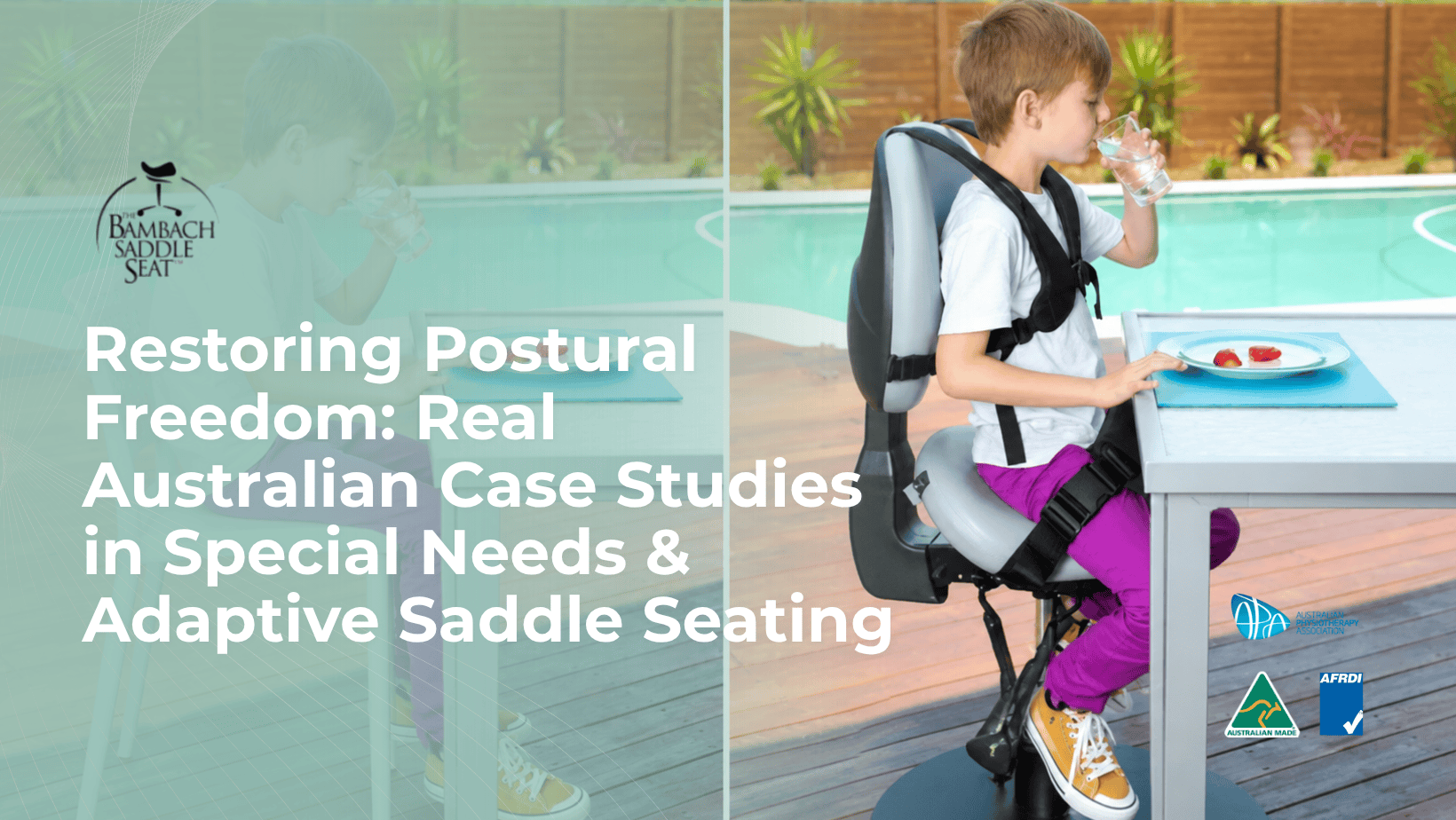
By replicating the natural rider’s saddle position, the Bambach Saddle Seat was engineered to stabilize the pelvis in a neutral position, open the hip angle to 135°, and restore the natural “S” curve of the spine. Today, Bambach posture chairs are prescribed across Australia by Occupational Therapists (OTs) and Physiotherapists as clinically validated assistive technology.

Real Australian Case Studies: Transforming Special Needs Posture

Case Study 1: Ruby – Managing Muscular Atrophy & Classroom Fatigue

  • Clinical Background: Ruby was diagnosed with muscular atrophy, a condition causing progressive muscle weakness and difficulty maintaining upright posture over extended periods.
  • The Postural Problem: In a standard classroom chair, Ruby suffered severe postural collapse. Her pelvis tilted backward (posterior pelvic tilt), collapsing her spine into a flattened lumbar “C” curve with hunched shoulders and forward head projection. To view her work, she hyperextended her cervical spine and protruded her chin, leading to rapid physical exhaustion, thoracic compression, and an elevated risk of progressive spinal deformities.
  • The Bambach Intervention: Ruby’s Occupational Therapist recommended trialling a Bambach Small Adaptive Saddle Chair fitted with a reduced abduction seat, standard backrest, an 80 mm drop-through gas lift, and locking castors.
  • Clinical Outcome:
    • Neutral Pelvic Alignment: Opening Ruby’s hip angle naturally rotated her pelvis into a neutral upright position, eliminating the slumped “C” curve.
    • Upper Limb Independence: With her core and lower body stabilized, her head and shoulders returned to a comfortable, neutral position. This freed her arms from bracing, allowing her to focus on fine motor tasks and schoolwork without premature fatigue.
    • Optimized Respiration: Restoring natural lumbar lordosis expanded her thoracic cavity, reducing abdominal compression and supporting overall respiratory function.

“With her pelvis now in its neutral position, Ruby can assume and maintain a correct posture, which greatly improves her ability to perform functional tasks as well as working longer without fatigue.” — Bambach Clinical Case Report

Case Study 2: David – Adult Cerebral Palsy & Functional Mobility

  • Clinical Background: David lives with Cerebral Palsy characterized by increased adductor muscle tone, predominantly on his right side.
  • The Postural Problem: David’s tight hip adductors made walking difficult, confining him largely to a wheelchair. When seated sacrally in his wheelchair or on flat chairs, his shoulders hunched, his shoulder blades winged, his chin protruded, and his pelvis pulled obliquely to the right.
  • The Bambach Intervention: David trialled a Bambach Saddle Seat adjusted to accommodate his frame and computer workstation.
  • Clinical Outcome:
    • Inhibition of Abnormal Tone: The saddle seat’s contoured design held David’s hips abducted and extended at a 45° angle, inhibiting abnormal muscle tone and restoring symmetrical alignment.
    • Active Weight Bearing & Mobility: Rather than remaining passive, David’s legs and feet achieved full plantar contact with the floor. He began actively using his legs to push, pull, and propel his chair around the room.
    • Gait and Functional Gains: Activating his postural core and back muscles significantly improved his spinal strength. David reported walking greater distances independently, reducing his reliance on his wheelchair during daily outings.

“My back is a lot straighter and it has helped my walking, as I can now walk straighter and have more strength in my back.” — David, Bambach User

Biomechanical Comparison: Conventional Seating vs. Bambach Adaptive Saddle Seating

Biomechanical MetricStandard Wheelchair / Flat ChairBambach Adaptive Saddle Chair
Pelvic OrientationPosterior tilt (sacral sitting)Neutral forward tilt (upright ischial tuberosity support)
Spinal ProfileFlattened “C” curve (slumped kyphosis)Natural “S” curve (preserved lumbar lordosis)
Hip AngleRestricted 90° angleOpen 135° open hip angle
Upper Limb MobilityArms forced to brace torso for balanceArms completely free for fine motor tasks & learning
Lower Limb EngagementPassive, unweighted positioningActive plantar contact & sensory proprioceptive feedback
Respiratory CavityCompressed thoracic & abdominal spaceOpen thoracic cavity for maximum lung capacity


Tested Strength & Trust: AFRDI Level 6 Certification & NDIS Approval

When prescribing adaptive seating for special needs users, durability, structural integrity, and clinical safety are paramount.

Certification StandardStructural & Clinical Impact
AFRDI Level 6 Tested

Certified for Severe Commercial & Heavy Clinical Use

Heavy Structural Loads

Engineered to withstand extreme daily wear, dynamic spasticity, and high impact forces.

NDIS Assistive Technology

Approved Adaptive Equipment

Clinical Funding & Safety

Fully approved under Australian NDIS funding for specialized adaptive seating equipment.


  • AFRDI Level 6 Certification: The Bambach Saddle Seat is certified to AFRDI Level 6 (Severe Commercial Use) by the Australasian Furnishing Research and Development Institute. This certification guarantees that the chair can withstand intense dynamic loads, sudden movements caused by spasticity, and continuous heavy-duty use in schools, clinics, and homes.
  • Australian Physiotherapy Association (APA) Endorsed: Recognised by clinical bodies across Australia for its proven anatomical benefits.
  • NDIS Assistive Technology Funding: As a clinically validated posture device, the Bambach Saddle Seat is regularly funded under the National Disability Insurance Scheme (NDIS) under Capital Supports / Assistive Technology.

Explore our complete range of Special Needs Adaptive Saddle Chairs or read more real-world results in our Australian Clinical Case Studies Archive. For paediatric requirements, view the Bambach Small Adaptive Chair Range.


Yes. The Bambach Saddle Seat is classified as clinically prescribed Assistive Technology. NDIS participants can work alongside their registered Occupational Therapist or Physiotherapist to conduct a seating trial, document functional goals (such as increased independence, improved posture, or upper-limb control), and submit an Assistive Technology assessment report for funding approval.

AFRDI Level 6 certification ensures that the chair has undergone rigorous testing for extreme durability, stability, and structural strength under severe commercial conditions. For individuals with neurological conditions who experience involuntary movements, high muscle tone, or sudden spasms, AFRDI Level 6 approval provides assurance that the seating frame will remain safe and stable.

When a person slumps in a conventional chair, the torso compresses, crowding the lungs, diaphragm, and digestive organs while forcing the head forward. By holding the spine in its natural "S" curve, the Bambach opens the thoracic and abdominal cavities. This alignment expands lung volume and positions the head and neck neutrally over the shoulders, facilitating smoother swallowing and improved vocal control.

Yes. By positioning the pelvis upright and enabling full foot contact on the floor or footring, the Bambach provides a wide, stable base of support. This triggers natural postural righting reactions and engages dormant core muscles safely, rather than allowing the torso to collapse into passive slumping. Optional accessories—such as adjustable backrests, trunk supports, and side harness systems—can also be integrated for additional support.