
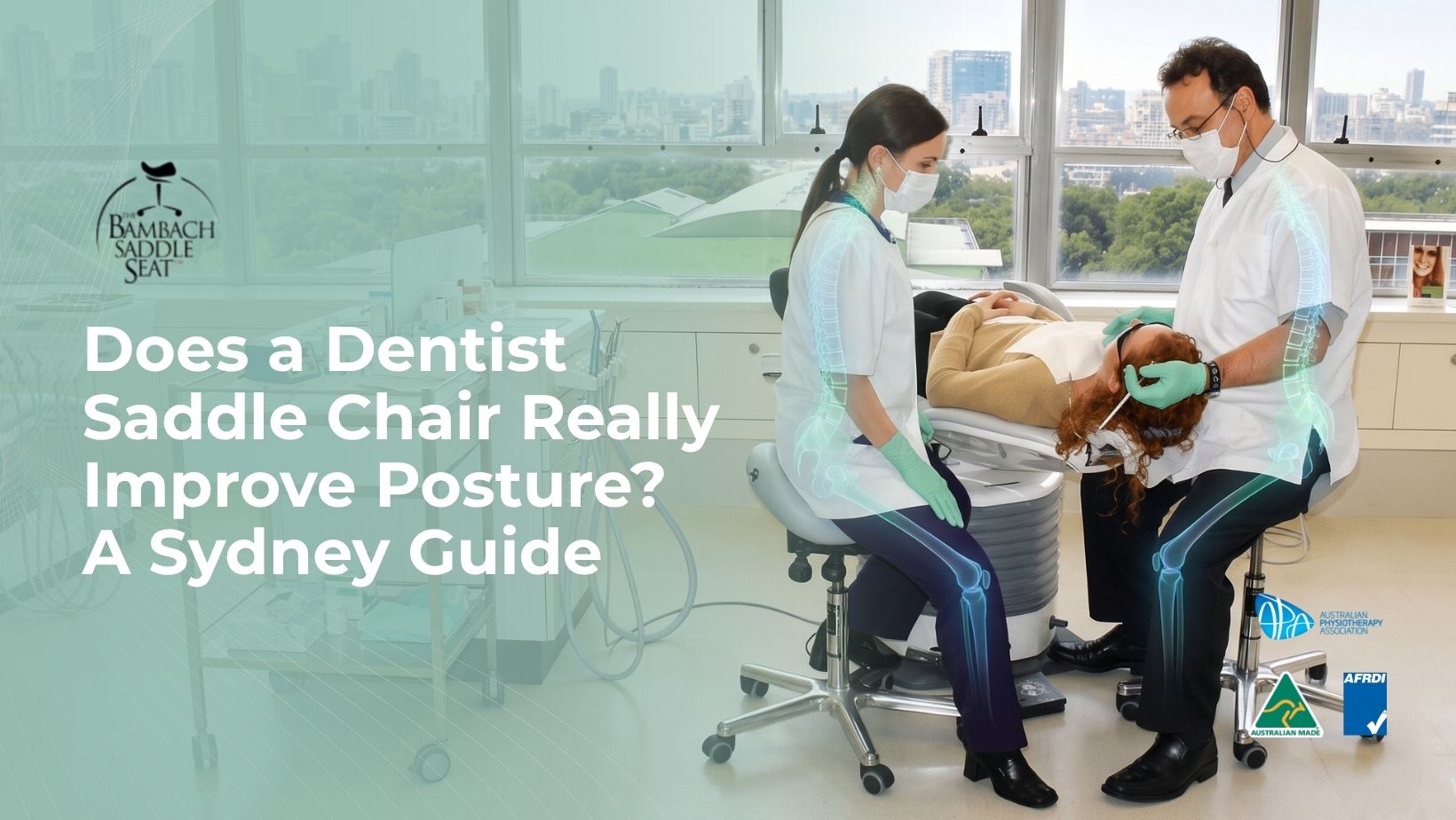
A dentist saddle chair can improve posture for Sydney dental teams, but the research is stronger on how you sit than on whether pain goes away. In a 2018 systematic review, dental students on saddle-style stools scored about three points better on a standard posture assessment than students on conventional stools. None of the studies in that review measured pain. This guide covers what the evidence shows, how a saddle seat changes your position at the chair, and how to choose one for a dental surgery in Sydney.
Why do Sydney dentists, hygienists and assistants sit in pain?
Neck, lower back and shoulder pain are common across the dental profession. The table below shows the main figures from international and Australian research.
| Study | Who was studied | What it found |
| Lietz, Kozak & Nienhaus (2018) | Dentists worldwide, 30 studies pooled | Over 12 months: neck 58.5%, lower back 56.4%, shoulders 43.1%, any body region 78.0% |
| Marshall, Duncombe, Robinson & Kilbreath (1997) | 355 NSW dentists, 80% response | 82% had at least one symptom in the previous month; 64% reported pain, most often back pain |
| Leggat & Smith (2006) | 285 Queensland dentists | 87.2% had at least one symptom in 12 months; neck 57.5%, lower back 53.7%, shoulder 53.3% |
The NSW survey is nearly 30 years old, so treat its percentages as a baseline rather than a current rate. The pattern is consistent, though: dentists who work leaning forward for hours report pain in the same three places.
This matters to every role in a Sydney practice, from a principal in the CBD to a hygienist in the Inner West. The seat you sit on sets the position of your pelvis, and your pelvis sets the position of everything above it.
Do saddle seats really improve dentist posture? The short answer
A dentist saddle chair is likely to improve working posture, and the evidence for that is moderate. The best published test is a 2018 systematic review and meta-analysis by Gouvêa and colleagues in PLOS ONE. It pooled two studies of 150 second-year dental students working on phantom heads, with follow-up of 10 to 12 weeks.
The saddle-stool group scored 3.16 points lower on the RULA posture assessment (95% CI −4.02 to −2.30). A lower RULA score means a lower ergonomic risk. The reviewers rated the certainty of the evidence as moderate.
There are limits you should know about:
- The participants were students on phantom heads, not practising clinicians treating patients.
- The results differed a lot between the two studies (I² of 95%).
- The review reported no pain outcomes, so it cannot tell you a saddle seat reduces pain.
In plain terms, a saddle seat changes how you sit. Whether that changes how you feel after a full list depends on your body, your bench height and your habits.
How a saddle seat changes the way you sit
A saddle seat is shaped like a horse saddle, so your thighs slope down and apart instead of sitting flat. Here is what that does, step by step:
- Your hips open up. Bambach describes its design as holding the hips at a 135° open angle, which is wider than a flat seat allows.
- Your pelvis tips towards neutral. A neutral pelvis makes it easier to keep the natural curve in your lower back, instead of slumping into a rounded spine.
- You can sit closer to the patient. With your thighs angled down and apart, you can bring your knees around the chair head and stay upright instead of leaning in.
- Your neck and shoulders have less to compensate for. When the trunk stays upright, you may not need to crane your neck to see the mouth.
These are the mechanisms the design aims for. They explain why posture scores improve, but they are not a guarantee of less pain.
Saddle seat vs flat operator stool vs office chair
| Saddle seat | Flat operator stool | Office chair | |
| Hip position | Open, thighs sloping down | Thighs level, hips closer to 90° | Thighs level, often reclined |
| Pelvis | Encouraged towards neutral | Can tip backwards | Tips backwards when slouched |
| Closeness to patient | Close, upright | Close, but often leaning | Armrests and base can get in the way |
| Back support | Optional back for hygienists | Usually none | Built in, but unused when leaning forward |
| Best for | Seated clinical work | Short procedures | Admin and reception |
“Bambach’s are comfortable & relieve the pressure that dentistry puts on our body. Also the range of movement/tilt enables us to achieve a more natural posture when working.”
— Jody, Family Dental Care
Find the right dental saddle seat for your body
Sore back after a long list? Use the Bambach seat calculator to match a saddle seat to your size and the way you work.
How to choose a dental saddle chair in Sydney
The right dental saddle stool is the one that fits your body and your bench. Work through these steps:
- Choose the seat size. Bambach seats come in Narrow, Small, Medium and Executive. Use the model guide to match the size to your hips and thighs.
- Decide on a back. Hygienists often prefer a model with a back and swing arm, offered in Narrow and Small sizes on the dental page.
- Pick the stem height. Stems come in Standard, Medium, Low and Drafting, so your knees can stay lower than your hips at your bench height.
- Add a footring for assistants. Dental assistants usually sit higher than the dentist, and a footring allows the required sitting height.
- Check certification and warranty. Bambach seats carry AFRDI Level 6 certification and a 5-year warranty.
- Allow a week to adapt. Dr Gregori Kurtzman, quoted in Dental Economics, said, “It took about a week to adapt to the Bambach.”
You can see the full range on the Bambach chairs page and read the dental saddle chair guide.
A Sydney-made saddle seat designed by an occupational therapist
The original Bambach saddle seat was designed in 1988 by Mary Gale, an occupational therapist. Seats are hand-upholstered and made in Sydney, and the business is based in Marrickville in the Inner West. Read the Bambach story, or see how a dental team used one in the dentist back and sciatic pain case study and the dental assistant neck pain case study.
What a saddle seat will not do
A saddle seat is one part of a safe workstation, not a treatment. Patient height, instrument reach, loupes, scheduling and regular movement breaks all affect strain. If you have ongoing pain, see your GP or physiotherapist. SafeWork NSW has guidance on managing manual tasks and workstation risks in NSW workplaces.
Back pain at the chair? Start with the seat calculator
Back pain after a long list? The right seat may help. Use the Bambach seat calculator to find your saddle seat. Bambach sells online and through distributors, and its Marrickville address (7/87 Fitzroy St, Marrickville NSW 2204) is an office and warehouse, not a shop. Call 02 8966 4800 or find a Bambach distributor near your practice.
Yes, the best available evidence says they are likely to. A 2018 meta-analysis found dental students on saddle stools scored 3.16 points lower (better) on the RULA posture assessment, with moderate certainty. The studies used students on phantom heads and did not measure pain.
They may help by supporting a more neutral pelvis and lower back, but the research has not proven pain relief. A saddle seat is not a treatment. See your GP or physiotherapist about ongoing back pain, and use the seat as part of a wider workstation set-up.
There is no single best chair, because fit matters most. Choose the seat size (Narrow, Small, Medium or Executive), stem height and back option that suit your body and bench, and use the seat calculator to narrow the choice. Bambach seats are made in Sydney and carry AFRDI Level 6 certification.
Yes. Bambach lists hygienist models with a back and swing arm in Narrow and Small sizes. Dental assistants sit higher than the dentist, so a footring allows the required sitting height.
It varies by person. Dr Gregori Kurtzman, quoted in Dental Economics, said it took about a week to adapt to the Bambach. Bambach’s 30-day money-back guarantee gives you time to decide.
Look for a seat size that fits your hips, an adjustable stem height, a back and swing arm if you are a hygienist, a footring for assistants, AFRDI certification and a clear warranty. Bambach offers a 5-year warranty.