
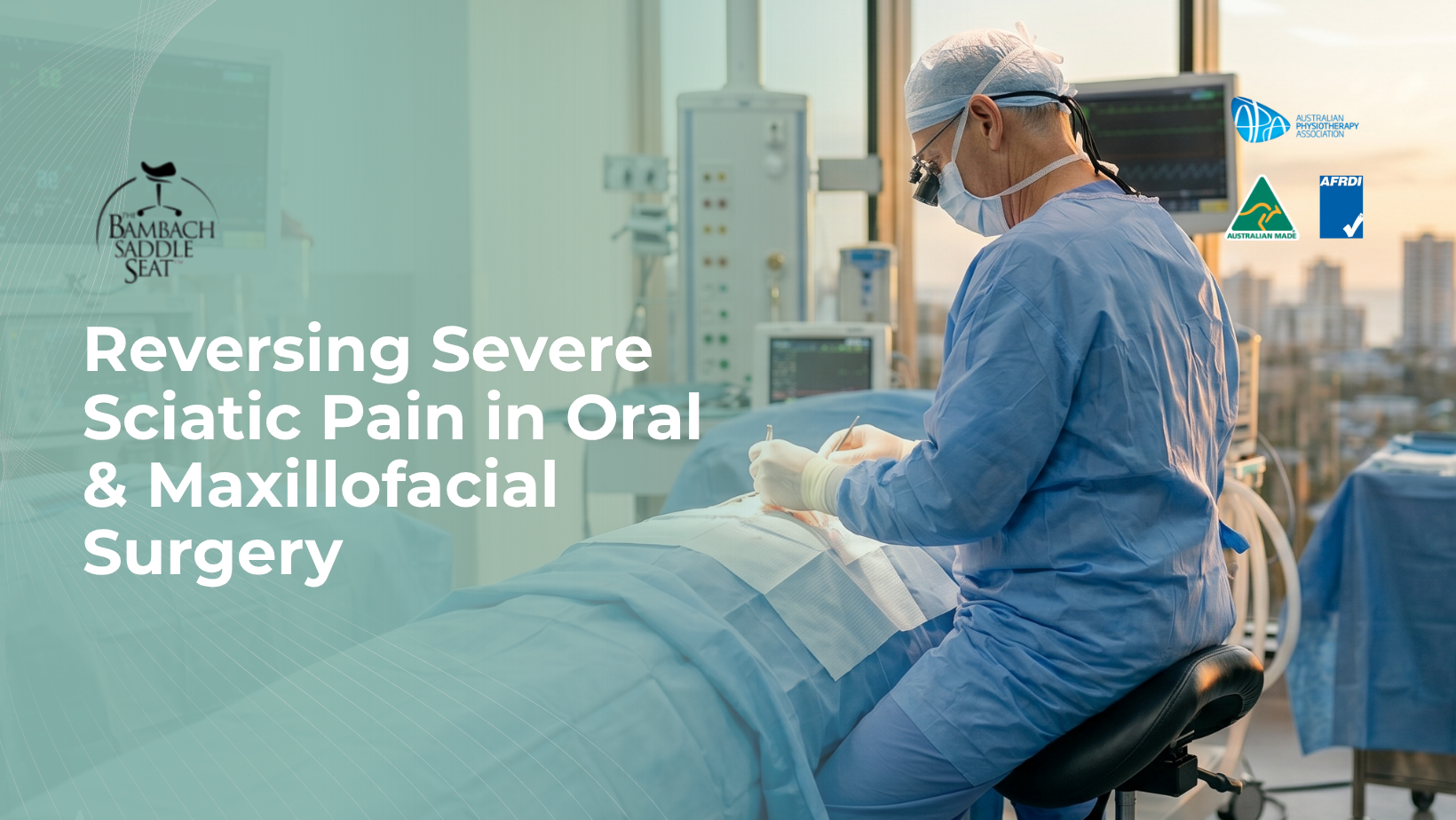
Case Study: Reversing Severe Sciatic Pain in Oral & Maxillofacial Surgery
Dentist: Back and Sciatic
Name: Dr T (M.B.S, M.B,ChB.,F.R.A.C.D.S.,O.M.S.), Occupation: Oral Maxio Facial Surgeon.
The Problem
Oral Maxillofacial Surgeon Dr T suffered from chronic back issues and debilitating sciatic pain that severely restricted his life outside of work. The condition became so severe that after simply packing the car for a family holiday, he was physically unable to pick up or hold his children. To manage the pain during long, high-precision procedures, Dr T was forced to perform 100% of his surgeries standing up. Despite a rigorous routine of physiotherapy, targeted exercises, and competitive rowing, he could not achieve lasting relief from the static postural strain of his profession.
The Intervention
A fellow surgeon recommended the Bambach Saddle Seat after seeing it at a medical conference in Cairns, Australia. Dr T integrated a standard Bambach model customized with a foot-operated height adjuster, allowing him to alter his positioning hands-free while preserving a sterile surgical environment.
Because Dr T operates using surgical loupes, his work demands extreme upper-body stability and a static “hold” position. The Bambach’s unique contour dropped his thighs into an open 135-degree angle, tilting his pelvis forward and automatically locking his spine into its natural “S” curve. This balanced alignment transferred his upper-body weight safely onto his skeletal structure, immediately taking the pressure off his compressed lumbar discs and sciatic nerve.
The Outcome
- Eradication of Sciatic Symptoms: Combined with his exercise regime, the Bambach dramatically improved Dr T’s symptoms, allowing him to return to an active lifestyle and hold his children pain-free.
- Dynamic Surgical Posture: Previously bound to standing for all operations, Dr T now remains comfortably and safely seated for 30% of his surgical schedule.
Cognitive Behavioral Shift: Dr T notes that because the Bambach is completely different to a standard office chair, it serves as an active, continuous reminder to maintain proper biomechanics throughout the day.
Can a saddle chair help a surgeon who prefers to work standing up?
Yes. Many surgeons stand because traditional office stools cause immediate, agonizing lower back strain. A saddle chair perfectly replicates the healthy spinal alignment of standing while eliminating lower limb fatigue, blood pooling, and joint stress. It acts as an ideal hybrid solution, allowing surgeons to sit for blocks of time to conserve physical energy without compromising their posture.
Why is a foot-operated height adjuster necessary for surgical stools?
In operating theatres and sterile clinical environments, hands-free adjustments are a strict medical necessity. A foot-operated pneumatic ring allows the surgeon to effortlessly raise or lower the seat pan using their heel, completely removing the need to touch manual levers, thereby preventing cross-contamination and preserving the sterile field.