Category: Veterinary

How Bambach Saddle Seats Are Helping Veterinary Clinics Tackle Australia’s MSD Crisis

The veterinary profession is physically demanding, unpredictable, and inherently hazardous to the human body. Devoted to the care of their furry, feathered, and scaly patients, veterinarians and vet nurses routinely put the health of animals above their own. The clinical consequence of this dedication is severe: a staggering 67% of veterinary surgeons suffer from workplace musculoskeletal disorders (MSDs).

At Bambach, we recognize that this is not just an occupational hazard; it is an industry-wide crisis that drives passionate professionals into early retirement.

For decades, we have partnered with animal healthcare professionals to engineer the optimal ergonomic seating for vet clinics. We don’t just supply furniture; we provide a biomechanical intervention. Today, over 300 veterinary practices across Australia rely on the Bambach Saddle Seat to prevent injuries, maintain clinical precision, and extend careers. In this guide, we break down the evidence behind the veterinary MSD crisis and explain how our original continuous-contour design remains the ultimate defense.

Why Do 67% of Veterinarians Suffer from Musculoskeletal Injuries? 

To understand why vet clinic MSD prevention is so critical, we must examine the physical realities of the consulting room and the surgical theater.

Standard medical stools and office chairs are designed for static, forward-facing desk work. They force the user’s hips into a closed, 90-degree angle, which flattens the lumbar spine into a weak “C” shape. When a veterinarian sits in a standard chair and leans forward to examine a nervous dog on the floor or a cat on a treatment table, their already compromised spine bears massive, asymmetrical strain.

The primary causes of veterinary MSDs include:

  • Static Forward Flexion: Prolonged leaning over surgical tables or microscopes without pelvic support.
  • Awkward Reaching: Twisting to access instruments, medications, or to restrain uncooperative patients.
  • Lack of Core Stability: Conventional flat stools require the lower back muscles to work constantly just to keep the body upright, leading to rapid muscular fatigue and spasm.

Treating patients requires mobility, stability, and precise hand-eye coordination. When your chair fights your anatomy, your spine pays the price.

How Does Bambach Saddle Chair Prevent Vet Clinic Back Pain?

We engineered a chair to set your spine free. Created by an Australian occupational therapist, the Bambach Saddle Seat utilizes a continuous, unbroken contour that mimics the only posture where the human spine is perfectly balanced: horseback riding.

Here is how our original veterinary saddle chair Australia design directly combats the physiological stressors of veterinary work:

1. The 135-Degree Anatomical Advantage

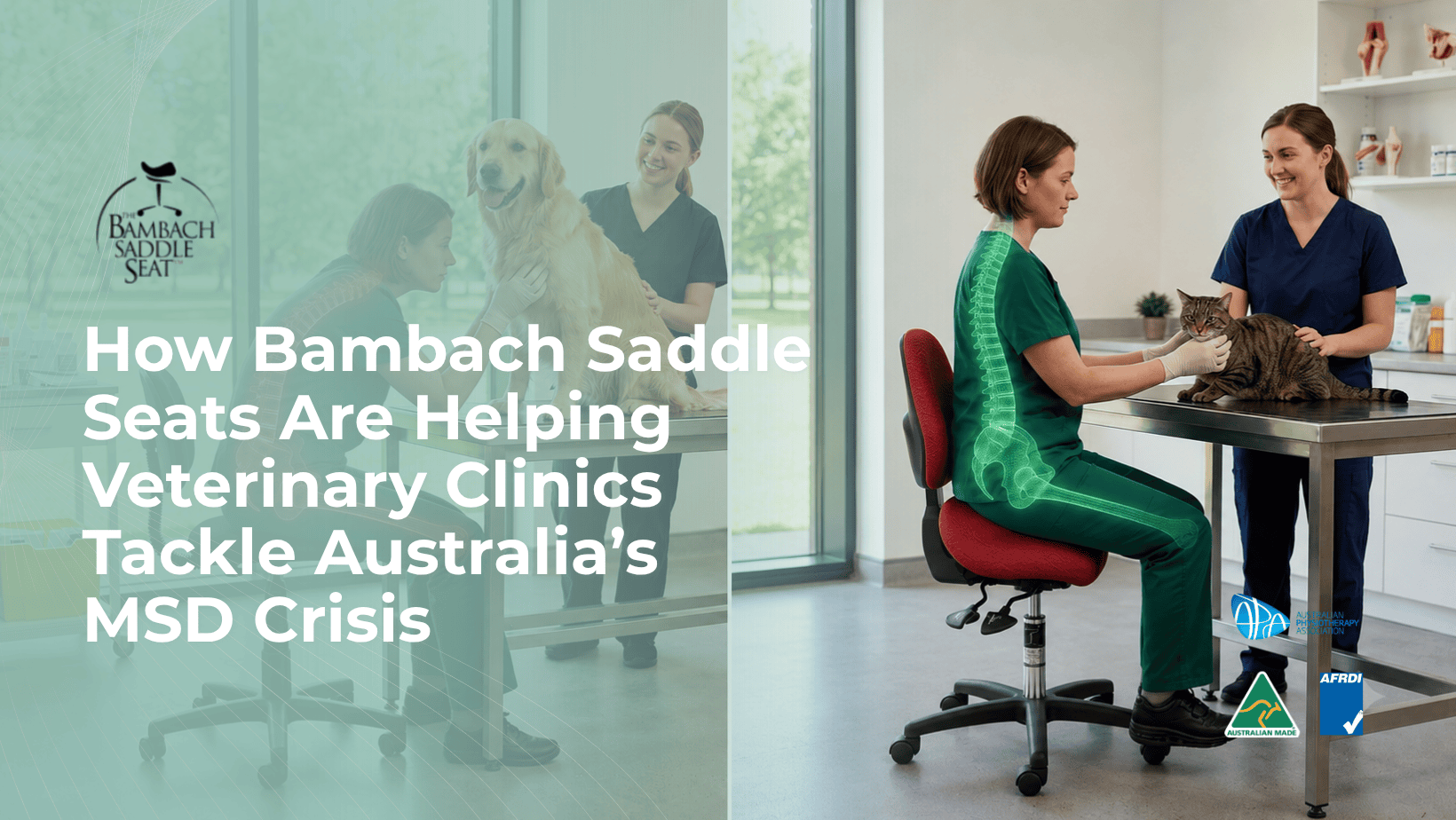
By opening the hip angle to 135 degrees, the Bambach naturally abducts the legs and anchors the pelvis in an upright, neutral position. This structural alignment effortlessly preserves the healthy “S” curve of the spine, even when you lean forward to examine a patient on the floor.

2. Unbroken Core Stability

Unlike cheap split-seat designs that fail to provide uniform support, our solid-seat geometry locks the pelvis in place. This provides an ultra-stable foundation, freeing your upper body to reach, twist, and perform delicate procedures—such as suturing or dental scaling—without straining your lumbar discs.

3. Maximum Mobility and Footprint

Veterinarians need to move dynamically around exam tables. The straddle posture gives you a wide, stable base, allowing you to use your legs to easily propel the chair around the clinic. The compact design ensures you can get as close to the treatment table as possible without restrictive armrests or bulky seat pans getting in the way.

Evidence Roundup: Trusted by 300+ Australian Practices

The effectiveness of the Bambach Saddle Seat is not theoretical; it is clinically proven and industry-tested.

“We didn’t rewrite the laws of anatomy. We just built a clinical stool to respect them.”

Currently, our seats are the foundation of occupational health in over 300 veterinary practices nationwide. From small suburban clinics to major emergency animal hospitals, practice managers are investing in Bambach to reduce staff absenteeism, lower worker’s compensation claims, and improve daily clinical efficiency.

The occupational hazard of veterinary medicine is a well-documented crisis. According to studies published in the National Library of Medicine, an overwhelming 96% of surveyed veterinarians report experiencing work-related musculoskeletal disorders (MSDs) within a one-year period, with the lower back, shoulders, and neck being the most frequently affected areas. Furthermore, a cross-sectional survey of veterinary surgeons found that 93% experienced musculoskeletal symptoms directly associated with performing surgery, with discomfort significantly worsening during prolonged procedures.

Read also :  https://www.orthovetsupersite.com/abstract/musculoskeletal-symptoms-reported-specialist-veterinary-surgeons 

Veterinarians utilizing our seats report immediate reductions in this neck, shoulder, and lower back fatigue. By opening the hip angle to 135 degrees, the saddle seat naturally tilts the pelvis forward to maintain the spine’s healthy curvature, effectively counteracting the static, forward-leaning postures that drive veterinary MSDs. Furthermore, this upright, open hip posture prevents the chest cavity from compressing. This allows the diaphragm to move freely, reducing abdominal compression, increasing oxygen intake, and promoting healthy blood circulation during long, high-stress surgical procedures.

What is the Best Ergonomic Chair for Vets in Australia? 


If you are upgrading your clinic’s furniture, you need equipment that withstands the rigors of veterinary medicine. Here is exactly what you should look for when sourcing the best chair for vets Australia has to offer:

Essential Feature Why It Matters for Vet Clinics The Bambach Standard
Medical-Grade Upholstery Clinics are messy. Chairs must withstand bodily fluids, fur, and harsh chemical disinfectants. We offer premium, surgical-grade vinyl that is non-porous, highly durable, and easy to sanitize.
Unbroken Pelvic Support Split seats lack surface stability, forcing the core to work harder and causing fatigue. Our continuous, unbroken saddle contour provides immediate, effortless pelvic locking.
Height Customization Vets work at various heights, from low floor exams to high surgical tables. We provide multiple gas stem heights and foot-ring options tailored to your specific workstation.
Clinical Endorsements Ergonomic is a marketing term; you need scientifically backed medical furniture. Designed by an OT, AFRDI Level 6 tested, and trusted by over 300 Australian vet practices.


Protect Your Team, Extend Your Career

Your practice relies on the health and stamina of your veterinarians and nurses. Stop letting flat, unsupportive stools dictate the length and quality of your career.

It is time to invest in a biomechanical solution that actively protects your spine. Explore our dedicated range of Veterinary Saddle Chairs or dive deeper into the science of Veterinary Ergonomic Seating to see how we can customize a solution for your entire clinic.

Ready to eliminate workplace back pain and tackle the MSD crisis head-on? 

Contact Us today for a personalized fitting assessment for your practice.


During surgery, vets often hold static, leaned-forward postures for hours. The Bambach locks the pelvis in an upright tilt, maintaining the spine's natural "S" curve even when leaning forward. This prevents the lower back from collapsing into a painful "C" shape, eliminating the primary cause of surgical back pain.

Yes. The straddle position of the Bambach provides a wide, incredibly stable base of support. Because your feet remain flat on the floor and your legs are separated, you have far greater balance and leverage to safely handle or restrain animals than you would balancing on a standard flat stool.

Absolutely. We customize each Bambach chair with the appropriate gas stem height for your specific needs. We can configure low-height stems for examining large dogs near the floor, or high-drafting stems with foot-rings for working comfortably at elevated surgical or dental tables.

We know vet clinics require strict hygiene. Our chairs can be upholstered in high-quality, surgical-grade vinyl. This material is non-porous, waterproof, and designed to withstand the harsh chemical disinfectants used in animal hospitals to prevent cross-contamination.

Split-seat designs lack the continuous surface area required to properly stabilize the pelvis. In a fast-paced vet clinic, you need the reliable, uniform support of a continuous-contour seat so you aren't fighting to balance on two separate pads while trying to focus on a critical patient.

Because standard chairs allow core muscles to weaken, it typically takes 1 to 2 weeks for a practitioner's body to adapt to the active sitting posture of a Bambach. We recommend transitioning gradually, starting with a few hours a day during consultations before moving on to multi-hour surgeries.

Yes, we work directly with practice managers and veterinary teams across Australia to ensure the correct seat size, height, and accessories are selected for your specific clinic environment and staff body types.

Why Vets Have the Worst Back Pain in Healthcare – And What to Do About It

The 67% Crisis – Why Veterinary MSD Rates Shock Even Clinicians

Most healthcare workers know their profession is physically demanding. But ask them which clinical specialty carries the highest rate of work-related musculoskeletal disorders (MSDs) — the chronic injuries to muscles, tendons, nerves, and spinal structures that accumulate from occupational posture — and most will not answer: veterinary medicine.

They should. Research consistently identifies that approximately 67% of veterinary surgeons are affected by work-related MSDs during their careers. In some studies, rates of neck and shoulder pain among practising vets exceed 80%. Back pain is so endemic in the profession that many veterinarians describe it not as an injury but simply as a condition of the job — an assumption that deserves urgent clinical challenge.

These are not minor aches. MSDs are the leading cause of early career exit in veterinary medicine. A 2019 survey by the Australian Veterinary Association found that physical injury and chronic pain ranked among the top drivers of reduced working hours and premature retirement. A career that takes a decade to build and hundreds of thousands of dollars to qualify for is being cut short by a problem that is, in large part, biomechanically preventable.

“Physical injury and chronic pain rank among the top drivers of reduced working hours and premature retirement in veterinary medicine — yet the postural root cause is largely preventable.” — Australian Veterinary Association, workforce and wellbeing research

The Biomechanics of Vet Back Pain — Why the Examination Table Is the Enemy

To understand why veterinary practice is so damaging to the spine, you need to understand what happens mechanically when a clinician sits on a standard flat stool and leans forward to examine or treat a patient.

What happens on a flat stool

On a conventional flat seat, the hip angle sits at approximately 90°. This angle forces the pelvis to rotate backward — a position called posterior pelvic tilt. The moment the pelvis tilts posteriorly, it pulls the lumbar spine into flexion, collapsing the natural inward curve (lordosis) of the lower back into a rounded, “C”-shaped posture.

In this position, the intervertebral discs — the gel-filled shock absorbers between vertebrae — are compressed asymmetrically. The posterior portion of each disc bears disproportionate load. When this compression is sustained across a full consulting day of 8–12 hours, disc material is progressively pushed outward, dehydrated, and degraded. Over months and years, this is the mechanical process that produces disc herniation, facet joint arthritis, and the chronic lower back pain that ends veterinary careers.

Now add the forward lean. Veterinary examination requires practitioners to lean over tables, peer closely at patients, perform fine procedures with elevated arms, and sustain these positions for minutes at a time across dozens of consultations per day. Each degree of forward lean exponentially increases the compressive load on the lumbar discs — a load already elevated by the posterior pelvic tilt of the standard stool. The neck compensates by extending forward to maintain visual field, loading the cervical discs. The shoulders protract to reach the patient, loading the trapezius and rotator cuff tendons. The entire postural chain is under duress simultaneously.

Flat Stool vs. Bambach Saddle Seat — Hip Angle Comparison

Standard Flat Stool Bambach Saddle Seat
Hip angle ~90° ~135°
Pelvic position Posterior tilt Neutral / forward tilt
Lumbar curve Collapsed — “C” shape Natural S-curve restored
Disc loading Asymmetric compression Even distribution
Muscle activation Passive — structures fatigue Active, low-level — sustainable

Why repetition accelerates the damage

A full-time veterinarian in a busy mixed or small-animal practice may spend 70–80% of each working day seated at examination tables or surgical stations. The sustained, repetitive nature of this loading — not any single traumatic incident — is what drives the alarming MSD prevalence rates. The spine’s structures do not fail suddenly; they degrade incrementally, until one ordinary consultation produces a pain response that marks the end of capacity.

How Vets Compare to Other Healthcare Workers — And Why the Gap Is Striking

Clinical Profession MSD Prevalence Primary Injury Sites Primary Postural Driver
Veterinary surgeons ~67% Lumbar spine, neck, shoulder Forward lean over variable-height patients and tables
Dentists ~64% Neck, shoulder, lower back Sustained lateral rotation over fixed chair-height patient
Surgeons (human) ~53% Neck, lower back, shoulder Static standing posture with fine motor precision
Nurses ~45–52% Lower back, neck Patient handling, awkward lifting
GPs / General practitioners ~30–40% Neck, upper back Computer workstation posture, examination lean

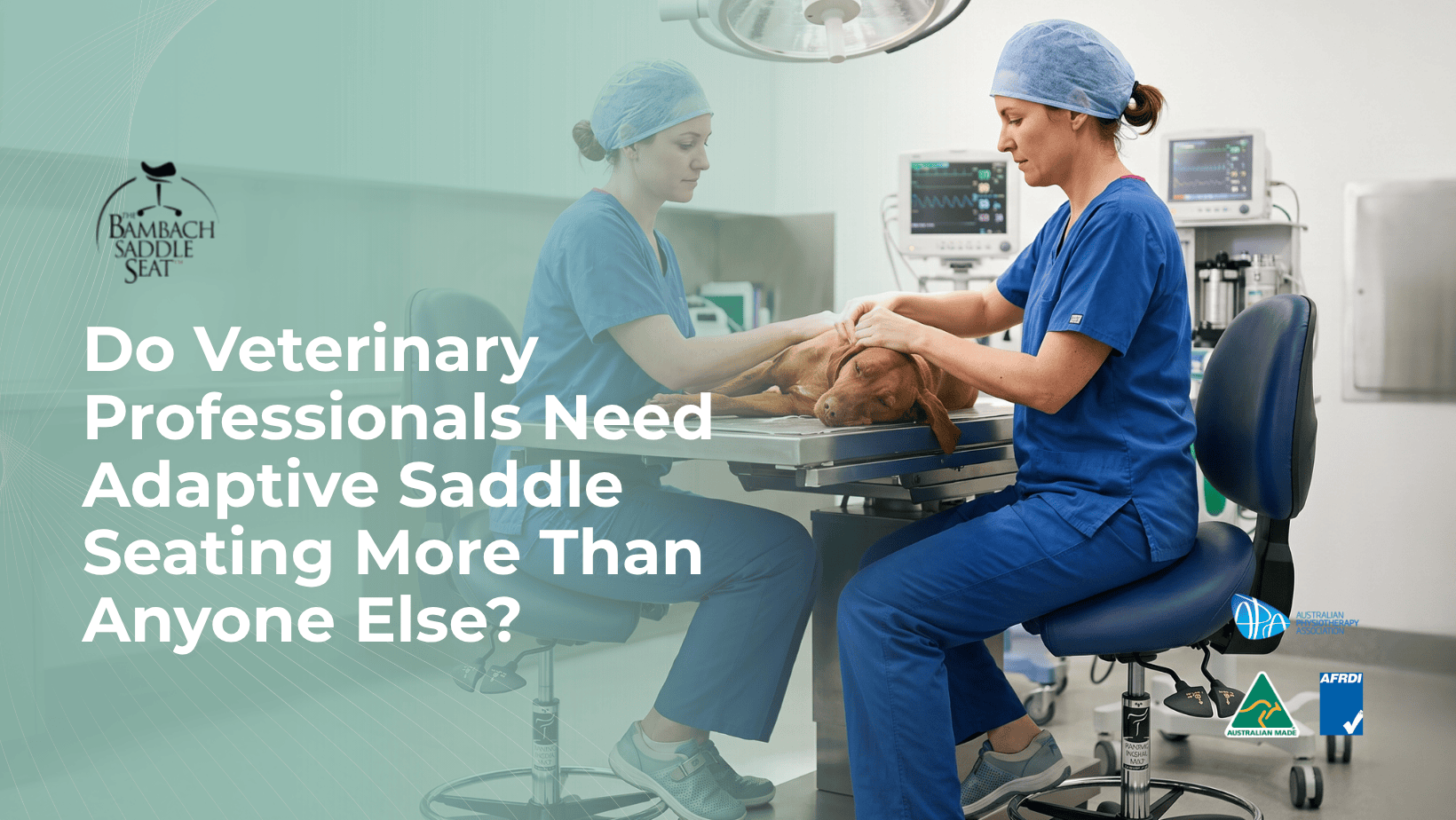
Veterinary practitioners face a unique combination of postural challenges that other clinicians do not. Unlike dentists, who work on patients at a fixed, standardised height, vets treat patients ranging from a mouse on a bench to a 40kg dog on an examination table of varying height to a horse requiring ground-level examination. This constant adaptation — which forces repeated postural reconfiguration rather than a consistent posture — is a key driver of why vet MSD rates consistently lead clinical profession comparisons.

Dental professionals face analogous challenges — which is why Bambach’s dental ergonomic seating (bambach.com.au/ergonomic-back-support-seating/dental/) addresses the same biomechanical root cause — but the variability of veterinary practice adds an additional layer of complexity that makes seating adaptability a non-negotiable requirement.

Why Saddle Seating Is a Career-Extending Clinical Intervention — Not a Comfort Upgrade

The saddle chair’s core mechanism is simple but profound: by changing the shape of the seat surface from flat to saddle-contoured, the thighs are caused to drop downward and outward rather than resting horizontal. This single geometric change opens the hip angle from approximately 90° to 110–135°, which tips the pelvis forward into its neutral position — the position that allows the lumbar spine to reassume its natural lordotic curve spontaneously, without muscular effort or conscious postural correction.

The implications for a veterinary clinician are significant across four dimensions:

  • Spinal alignment — Lumbar lordosis restored passively, without requiring the clinician to brace or consciously “sit up straight.” The correct posture is the position of least resistance, not maximum effort.
  • Clinical mobility — The wide straddle stance anchors the clinician firmly to the floor while allowing 360° rotation around the examination table. This is particularly valuable in veterinary practice where moving around the patient is constant.
  • Surgical precision — A stable pelvis removes tension from the shoulder girdle, reducing the muscle tremor that undermines fine motor procedures. Suturing, dental extractions, and ophthalmic procedures all benefit from this stability.
  • Fatigue reduction — The open chest posture improves breathing and circulation across long consulting shifts, reducing both physical fatigue and the cognitive fatigue that accumulates when the body is working against its own postural load.

The Bambach Saddle Seat (bambach.com.au/ergonomic-back-support-seating/veterinary-ergonomic-seating/) is the original saddle seat — designed by Australian Occupational Therapist Mary Gale, AFRDI Level 6 certified, APA endorsed, and trusted by more than 300 veterinary practices across Australia. It is the only saddle seat custom-made in four distinct sizes to suit different body types and pelvic widths, and the only one specifically configured for the height and infection-control requirements of veterinary clinical environments.

Vet Clinic Buyer’s Checklist — What to Evaluate Before You Purchase

Not all ergonomic seating marketed to healthcare professionals is appropriate for veterinary clinic use. Use this checklist when evaluating any saddle chair for your practice.

Infection Control & Materials

  • ☐ Surgical-grade vinyl upholstery that withstands chlorhexidine, bleach solutions, and quaternary ammonium compounds
  • ☐ Seamless or minimal-seam construction to eliminate biological material harbours
  • ☐ Non-porous, fluid-impermeable seat surface for wet-area and surgical theatre use

Height Range & Adjustability

  • ☐ Multiple gas stem height options covering a wide range (typically 44–70cm+ seat height)
  • ☐ Low-position capability for ground-level or floor-based examination
  • ☐ Pneumatic gas-lift height adjustment — not screw-thread — for rapid one-hand reconfiguration between patients

Fit & Certification

  • ☐ Minimum three to four seat sizes available — single-size saddle seats are a clinical compromise
  • ☐ AFRDI Level 6 certification — independent structural integrity verification for commercial clinical use
  • ☐ APA (Australian Physiotherapy Association) endorsement

Durability & Commercial Use

  • ☐ Minimum 5-year commercial warranty — domestic warranties are insufficient for multi-shift clinical use
  • ☐ Castor type appropriate for clinic flooring (hard rubber for tile/vinyl; carpet castors for carpeted rooms)
  • ☐ 30-day money-back guarantee — any supplier confident in clinical performance should offer one

Bambach Saddle Seat · 7/87 Fitzroy St, Marrickville NSW 2204 · +61 2 8966 4800 · bambach.com.au


The evidence strongly supports saddle seating as a preventive ergonomic intervention. By restoring the pelvis to its neutral position, the saddle seat prevents the posterior pelvic tilt that drives lumbar disc compression on a standard stool. It does not guarantee injury-free practice — workstation height, patient positioning, and rest breaks all contribute — but removing the seating root cause of lumbar loading eliminates the single most controllable postural driver of vet MSD injury.

Yes, provided the chair is upholstered in surgical-grade vinyl. The Bambach veterinary saddle seat is available in surgical-grade vinyl that resists bodily fluids and withstands hospital-grade cleaning chemicals — making it suitable for operating theatres, wet prep areas, and dental procedure suites within a veterinary practice.

Kneeling chairs load the knees and shins, creating new pressure points during long sessions. Balance balls offer no height adjustability and no clinical certifications. Saddle seating opens the hip angle through geometry alone — no instability, no additional joint loading, full height adjustability, and independently certified structural integrity for commercial clinical use.

Saddle seating is frequently prescribed as part of occupational rehabilitation for existing spinal conditions, including disc pathology and facet joint degeneration. The Bambach is endorsed by the Australian Physiotherapy Association and commonly recommended for practitioners managing existing lower back pain. Consult your occupational therapist or physiotherapist about suitability for your specific clinical presentation.

Both share the same core saddle geometry and postural mechanism — the clinical root cause they address is identical. The primary differences lie in height range options (veterinary configurations extend across a wider range to accommodate more varied table heights) and potentially in base configuration for different clinical flooring. Both are available in surgical-grade vinyl. The Bambach team can advise on the right configuration for your workflow.

See the dental saddle chair at bambach.com.au/ergonomic-back-support-seating/dental/.