
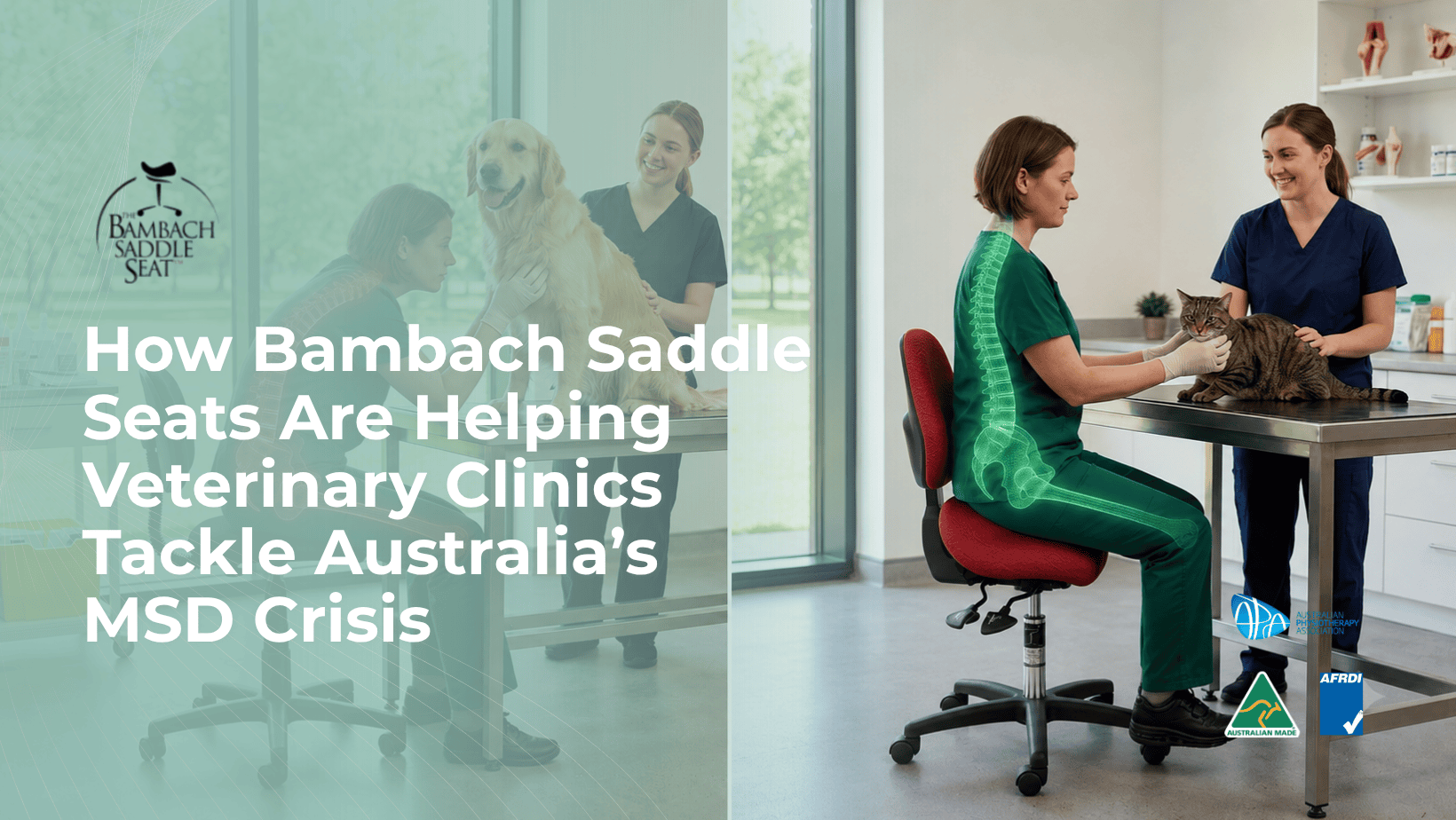
The Hidden Cost of Animal Healthcare
The veterinary profession is physically demanding and unpredictable. Consequently, it is inherently hazardous to the human body. Devoted to their patients, veterinarians and vet nurses routinely put animal health above their own.
As a result, the clinical consequence of this dedication is severe. In fact, a staggering 67% of veterinary surgeons suffer from workplace musculoskeletal disorders (MSDs).
An Industry-Wide Career Hazard
At Bambach, we recognise that back pain is not just an occupational hazard. Instead, it is an industry-wide crisis that drives passionate professionals into early retirement.
For decades, we have partnered with animal healthcare teams to engineer optimal ergonomic seating. Therefore, we do not just supply furniture. Ultimately, we provide a proven biomechanical intervention.
Today, over 300 veterinary practices across Australia rely on the Bambach Saddle Seat. As a result, clinics prevent injuries, maintain precision, and extend clinical careers. In this guide, we break down the evidence behind the veterinary MSD crisis. Furthermore, we explain why our original continuous-contour design remains the ultimate defense.
Why Do 67% of Veterinarians Suffer from Musculoskeletal Injuries?
To understand why vet clinic MSD prevention is critical, we must examine daily clinical routines. Specifically, we need to analyze the physical realities of consult rooms and surgical suites.
Standard medical stools and office chairs are designed for static, desk-based tasks. Consequently, they force hip angles into a closed 90-degree position. This posture flattens the lumbar spine into a weak, slumped “C” shape.
When a veterinarian leans forward on a flat seat to examine a nervous dog on the floor or a cat on a table, spinal strain multiplies. As a result, the already compromised spine bears massive, asymmetrical stress.
Specifically, the primary causes of veterinary MSDs include:
Static Forward Flexion: Prolonged leaning over surgical tables or microscopes without pelvic support.
Awkward Reaching: Twisting to access instruments, medications, or to restrain uncooperative patients.
Lack of Core Stability: Conventional flat stools require lower back muscles to contract constantly. Consequently, this leads to rapid muscle fatigue and spasms.
Treating animals requires mobility, balance, and fine-motor control. Therefore, when your chair fights your natural anatomy, your spine suffers.
How Does Bambach Saddle Chair Prevent Vet Clinic Back Pain?
We engineered a seating solution to set your spine free. Created by an Australian occupational therapist, Mary Gale, the Bambach Saddle Seat utilizes an unbroken contour. As a result, it replicates the natural posture achieved during horseback riding.
Here is how our original Australian veterinary saddle chair directly combats daily physical stress:
1. The 135-Degree Anatomical Advantage
By opening the hip angle to 135 degrees, the Bambach naturally abducts the legs. Consequently, it anchors the pelvis in an upright, neutral stance. This structural alignment effortlessly preserves the healthy “S” curve of the spine. Therefore, clinicians maintain correct posture even when leaning down toward floor exams.
2. Unbroken Core Stability
In contrast to cheap split-seat designs that lack uniform support, our solid-seat geometry locks the pelvis in place. Consequently, this provides an ultra-stable foundation. It frees your upper body to reach, twist, and perform delicate procedures—such as suturing or dental scaling—without straining lumbar discs.
3. Maximum Mobility and Compact Footprint
Veterinarians must move dynamically around exam tables. Fortunately, the straddle posture gives you a wide, stable base. As a result, clinicians can easily propel the chair using their legs. Additionally, the compact footprint allows you to sit extremely close to treatment tables without bulky seat pans or armrests blocking your path.
Evidence Roundup: Trusted by 300+ Australian Practices
The effectiveness of the Bambach Saddle Seat is not theoretical. In fact, it is clinically proven and extensively tested.
“We didn’t rewrite the laws of anatomy. We just built a clinical stool to respect them.”
Currently, our seats form the foundation of workplace safety in over 300 veterinary practices nationwide. From small suburban clinics to major emergency hospitals, practice managers invest in Bambach to lower absenteeism, reduce workers’ compensation claims, and boost daily efficiency.
Furthermore, the occupational hazards of veterinary medicine are well-documented in scientific literature. According to research published in the National Library of Medicine, an overwhelming 96% of surveyed veterinarians report experiencing work-related MSDs within a single year. Specifically, the lower back, shoulders, and neck are the most frequently damaged areas.
Additionally, a cross-sectional survey of specialist veterinary surgeons revealed that 93% experienced musculoskeletal symptoms directly linked to performing surgery. Furthermore, this discomfort worsened significantly during extended procedures.
You can read the full study here: Orthovetsupersite Surgical Musculoskeletal Study.
Veterinarians using our seats report immediate relief from neck, shoulder, and lower back strain. By opening the hip stance to 135 degrees, the saddle seat tilts the pelvis forward into neutral balance. Consequently, this alignment counteracts the forward-leaning postures that drive veterinary MSDs.
In addition, this upright posture prevents chest cavity compression. As a result, the diaphragm moves freely, reducing abdominal compression, increasing oxygen intake, and improving circulation during high-stress surgeries.
What is the Best Ergonomic Chair for Vets in Australia?
When upgrading clinic furniture, you need equipment built for demanding medical environments. Below is a clear comparison of what to look for when selecting the best veterinary chair in Australia:
| Essential Feature | Why It Matters for Vet Clinics | The Bambach Standard |
Medical-Grade Upholstery | Veterinary clinics are messy. Chairs must withstand fluids, fur, and harsh disinfectants. | Seamless, surgical-grade vinyl that is non-porous, durable, and easy to sanitise. |
Unbroken Pelvic Support | Split seats lack stability. Consequently, they force core muscles to overwork and fatigue. | Original, continuous saddle contour that delivers immediate pelvic locking. |
Height Customization | Vets work at varied heights, ranging from floor exams to raised surgical tables. | Multiple gas stem heights and custom foot-ring options tailored to your clinic. |
Clinical Endorsements | Ergonomic is often a buzzword. Therefore, you need scientifically validated seating. | OT-designed, AFRDI Level 6 certified, and trusted by 300+ Australian practices. |
Protect Your Team and Extend Your Career
Your practice relies entirely on the health and stamina of your team. Therefore, stop letting flat, unsupportive stools shorten your clinical career.
Instead, invest in a biomechanical solution that actively protects your spine. Explore our range of Veterinary Saddle Chairs to see how we can customize seating for your clinic.
Are you ready to eliminate workplace back pain and tackle the MSD crisis head-on? Take our two-minute seat finder quiz today, or contact our team to discuss a multi-chair setup for your practice.
How does the Bambach Saddle Seat help prevent back pain during surgery?
During surgery, vets often hold static, leaned-forward postures for hours. The Bambach locks the pelvis in an upright tilt, maintaining the spine's natural "S" curve even when leaning forward. This prevents the lower back from collapsing into a painful "C" shape, eliminating the primary cause of surgical back pain.
Is a saddle chair safe to use when dealing with unpredictable animals?
Yes. The straddle position of the Bambach provides a wide, incredibly stable base of support. Because your feet remain flat on the floor and your legs are separated, you have far greater balance and leverage to safely handle or restrain animals than you would balancing on a standard flat stool.
Can I use the Bambach for both floor exams and high treatment tables?
Absolutely. We customize each Bambach chair with the appropriate gas stem height for your specific needs. We can configure low-height stems for examining large dogs near the floor, or high-drafting stems with foot-rings for working comfortably at elevated surgical or dental tables.
How easy is it to clean the Bambach in a veterinary environment?
We know vet clinics require strict hygiene. Our chairs can be upholstered in high-quality, surgical-grade vinyl. This material is non-porous, waterproof, and designed to withstand the harsh chemical disinfectants used in animal hospitals to prevent cross-contamination.
Why shouldn't our clinic just buy cheaper split-seat saddle chairs?
Split-seat designs lack the continuous surface area required to properly stabilize the pelvis. In a fast-paced vet clinic, you need the reliable, uniform support of a continuous-contour seat so you aren't fighting to balance on two separate pads while trying to focus on a critical patient.
How long does it take for a veterinarian to adjust to a saddle seat?
Because standard chairs allow core muscles to weaken, it typically takes 1 to 2 weeks for a practitioner's body to adapt to the active sitting posture of a Bambach. We recommend transitioning gradually, starting with a few hours a day during consultations before moving on to multi-hour surgeries.
How do you work out the right seat size and setup for our clinic?
Yes, we work directly with practice managers and veterinary teams across Australia to ensure the correct seat size, height, and accessories are selected for your specific clinic environment and staff body types.