Tag: veterinary

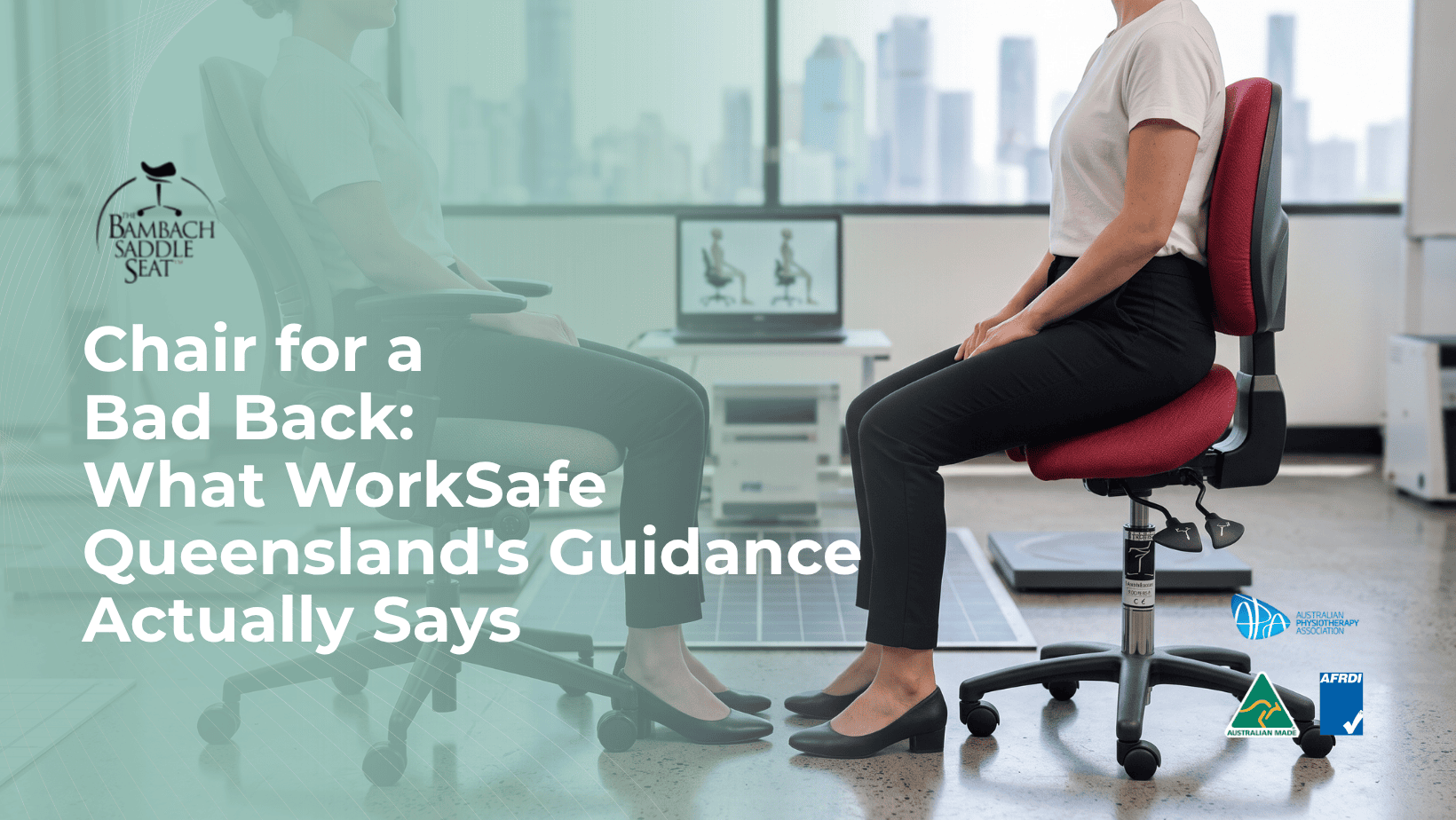
Chair for a Bad Back: What WorkSafe Queensland’s Guidance Actually Says

If you’re searching for a chair for a bad back, the most reliable place to start isn’t a product review site. It’s WorkSafe Queensland, the state government body responsible for workplace health and safety. Its guidance on selecting and adjusting an office chair sets out, in plain terms, what an ergonomic chair needs to do.

Quick answer: WorkSafe Queensland’s guidance says a comfortable hip and back position sits at a hip angle of roughly 100 to 120 degrees, achieved by tilting the backrest until the lumbar curve fits your lower back. A saddle seat works on the same underlying principle, opening the hip angle further still (around 135 degrees) through the shape of the seat itself, rather than relying on you to find and hold the right backrest position all day.

What WorkSafe Says a Good Office Chair Needs

WorkSafe Queensland’s guidance covers two things: what to look for when buying a chair, and how to adjust one once you have it.

On buying, it points to a handful of practical features. The chair should have controls you can reach and operate while seated. It needs a weight rating that actually suits you – many standard chairs are only rated to 120kg, so this is worth checking rather than assuming. A curved lumbar support that adjusts to your lower back, a backrest that tilts, a seat pan that tilts independently, enough cushioning to support your thighs and hips, and a stable five-point caster base round out the list.

On adjusting, the guidance is just as specific. Set the seat height so your elbows sit level with the desk. Add a footrest if your feet don’t reach the floor. Move the backrest up or down until the lumbar curve matches your own. Leave two to three fingers’ width of clearance behind your knee. Tilt the backrest until you reach that 100 to 120 degree hip angle. Then bring the chair close enough to the desk that your forearms stay supported without leaning or perching.

That’s a genuinely useful checklist, and it applies to any office chair, not just a particular brand.

The Hip Angle Is the Part That Does the Work

The reason WorkSafe’s guidance keeps returning to hip angle is that it’s the single adjustment with the most influence on lower back load. A flat 90-degree seat pulls the pelvis backward and flattens the natural curve of the lumbar spine. Opening that angle, whether to 100-120 degrees on a standard chair or further on a saddle seat, lets the pelvis sit in a more neutral position and takes pressure off the lower discs.

Where the two approaches differ is in how that angle is achieved and maintained.

On a standard office chair, the correct hip angle depends on you setting the backrest tilt correctly and staying in that position. It’s easy to get it right when you first sit down and drift out of it an hour later, especially once you lean forward to type or reach for something on the desk. WorkSafe’s own adjustment steps exist precisely because this setup has to be done deliberately, and redone if it slips.

A saddle seat builds the open hip angle into the shape of the seat itself, at roughly 135 degrees. There’s no backrest tilt to maintain, because the geometry of the seat holds the pelvis in that position by default. This doesn’t replace the value of WorkSafe’s checklist – a saddle seat still needs the right height, the right seat size, and a stable base – but it removes the one variable most people struggle to keep consistent through a working day.

Bambach Saddle Seat vs Standard Adjustable Chair Against WorkSafe’s Own Criteria

WorkSafe criterionStandard adjustable chairBambach Saddle seat
Hip angle100-120°, requires backrest tilt to be set and held~135°, built into seat shape, no ongoing adjustment needed
Lumbar supportAdjustable pad, needs correct height matchAchieved through pelvic position rather than a pad
Seat height adjustmentYesYes
Seat pan tiltYes, separate adjustmentNot applicable, angle is fixed in the seat design
Caster baseFive-point, standardFive-point, standard
Load ratingOften capped around 120kg, check before buyingAvailable across multiple sizes to suit different body types
Adjustment periodMinimal, mostly a one-time setup1-2 weeks while postural muscles reactivate

Neither option is universally “better.” A well-adjusted standard chair that’s actually set up correctly, and re-checked regularly, can meet WorkSafe’s guidance perfectly well. A saddle seat suits people who want that same open hip angle without needing to reset it every time they change position.

Who Tends to Benefit Most From an Open Hip Angle

People in roles involving long, static periods of close work are the ones who report the most difference. This includes dentists and dental hygienists leaning over a patient for hours, veterinary staff holding fixed positions during procedures, and office workers doing long stretches of focused screen work where posture tends to drift. Bambach builds seat configurations specifically for dental, veterinary, and general office use, since each role loads the spine differently.

How to Choose a Chair for a Bad Back in 4 Steps

  1. Start with WorkSafe’s checklist. Whatever chair you’re considering, check it against the basics: adjustable height, adjustable lumbar support, a tilting backrest, and a load rating that suits you.
  2. Work out how long you sit in one stretch. Short blocks, most compliant chairs will do. Multiple hours at a time, prioritise whichever option holds the correct hip angle without you having to think about it.
  3. Be honest about whether you actually readjust your chair. If you set it up once and never touch it again, a seat that holds the angle by design will serve you better than one that depends on ongoing upkeep.
  4. Match the chair to the work, not just the pain. Desk-based, clinical, and close detail work each place different demands on the spine.

Take the free 2-minute seat finder quiz to see which configuration suits how you actually sit.


WorkSafe Queensland recommends a hip angle of 100 to 120 degrees for most people using a standard adjustable chair. Saddle seats open this angle further, to around 135 degrees, by design rather than through backrest adjustment.

A Bambach Saddle Seat is built around the same open hip angle principle WorkSafe Queensland's guidance describes, extended further than a standard chair's adjustable range. It isn't a government-endorsed product, but the underlying ergonomic mechanism is consistent with the official guidance.

Yes, if it's not adjusted correctly. A flat, 90-degree seat position tilts the pelvis backward and flattens the lower spine's natural curve, which is exactly why WorkSafe's guidance places so much emphasis on getting the hip angle right.

Most people take 1 to 2 weeks. Because Bambach Saddle Seat holds an open hip angle by default rather than through a backrest you set once, it activates postural muscles a flat chair allows to switch off, which can feel different at first.

If you have an existing diagnosed back condition, check with your GP or physiotherapist first. For general discomfort linked to prolonged flat-seat sitting, most people can trial a hip-angle chair directly, though results vary by individual.

Bambach has designed saddle seats in Australia since 1989, based on the same open hip angle principle WorkSafe Queensland describes for standard chairs. See the full range or find your nearest distributor. Prefer to talk it through first? Call +61 2 8966 4800.
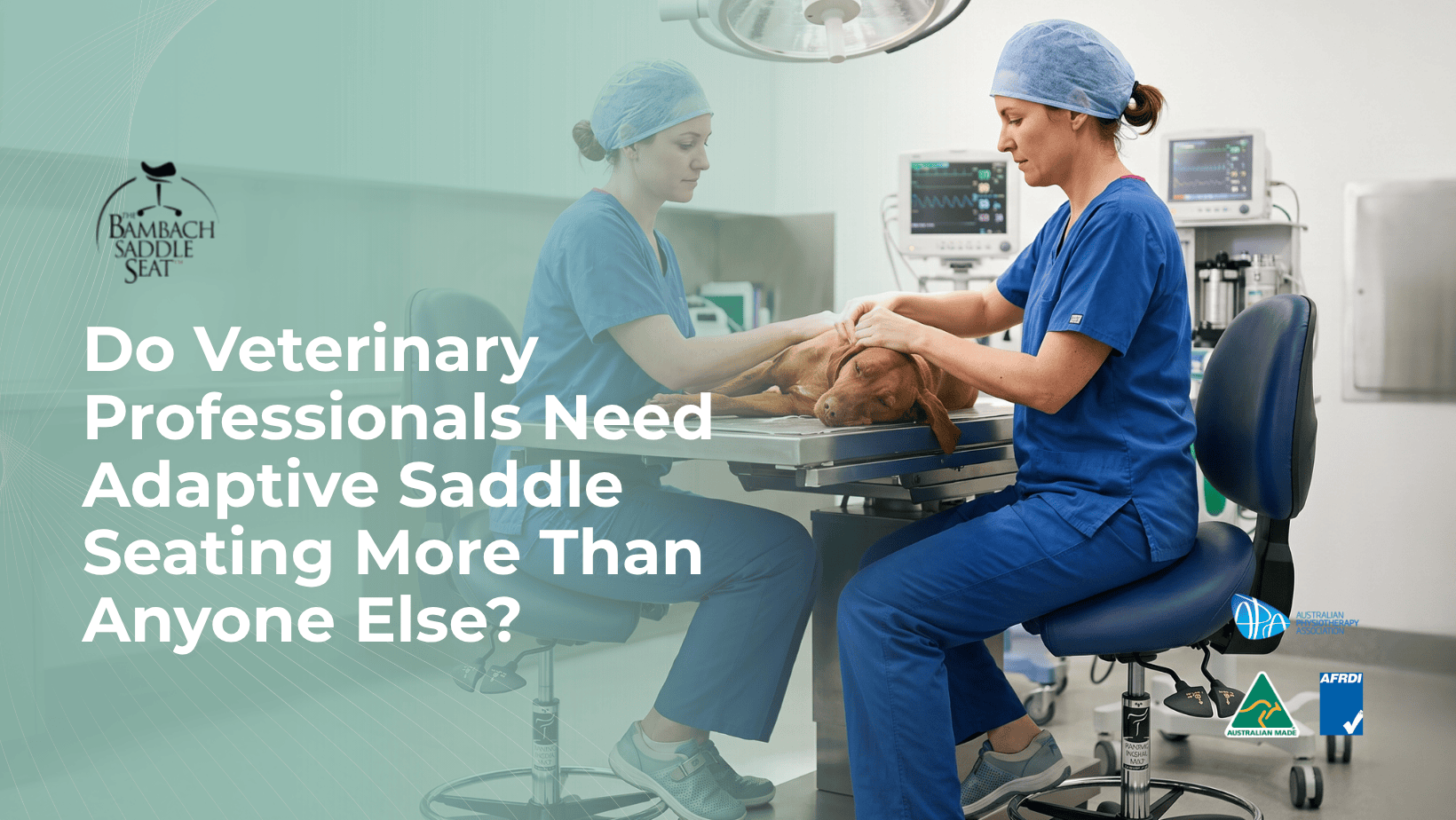
Do Veterinary Professionals Need Bambach Saddle Seating More Than Anyone Else?

Veterinary professionals face higher biomechanical strain and physical variability than almost any other healthcare discipline, including dentistry. While dentists treat humans in predictable, adjustable patient chairs, veterinary surgeons and nurses work on patients ranging from small kittens to 60 kg dogs. This creates extreme, unpredictable physical demands—forcing vets into severe spine twisting, static stooping over low examination tables, and awkward static postures during multi-hour surgeries.

According to data on workplace injuries from Safe Work Australia, work-related musculoskeletal disorders (WMSDs) represent the leading cause of chronic pain and early career retirement in clinical health environments. Furthermore, industry studies highlighted by the Australian Veterinary Association show that over 80% of practicing veterinarians report work-related back, neck, or shoulder pain during their careers.

The Bambach Saddle Seat resolves these physical demands by tilting the pelvis forward into a neutral position, opening the hip angle to 135°, and preserving the natural “S” curve of the spine without requiring constant backrest contact.

The Unique Postural Hazards of Veterinary Practice

  • Unpredictable Working Heights: Vets constantly switch between low examination tables, dental scale-and-polish stations, and elevated surgical suites, causing rapid lumbar fatigue.
  • Sterile Field Maintenance: Surgical procedures require absolute sterility. Standard manual lever adjustments force surgeons to break scrub or rely on assistance to adjust seat height.
  • Asymmetrical Upper-Body Strain: Holding animal limbs or applying downward pressure during clinical procedures creates severe rotator cuff tension when the core is unanchored on a flat stool.

Veterinary Biomechanics: Flat Stools vs. Bambach Veterinary Saddle Seating

Biomechanical FactorStandard Flat Vet StoolBambach Veterinary Saddle Chair
Lumbar CurveFlattened “C” curve (slumped lumbar kyphosis)Natural “S” curve (preserved lumbar lordosis)
Hip AngleClosed 90° angle (pinches hip flexors)Open 135° open hip stance
Surgical SterilityManual levers break sterile hand boundaryOptional foot-control gas lift for 100% hands-free height adjustment
Pelvic StabilityHips slide; torso leans forward to compensateContinuous contour locks sit bones (ischial tuberosities) in balance
Infection ControlStandard seams trap fur and clinical fluidsSeamless, medical-grade, fluid-resistant upholstery
Structural TestingBasic domestic or light office ratingAFRDI Level 6 certified for severe commercial/clinical use


Clinical Features Built for Australian Veterinary Clinics

Postural TechnologyClinical & Structural Impact
Hands-Free Foot Control

Surgical Height Adjustment

Preserves Surgical Sterility

Operate gas-lift height adjustments using a foot ring to maintain 100% surgical sterility in the operating room without breaking scrub.

AFRDI Level 6 Tested

Severe Commercial Certification

Heavy Clinical Durability

Independently tested to withstand heavy daily clinical loads, continuous movement, and sudden patient impacts without structural failure.


  1. Hands-Free Height Adjustment: Fitted with an optional foot-control mechanism, allowing veterinary surgeons to adjust chair height smoothly using their foot, preserving complete hand sterility during surgery.
  2. Continuous Pelvic Support: The unbroken, hand-upholstered saddle contour provides a solid foundation for precision surgical work, preventing the lateral shifting common in split-seat designs.
  3. Heavy-Duty Commercial Certification: Tested independently to AFRDI Level 6 (Severe Commercial Use), ensuring the frame withstands constant movement, heavy clinical daily wear, and dynamic shifts in weight.

Explore the complete Bambach Veterinary Category Range or read how Australian practitioners manage clinical posture in our Australian Case Studies Archive.


The foot-control system places a circular adjustment ring near the base of the chair. The surgeon depresses the ring with their foot to raise or lower the seat pneumatically. This allows seamless height adjustments during surgery without using their hands, maintaining strict sterile field protocols.

Precision surgical and dental procedures on animals require absolute lower-body stability. A continuous-contour seat pan provides a single, unbroken surface that locks the sit bones evenly in place. Split-seat designs use two independent moving pads that can shift under dynamic weight changes, reducing lateral stability when leaning over a patient.

Standard flat chairs hold the hips at 90 degrees, forcing the pelvis to tilt backward and flattening the lower back into an unhealthy "C" curve. An open 135-degree hip angle rotates the pelvis forward, naturally restoring the spine’s natural "S" curve. This takes pressure off spinal discs and reduces lower back strain during long surgeries.

Yes. Bambach veterinary models are upholstered in seamless, medical-grade vinyl engineered specifically for infection control. The material is fluid-resistant, easy to wipe down, and resistant to hospital-grade disinfectants, preventing animal fur, blood, and fluids from collecting in open seams.

AFRDI Level 6 is Australia's highest independent structural certification standard for severe commercial seating. Administered by the Australasian Furnishing Research and Development Institute, it verifies that the chair can withstand continuous, heavy-duty commercial wear, dynamic loads, and intense daily use without structural failure.

Yes. Veterinary nurses spend significant time leaning over exam tables, performing scale-and-polish procedures, taking X-rays, and running lab tests. A saddle stool keeps their spine aligned and mobile, allowing them to move quickly around the treatment room without straining their back and neck.

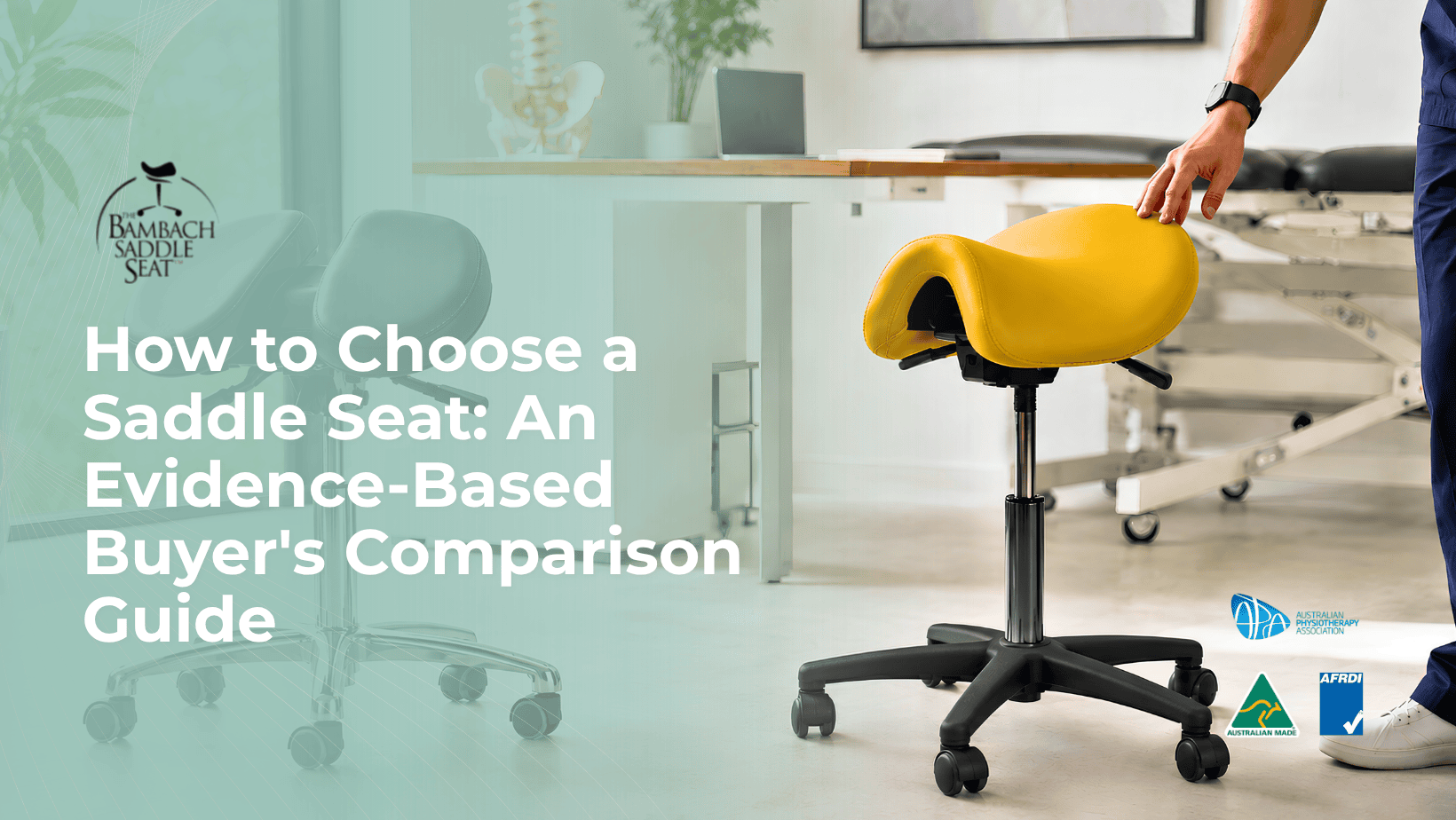
How to Choose a Saddle Seat: An Evidence-Based Buyer’s Comparison Guide

Saddle Seats are no longer a niche clinical product. Search for one today and you’ll find dozens of options — split-seat designs, single-contour designs, budget imports, and premium clinically certified models — all claiming to fix your posture. They are not interchangeable, and the differences between them have real consequences for your spine, your comfort, and how long the chair lasts.

A genuine saddle seat opens the hip angle to roughly 135 degrees, tilting the pelvis forward and letting the lumbar spine hold its natural “S” curve without a backrest. Beyond that shared principle, saddle seats diverge sharply in seat geometry (continuous-contour vs. split-seat), sizing options, certification, and country of design and manufacture — and those differences are what actually determine whether a chair helps your posture or just looks like it should.

This guide breaks down exactly what to evaluate before you buy, using the same criteria a physiotherapist, occupational therapist, or workplace health and safety (WHS) manager would use to assess clinical seating.

Why Not All Saddle Seats Are Built the Same

The term “saddle seat” describes a category, not a single design. Two chairs can both be called saddle seats and behave completely differently under your body.

The most consequential design fork in the category is seat geometry: whether the seat pan is a single, unbroken contour or is split into two separate pads.

Continuous-Contour Seats vs. Split-Seat Designs

FeatureContinuous-Contour SeatSplit-Seat Design
Pelvic stabilityLocks the pelvis with one uniform, uninterrupted surfaceTwo separate pads can shift independently, reducing lateral stability
Weight distributionEven distribution across both sit bones (ischial tuberosities)Can concentrate pressure unevenly if pads aren’t perfectly aligned to the user
Mobility & rotationFree rotation and side-to-side movement across one surfaceMovement can be restricted by the gap between pads
Best suited forClinical, surgical, dental, and precision tasks requiring a stable baseUsers who specifically want a divided seat for personal comfort reasons

Neither geometry is inherently “wrong” — but they solve different problems, and a chair built for one purpose won’t necessarily suit another. If your priority is a rock-stable base for precision clinical work (dentistry, surgery, veterinary procedures, fine motor tasks), a continuous, unbroken saddle contour designed specifically for that purpose is the evidence-backed choice.

Read also : https://www.bambach.com.au/about-us/case-studies/

5 Criteria for Evaluating Any Saddle Seat

Cut through the marketing claims and assess a saddle seat against these five factors. This is the same framework a workplace health and safety manager or referring clinician would use.

1. Country of Design vs. Country of Manufacture

Ask two separate questions: who designed this chair, and who makes it? Many saddle chairs sold in Australia are designed overseas and imported by a local distributor. That’s not automatically a problem — but it does mean the clinical credibility behind the design, the supply chain for parts and warranty claims, and the speed of local support can vary significantly. A chair designed and manufactured in Australia by the original clinical inventor offers a shorter, more accountable chain between the person who understood the biomechanical problem and the product in your workplace.

2. Clinical Origin and Endorsement

Look for a genuine clinical originator — ideally a named occupational therapist, physiotherapist, or other allied health professional credited with the design — rather than a general “ergonomic” claim. Also check for third-party endorsement from a recognised professional body (in Australia, the Australian Physiotherapy Association is the relevant benchmark), not just self-description marketing language. “Ergonomic” is an unregulated term in Australia; anyone can put it on a product listing.

3. Independent Structural Certification

For commercial or clinical environments, structural certification matters more than most buyers realise. In Australia and New Zealand, AFRDI Level 6 is the relevant independent testing standard for severe commercial use — it verifies the chair can withstand extreme daily loads, sudden movement, and continuous heavy use in clinics and offices. If a chair doesn’t disclose an independent certification, ask for it directly before buying for a commercial or multi-user setting.

4. Sizing and Custom Fit

Pelvic width varies significantly between individuals, and a single “one-size-fits-all” saddle seat will not properly support every body. Multiple seat sizes, adjustable gas-lift heights, and stem height options are what allow a saddle chair to genuinely fit an individual rather than approximate a fit. A wide range of sizing options is a strong signal that the manufacturer understands the anatomy they’re designing for.

5. Warranty, Stock Availability, and Local Support

A saddle chair is a multi-year investment, not a disposable purchase. Check the warranty length (five years or more is the benchmark for commercial-grade seating), whether the model you want is actually in stock and ready to ship, and whether local fitting or adjustment support is available if the chair doesn’t feel right initially. A long warranty paired with a genuine money-back trial period signals a manufacturer confident in their product’s fit.

Comparison Checklist: What to Ask Before You Buy

Use this as a direct checklist when comparing saddle chair options:

  • Is the seat a continuous contour, or a split/divided design?
  • Where was this chair designed, and by whom?
  • Where is it manufactured?
  • Is it endorsed by a recognised clinical body (e.g. the Australian Physiotherapy Association)?
  • Is it independently certified for commercial use (e.g. AFRDI Level 6)?
  • How many seat sizes are available, and how is the right size determined?
  • What is the warranty length, and does it cover the frame, gas lift, and upholstery?
  • Is the model in stock, or is it on backorder/preorder?
  • Is there a money-back trial period if the fit isn’t right?
  • Is the upholstery available in surgical-grade or infection-control vinyl if needed for a clinical setting?

The Original, Australian-Designed Saddle Seat

The Bambach Saddle Seat was designed in 1989 by Mary Gale, an Australian occupational therapist, after observing that patients who could not sit upright unsupported on a standard chair could sit balanced and symmetrical on horseback. That clinical observation became the original contoured saddle seat — a single, unbroken contour engineered to open the hip angle to 135 degrees and let the spine self-support in its natural curve.

Nearly 36 years on, Bambach remains designed, manufactured, and hand-upholstered in Marrickville, Sydney — not imported and repackaged. It is endorsed by the Australian Physiotherapy Association, independently tested to AFRDI Level 6 for severe commercial use, and available in multiple seat sizes and stem heights to fit individual bodies rather than approximate them. Every chair carries a five-year warranty and a 30-day money-back trial.

If you’re comparing saddle chairs and want to see how the original, clinically designed model measures up against the checklist above, explore the Bambach range or take our two-minute quiz to find the right seat, size, and configuration for your profession and body.

Ready to feel the difference a genuinely custom-fitted saddle seat makes? 

Book a fitting or trial with a Bambach specialist — or call +61 2 8966 4800 to talk through which model suits your workspace.


AFRDI Level 6 is a genuine, independent structural testing standard administered by the Australasian Furnishing Research and Development Institute. It verifies a chair can withstand severe, continuous commercial use without structural failure. Unlike the word "ergonomic" — which is unregulated in Australia and can be used by any manufacturer — AFRDI certification is independently verified and should be disclosed by any manufacturer marketing a chair for commercial or clinical use.

It can. A chair designed and manufactured locally by its original clinical inventor typically means a shorter supply chain for parts, warranty support, and stock availability, plus more direct accountability for the clinical claims behind the design. An imported chair isn't automatically inferior, but it's worth confirming local warranty support, stock lead times, and who is actually responsible for the clinical claims being made.

Because pelvic width varies significantly between individuals, a single "one size fits all" saddle seat cannot properly support every body. Look for a manufacturer offering multiple distinct seat sizes plus adjustable stem heights, so the chair is fitted to your specific anatomy rather than approximated.

Check our products HERE

No product or piece of furniture is "AHPRA approved." AHPRA (the Australian Health Practitioner Regulation Agency) registers and regulates individual healthcare practitioners — such as physiotherapists and dentists — not commercial furniture or medical devices. Genuine clinical credibility for a saddle chair comes from endorsement by a recognised professional body, such as the Australian Physiotherapy Association, and independent structural certification such as AFRDI Level 6.

Most users report a one- to two-week adjustment period. Because saddle seating actively engages core and postural muscles that are typically dormant on a standard flat chair, some mild muscle awareness during the first fortnight is normal and expected as your body adapts to active sitting.

Five years is the benchmark for a commercial-grade saddle chair, covering the frame, gas lift, and upholstery. Anything significantly shorter may indicate the manufacturer doesn't expect the chair to hold up under sustained daily commercial use.

A genuine money-back trial period — typically around 30 days — is a strong signal of manufacturer confidence. Because fit and adjustment period both matter for saddle seating, a trial period lets you assess whether a specific model and size genuinely suits your body and workspace before you're locked into the purchase.

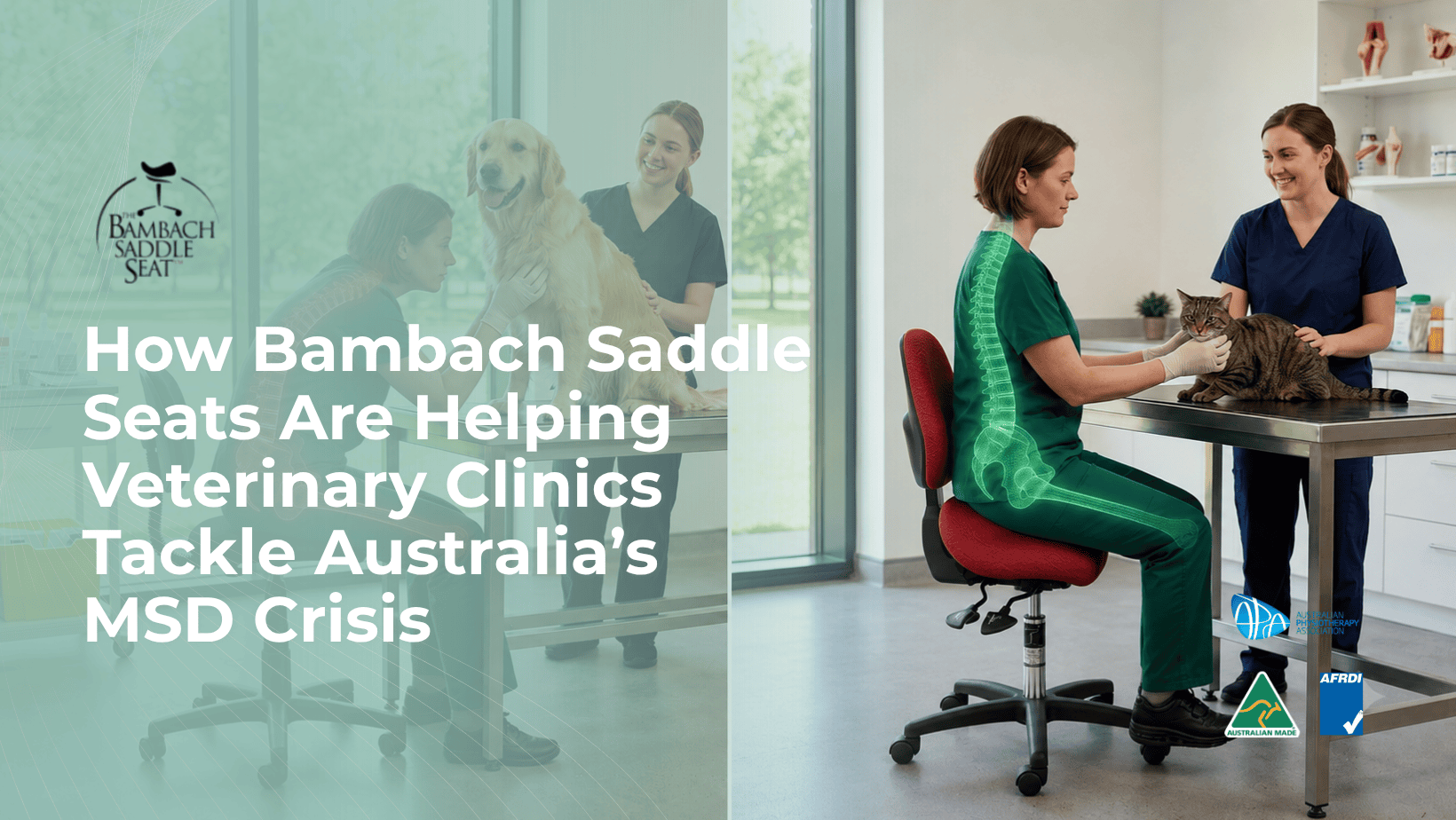
How Bambach Saddle Seats Are Helping Veterinary Clinics Tackle Australia’s MSD Crisis

The veterinary profession is physically demanding, unpredictable, and inherently hazardous to the human body. Devoted to the care of their furry, feathered, and scaly patients, veterinarians and vet nurses routinely put the health of animals above their own. The clinical consequence of this dedication is severe: a staggering 67% of veterinary surgeons suffer from workplace musculoskeletal disorders (MSDs).

At Bambach, we recognize that this is not just an occupational hazard; it is an industry-wide crisis that drives passionate professionals into early retirement.

For decades, we have partnered with animal healthcare professionals to engineer the optimal ergonomic seating for vet clinics. We don’t just supply furniture; we provide a biomechanical intervention. Today, over 300 veterinary practices across Australia rely on the Bambach Saddle Seat to prevent injuries, maintain clinical precision, and extend careers. In this guide, we break down the evidence behind the veterinary MSD crisis and explain how our original continuous-contour design remains the ultimate defense.

Why Do 67% of Veterinarians Suffer from Musculoskeletal Injuries? 

To understand why vet clinic MSD prevention is so critical, we must examine the physical realities of the consulting room and the surgical theater.

Standard medical stools and office chairs are designed for static, forward-facing desk work. They force the user’s hips into a closed, 90-degree angle, which flattens the lumbar spine into a weak “C” shape. When a veterinarian sits in a standard chair and leans forward to examine a nervous dog on the floor or a cat on a treatment table, their already compromised spine bears massive, asymmetrical strain.

The primary causes of veterinary MSDs include:

  • Static Forward Flexion: Prolonged leaning over surgical tables or microscopes without pelvic support.
  • Awkward Reaching: Twisting to access instruments, medications, or to restrain uncooperative patients.
  • Lack of Core Stability: Conventional flat stools require the lower back muscles to work constantly just to keep the body upright, leading to rapid muscular fatigue and spasm.

Treating patients requires mobility, stability, and precise hand-eye coordination. When your chair fights your anatomy, your spine pays the price.

How Does Bambach Saddle Chair Prevent Vet Clinic Back Pain?

We engineered a chair to set your spine free. Created by an Australian occupational therapist, the Bambach Saddle Seat utilizes a continuous, unbroken contour that mimics the only posture where the human spine is perfectly balanced: horseback riding.

Here is how our original veterinary saddle chair Australia design directly combats the physiological stressors of veterinary work:

1. The 135-Degree Anatomical Advantage

By opening the hip angle to 135 degrees, the Bambach naturally abducts the legs and anchors the pelvis in an upright, neutral position. This structural alignment effortlessly preserves the healthy “S” curve of the spine, even when you lean forward to examine a patient on the floor.

2. Unbroken Core Stability

Unlike cheap split-seat designs that fail to provide uniform support, our solid-seat geometry locks the pelvis in place. This provides an ultra-stable foundation, freeing your upper body to reach, twist, and perform delicate procedures—such as suturing or dental scaling—without straining your lumbar discs.

3. Maximum Mobility and Footprint

Veterinarians need to move dynamically around exam tables. The straddle posture gives you a wide, stable base, allowing you to use your legs to easily propel the chair around the clinic. The compact design ensures you can get as close to the treatment table as possible without restrictive armrests or bulky seat pans getting in the way.

Evidence Roundup: Trusted by 300+ Australian Practices

The effectiveness of the Bambach Saddle Seat is not theoretical; it is clinically proven and industry-tested.

“We didn’t rewrite the laws of anatomy. We just built a clinical stool to respect them.”

Currently, our seats are the foundation of occupational health in over 300 veterinary practices nationwide. From small suburban clinics to major emergency animal hospitals, practice managers are investing in Bambach to reduce staff absenteeism, lower worker’s compensation claims, and improve daily clinical efficiency.

The occupational hazard of veterinary medicine is a well-documented crisis. According to studies published in the National Library of Medicine, an overwhelming 96% of surveyed veterinarians report experiencing work-related musculoskeletal disorders (MSDs) within a one-year period, with the lower back, shoulders, and neck being the most frequently affected areas. Furthermore, a cross-sectional survey of veterinary surgeons found that 93% experienced musculoskeletal symptoms directly associated with performing surgery, with discomfort significantly worsening during prolonged procedures.

Read also :  https://www.orthovetsupersite.com/abstract/musculoskeletal-symptoms-reported-specialist-veterinary-surgeons 

Veterinarians utilizing our seats report immediate reductions in this neck, shoulder, and lower back fatigue. By opening the hip angle to 135 degrees, the saddle seat naturally tilts the pelvis forward to maintain the spine’s healthy curvature, effectively counteracting the static, forward-leaning postures that drive veterinary MSDs. Furthermore, this upright, open hip posture prevents the chest cavity from compressing. This allows the diaphragm to move freely, reducing abdominal compression, increasing oxygen intake, and promoting healthy blood circulation during long, high-stress surgical procedures.

What is the Best Ergonomic Chair for Vets in Australia? 


If you are upgrading your clinic’s furniture, you need equipment that withstands the rigors of veterinary medicine. Here is exactly what you should look for when sourcing the best chair for vets Australia has to offer:

Essential FeatureWhy It Matters for Vet ClinicsThe Bambach Standard
Medical-Grade UpholsteryClinics are messy. Chairs must withstand bodily fluids, fur, and harsh chemical disinfectants.We offer premium, surgical-grade vinyl that is non-porous, highly durable, and easy to sanitize.
Unbroken Pelvic SupportSplit seats lack surface stability, forcing the core to work harder and causing fatigue.Our continuous, unbroken saddle contour provides immediate, effortless pelvic locking.
Height CustomizationVets work at various heights, from low floor exams to high surgical tables.We provide multiple gas stem heights and foot-ring options tailored to your specific workstation.
Clinical EndorsementsErgonomic is a marketing term; you need scientifically backed medical furniture.Designed by an OT, AFRDI Level 6 tested, and trusted by over 300 Australian vet practices.


Protect Your Team, Extend Your Career

Your practice relies on the health and stamina of your veterinarians and nurses. Stop letting flat, unsupportive stools dictate the length and quality of your career.

It is time to invest in a biomechanical solution that actively protects your spine. Explore our dedicated range of Veterinary Saddle Chairs or dive deeper into the science of Veterinary Ergonomic Seating to see how we can customize a solution for your entire clinic.

Ready to eliminate workplace back pain and tackle the MSD crisis head-on? 

Contact Us today for a personalized fitting assessment for your practice.


During surgery, vets often hold static, leaned-forward postures for hours. The Bambach locks the pelvis in an upright tilt, maintaining the spine's natural "S" curve even when leaning forward. This prevents the lower back from collapsing into a painful "C" shape, eliminating the primary cause of surgical back pain.

Yes. The straddle position of the Bambach provides a wide, incredibly stable base of support. Because your feet remain flat on the floor and your legs are separated, you have far greater balance and leverage to safely handle or restrain animals than you would balancing on a standard flat stool.

Absolutely. We customize each Bambach chair with the appropriate gas stem height for your specific needs. We can configure low-height stems for examining large dogs near the floor, or high-drafting stems with foot-rings for working comfortably at elevated surgical or dental tables.

We know vet clinics require strict hygiene. Our chairs can be upholstered in high-quality, surgical-grade vinyl. This material is non-porous, waterproof, and designed to withstand the harsh chemical disinfectants used in animal hospitals to prevent cross-contamination.

Split-seat designs lack the continuous surface area required to properly stabilize the pelvis. In a fast-paced vet clinic, you need the reliable, uniform support of a continuous-contour seat so you aren't fighting to balance on two separate pads while trying to focus on a critical patient.

Because standard chairs allow core muscles to weaken, it typically takes 1 to 2 weeks for a practitioner's body to adapt to the active sitting posture of a Bambach. We recommend transitioning gradually, starting with a few hours a day during consultations before moving on to multi-hour surgeries.

Yes, we work directly with practice managers and veterinary teams across Australia to ensure the correct seat size, height, and accessories are selected for your specific clinic environment and staff body types.