
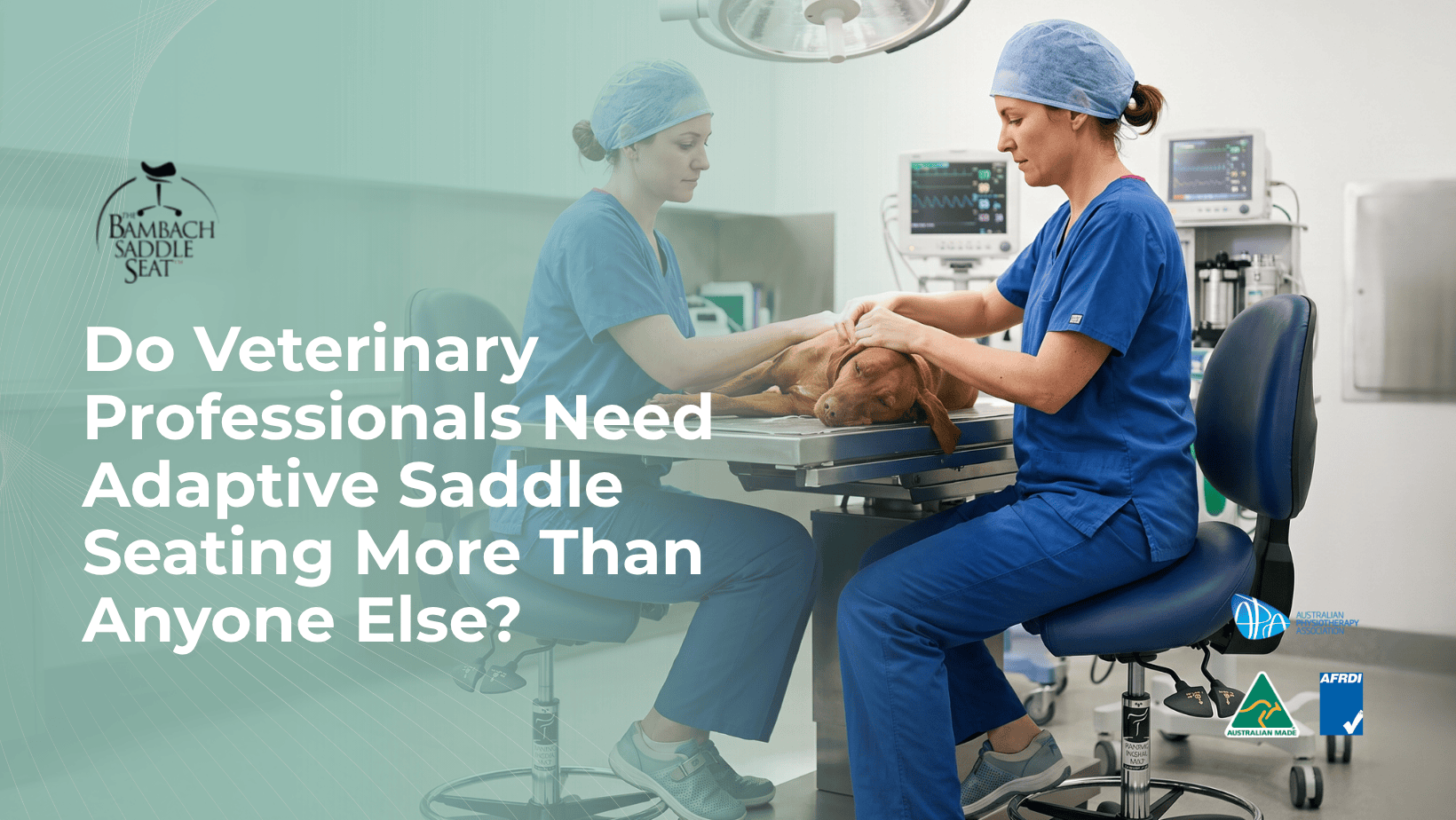
Veterinary professionals face higher biomechanical strain and physical variability than almost any other healthcare discipline, including dentistry. While dentists treat humans in predictable, adjustable patient chairs, veterinary surgeons and nurses work on patients ranging from small kittens to 60 kg dogs. This creates extreme, unpredictable physical demands—forcing vets into severe spine twisting, static stooping over low examination tables, and awkward static postures during multi-hour surgeries.
According to data on workplace injuries from Safe Work Australia, work-related musculoskeletal disorders (WMSDs) represent the leading cause of chronic pain and early career retirement in clinical health environments. Furthermore, industry studies highlighted by the Australian Veterinary Association show that over 80% of practicing veterinarians report work-related back, neck, or shoulder pain during their careers.
The Bambach Saddle Seat resolves these physical demands by tilting the pelvis forward into a neutral position, opening the hip angle to 135°, and preserving the natural “S” curve of the spine without requiring constant backrest contact.
The Unique Postural Hazards of Veterinary Practice
- Unpredictable Working Heights: Vets constantly switch between low examination tables, dental scale-and-polish stations, and elevated surgical suites, causing rapid lumbar fatigue.
- Sterile Field Maintenance: Surgical procedures require absolute sterility. Standard manual lever adjustments force surgeons to break scrub or rely on assistance to adjust seat height.
- Asymmetrical Upper-Body Strain: Holding animal limbs or applying downward pressure during clinical procedures creates severe rotator cuff tension when the core is unanchored on a flat stool.
Veterinary Biomechanics: Flat Stools vs. Bambach Veterinary Saddle Seating
| Biomechanical Factor | Standard Flat Vet Stool | Bambach Veterinary Saddle Chair |
| Lumbar Curve | Flattened “C” curve (slumped lumbar kyphosis) | Natural “S” curve (preserved lumbar lordosis) |
| Hip Angle | Closed 90° angle (pinches hip flexors) | Open 135° open hip stance |
| Surgical Sterility | Manual levers break sterile hand boundary | Optional foot-control gas lift for 100% hands-free height adjustment |
| Pelvic Stability | Hips slide; torso leans forward to compensate | Continuous contour locks sit bones (ischial tuberosities) in balance |
| Infection Control | Standard seams trap fur and clinical fluids | Seamless, medical-grade, fluid-resistant upholstery |
| Structural Testing | Basic domestic or light office rating | AFRDI Level 6 certified for severe commercial/clinical use |
Clinical Features Built for Australian Veterinary Clinics
| Postural Technology | Clinical & Structural Impact |
| Hands-Free Foot Control Surgical Height Adjustment | Preserves Surgical Sterility Operate gas-lift height adjustments using a foot ring to maintain 100% surgical sterility in the operating room without breaking scrub. |
| AFRDI Level 6 Tested Severe Commercial Certification | Heavy Clinical Durability Independently tested to withstand heavy daily clinical loads, continuous movement, and sudden patient impacts without structural failure. |
- Hands-Free Height Adjustment: Fitted with an optional foot-control mechanism, allowing veterinary surgeons to adjust chair height smoothly using their foot, preserving complete hand sterility during surgery.
- Continuous Pelvic Support: The unbroken, hand-upholstered saddle contour provides a solid foundation for precision surgical work, preventing the lateral shifting common in split-seat designs.
- Heavy-Duty Commercial Certification: Tested independently to AFRDI Level 6 (Severe Commercial Use), ensuring the frame withstands constant movement, heavy clinical daily wear, and dynamic shifts in weight.
Explore the complete Bambach Veterinary Category Range or read how Australian practitioners manage clinical posture in our Australian Case Studies Archive.
How does foot-control height adjustment work during veterinary surgery?
The foot-control system places a circular adjustment ring near the base of the chair. The surgeon depresses the ring with their foot to raise or lower the seat pneumatically. This allows seamless height adjustments during surgery without using their hands, maintaining strict sterile field protocols.
Why is a continuous-contour saddle seat preferred over a split-seat for vet work?
Precision surgical and dental procedures on animals require absolute lower-body stability. A continuous-contour seat pan provides a single, unbroken surface that locks the sit bones evenly in place. Split-seat designs use two independent moving pads that can shift under dynamic weight changes, reducing lateral stability when leaning over a patient.
What is the benefit of an open 135-degree hip angle for veterinarians?
Standard flat chairs hold the hips at 90 degrees, forcing the pelvis to tilt backward and flattening the lower back into an unhealthy "C" curve. An open 135-degree hip angle rotates the pelvis forward, naturally restoring the spine’s natural "S" curve. This takes pressure off spinal discs and reduces lower back strain during long surgeries.
Are Bambach veterinary saddle chairs resistant to animal fur and clinical fluids?
Yes. Bambach veterinary models are upholstered in seamless, medical-grade vinyl engineered specifically for infection control. The material is fluid-resistant, easy to wipe down, and resistant to hospital-grade disinfectants, preventing animal fur, blood, and fluids from collecting in open seams.
What does AFRDI Level 6 certification mean for a veterinary practice?
AFRDI Level 6 is Australia's highest independent structural certification standard for severe commercial seating. Administered by the Australasian Furnishing Research and Development Institute, it verifies that the chair can withstand continuous, heavy-duty commercial wear, dynamic loads, and intense daily use without structural failure.
Can veterinary nurses and technicians benefit from using a saddle stool?
Yes. Veterinary nurses spend significant time leaning over exam tables, performing scale-and-polish procedures, taking X-rays, and running lab tests. A saddle stool keeps their spine aligned and mobile, allowing them to move quickly around the treatment room without straining their back and neck.