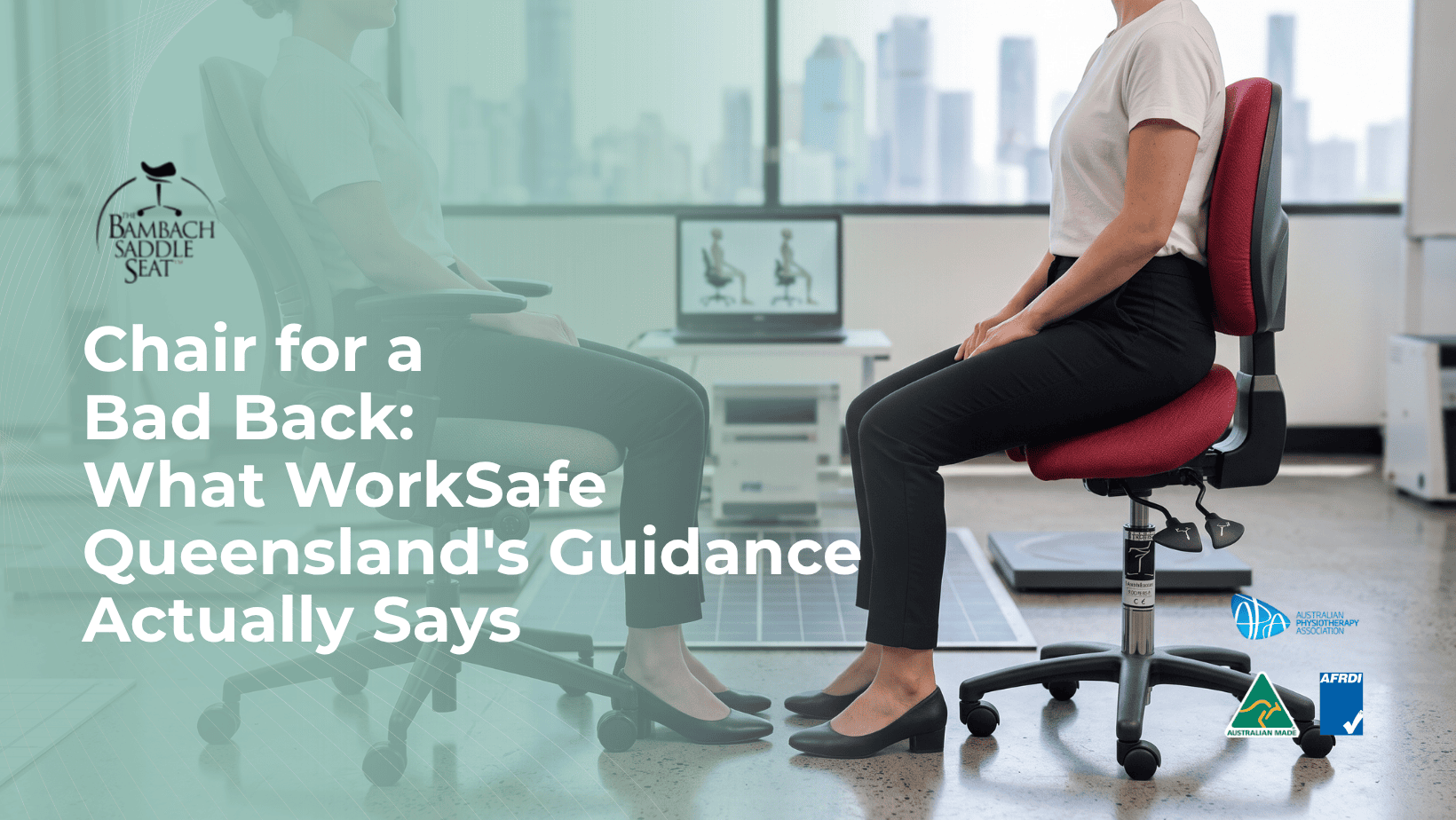
Chair for a Bad Back: What WorkSafe Queensland’s Guidance Actually Says
If you’re searching for a chair for a bad back, the most reliable place to start isn’t a product review site. It’s WorkSafe Queensland, the state government body responsible for workplace health and safety. Its guidance on selecting and adjusting an office chair sets out, in plain terms, what an ergonomic chair needs to do.
Quick answer: WorkSafe Queensland’s guidance says a comfortable hip and back position sits at a hip angle of roughly 100 to 120 degrees, achieved by tilting the backrest until the lumbar curve fits your lower back. A saddle seat works on the same underlying principle, opening the hip angle further still (around 135 degrees) through the shape of the seat itself, rather than relying on you to find and hold the right backrest position all day.
What WorkSafe Says a Good Office Chair Needs
WorkSafe Queensland’s guidance covers two things: what to look for when buying a chair, and how to adjust one once you have it.
On buying, it points to a handful of practical features. The chair should have controls you can reach and operate while seated. It needs a weight rating that actually suits you – many standard chairs are only rated to 120kg, so this is worth checking rather than assuming. A curved lumbar support that adjusts to your lower back, a backrest that tilts, a seat pan that tilts independently, enough cushioning to support your thighs and hips, and a stable five-point caster base round out the list.
On adjusting, the guidance is just as specific. Set the seat height so your elbows sit level with the desk. Add a footrest if your feet don’t reach the floor. Move the backrest up or down until the lumbar curve matches your own. Leave two to three fingers’ width of clearance behind your knee. Tilt the backrest until you reach that 100 to 120 degree hip angle. Then bring the chair close enough to the desk that your forearms stay supported without leaning or perching.
That’s a genuinely useful checklist, and it applies to any office chair, not just a particular brand.
The Hip Angle Is the Part That Does the Work
The reason WorkSafe’s guidance keeps returning to hip angle is that it’s the single adjustment with the most influence on lower back load. A flat 90-degree seat pulls the pelvis backward and flattens the natural curve of the lumbar spine. Opening that angle, whether to 100-120 degrees on a standard chair or further on a saddle seat, lets the pelvis sit in a more neutral position and takes pressure off the lower discs.
Where the two approaches differ is in how that angle is achieved and maintained.
On a standard office chair, the correct hip angle depends on you setting the backrest tilt correctly and staying in that position. It’s easy to get it right when you first sit down and drift out of it an hour later, especially once you lean forward to type or reach for something on the desk. WorkSafe’s own adjustment steps exist precisely because this setup has to be done deliberately, and redone if it slips.
A saddle seat builds the open hip angle into the shape of the seat itself, at roughly 135 degrees. There’s no backrest tilt to maintain, because the geometry of the seat holds the pelvis in that position by default. This doesn’t replace the value of WorkSafe’s checklist – a saddle seat still needs the right height, the right seat size, and a stable base – but it removes the one variable most people struggle to keep consistent through a working day.
Bambach Saddle Seat vs Standard Adjustable Chair Against WorkSafe’s Own Criteria
| WorkSafe criterion | Standard adjustable chair | Bambach Saddle seat |
| Hip angle | 100-120°, requires backrest tilt to be set and held | ~135°, built into seat shape, no ongoing adjustment needed |
| Lumbar support | Adjustable pad, needs correct height match | Achieved through pelvic position rather than a pad |
| Seat height adjustment | Yes | Yes |
| Seat pan tilt | Yes, separate adjustment | Not applicable, angle is fixed in the seat design |
| Caster base | Five-point, standard | Five-point, standard |
| Load rating | Often capped around 120kg, check before buying | Available across multiple sizes to suit different body types |
| Adjustment period | Minimal, mostly a one-time setup | 1-2 weeks while postural muscles reactivate |
Neither option is universally “better.” A well-adjusted standard chair that’s actually set up correctly, and re-checked regularly, can meet WorkSafe’s guidance perfectly well. A saddle seat suits people who want that same open hip angle without needing to reset it every time they change position.
Who Tends to Benefit Most From an Open Hip Angle
People in roles involving long, static periods of close work are the ones who report the most difference. This includes dentists and dental hygienists leaning over a patient for hours, veterinary staff holding fixed positions during procedures, and office workers doing long stretches of focused screen work where posture tends to drift. Bambach builds seat configurations specifically for dental, veterinary, and general office use, since each role loads the spine differently.
How to Choose a Chair for a Bad Back in 4 Steps
- Start with WorkSafe’s checklist. Whatever chair you’re considering, check it against the basics: adjustable height, adjustable lumbar support, a tilting backrest, and a load rating that suits you.
- Work out how long you sit in one stretch. Short blocks, most compliant chairs will do. Multiple hours at a time, prioritise whichever option holds the correct hip angle without you having to think about it.
- Be honest about whether you actually readjust your chair. If you set it up once and never touch it again, a seat that holds the angle by design will serve you better than one that depends on ongoing upkeep.
- Match the chair to the work, not just the pain. Desk-based, clinical, and close detail work each place different demands on the spine.
Take the free 2-minute seat finder quiz to see which configuration suits how you actually sit.
What hip angle is best for a bad back?
WorkSafe Queensland recommends a hip angle of 100 to 120 degrees for most people using a standard adjustable chair. Saddle seats open this angle further, to around 135 degrees, by design rather than through backrest adjustment.
Is a saddle chair compliant with Australian workplace ergonomic guidelines?
A Bambach Saddle Seat is built around the same open hip angle principle WorkSafe Queensland's guidance describes, extended further than a standard chair's adjustable range. It isn't a government-endorsed product, but the underlying ergonomic mechanism is consistent with the official guidance.
Can a normal office chair actually cause lower back pain?
Yes, if it's not adjusted correctly. A flat, 90-degree seat position tilts the pelvis backward and flattens the lower spine's natural curve, which is exactly why WorkSafe's guidance places so much emphasis on getting the hip angle right.
How long does it take to adjust to a Bambach Saddle Seat after using a standard chair?
Most people take 1 to 2 weeks. Because Bambach Saddle Seat holds an open hip angle by default rather than through a backrest you set once, it activates postural muscles a flat chair allows to switch off, which can feel different at first.
Do I need medical advice before switching chair types for back pain?
If you have an existing diagnosed back condition, check with your GP or physiotherapist first. For general discomfort linked to prolonged flat-seat sitting, most people can trial a hip-angle chair directly, though results vary by individual.
Bambach has designed saddle seats in Australia since 1989, based on the same open hip angle principle WorkSafe Queensland describes for standard chairs. See the full range or find your nearest distributor. Prefer to talk it through first? Call +61 2 8966 4800.