How Bambach Saddle Seats Solve the Dental Musculoskeletal Crisis
The dental operatory is an ergonomic hazard zone. Day after day, dentists, dental hygienists, and assistants operate in confined spaces, holding precise, static, and asymmetrical postures for hours at a time. The physical toll of this profession is not just uncomfortable—it is a leading cause of premature career retirement.
The Bambach Saddle Seat was engineered specifically to solve the biomechanical failures of traditional operatory seating, restoring natural anatomy while you treat patients.
The Hidden Epidemic in Dentistry: What the Data Shows
Musculoskeletal disorders (MSDs) among dental professionals are among the highest reported across all healthcare fields. When forced to sit on standard flat stools while leaning over a patient’s oral cavity, the spine’s natural alignment collapses.
| Stage | Anatomical Trigger | Biomechanical Impact | Clinical Outcome |
| 1. Hip Posture | Standard 90° Seating Angle | Tightens hamstring tendons, forcing pelvic distortion | Posterior Pelvic Tilt (Pelvis rotates backward) |
| 2. Spinal Alignment | Loss of Lumbar Curve | Lumbar spine flattens from natural $S$-shape into a $C$-shape | Elevated intervertebral disc pressure & compression |
| 3. Upper Body Strain | Forward Head Projection | Shifts center of gravity forward over the operatory field | Severe trapezius strain & cervical spine compression |
| 4. Muscle Fatigue | Static Isometric Contraction | Muscles remain constantly engaged to prevent falling forward | Static Ischemia (Oxygen starvation & chronic pain) |
Clinical studies continuously highlight the severity of this issue:
- Up to 93% Overall Prevalence: A comprehensive systematic review published on PubMed revealed that between 64% and 93% of dental professionals report general work-related musculoskeletal pain, with the neck (19.8%–85%) and lower back (36.3%–60.1%) being the primary zones of severe chronic pain.
- Significant Postural Risk Reduction: A meta-analysis published in PLOS ONE confirmed that saddle seats provide a statistically significant reduction in ergonomic risk scores compared to conventional dental seats, directly correcting working posture during clinical tasks.
Why Traditional Dental Stools Cause Pain: According to Dentists
When dental practitioners describe their chronic symptoms, the same three core issues repeatedly surface:
1. Static Ischemia from Asymmetrical Leaning
To view the upper molars or work in tight quadrants, dentists twist their torsos while holding their arms in isometric contraction. On a flat stool, back muscles must work constantly to keep the upper body from falling forward. This continuous strain starves the muscular tissue of oxygen (static ischemia), creating intense burning sensations across the upper back and shoulders.
2. Flattening of the Lumbar Curve
Standard flat stools force the hips into a 90 degrees angle. This angle pulls on the hamstring tendons, tilting the pelvis backward and flattening the natural S-curve of the lower back into a slumped, collapsed C-shape.
3. Cervical Spine & Sciatic Compression
When the lower spine collapses into a C-shape, the head automatically projects forward to maintain line of sight. For every inch the head moves forward, the cervical spine experiences an additional 10 pounds of force. This leads to nerve impingement, disc herniation, and radiating sciatic pain down the legs.
The Bambach Solution: How the Saddle Seat Reverses Dental Strain
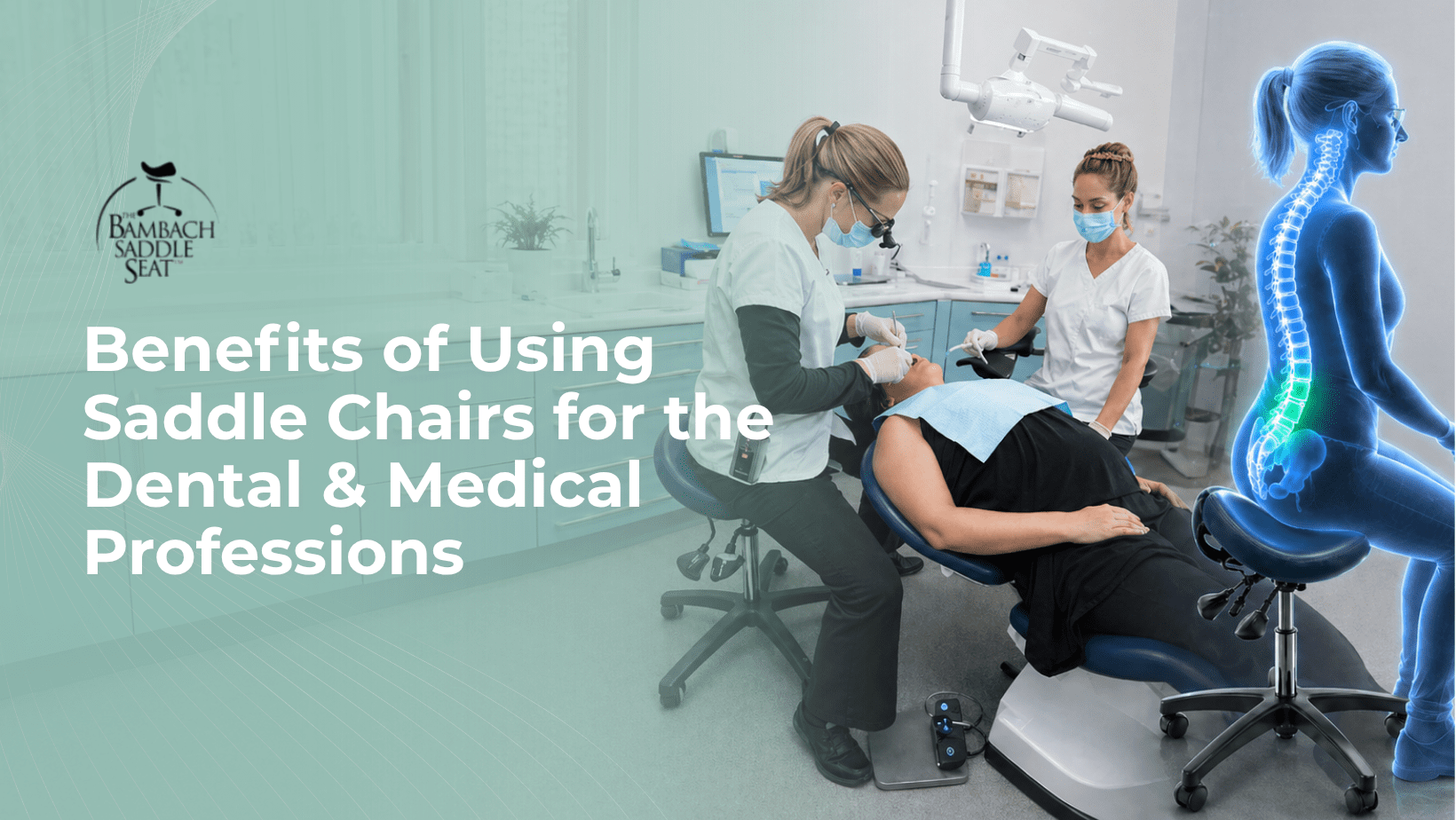
The Bambach Saddle Seat solves these issues by changing how your body interacts with gravity while seated.
| Stage | Anatomical Trigger | Biomechanical Impact | Clinical Outcome |
| 1. Hip Posture | Ergonomic 135° Open Hip Angle | Relieves hamstring tension on the ischial tuberosities | Neutral Pelvic Tilt (Pelvis rotates naturally forward) |
| 2. Spinal Alignment | Re-established Lumbar Lordosis | Spine effortlessly returns to its natural $S$-shape | Reduced disc compression & sciatic nerve relief |
| 3. Upper Body Strain | Centered Head & Shoulder Posture | Weight of head rests directly over the shoulder girdle | Trapezius relaxation & neck tension elimination |
| 4. Muscle Fatigue | Skeletal Weight-Bearing | Upper body weight is transferred directly to skeletal structure | Restored vascular flow & reduced fatigue |
1. Re-establishing the 135-Degree Open Hip Angle
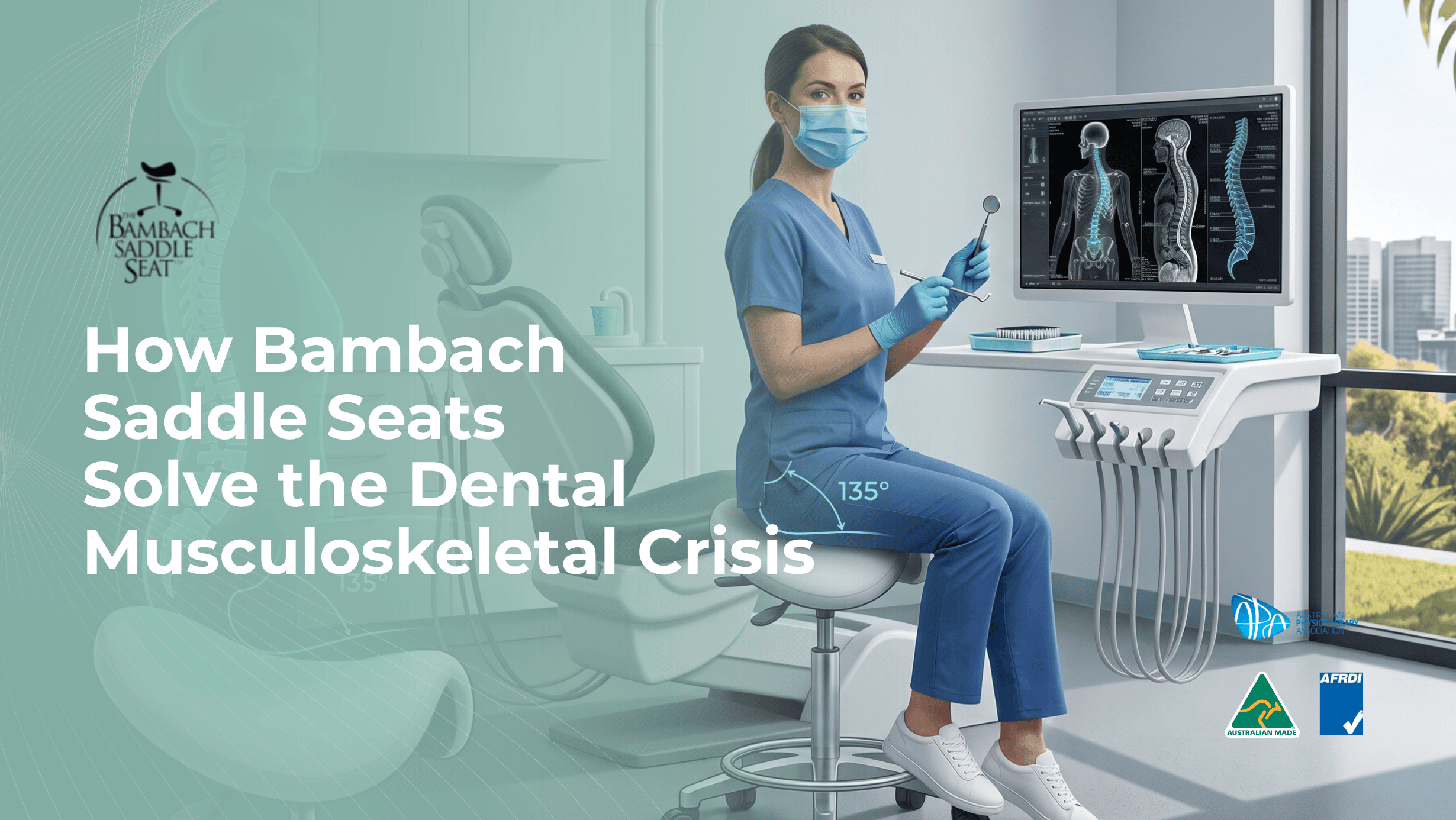
By opening the hip-to-torso angle from 90degrees to 135degrees, the Bambach seat naturally tilts the pelvis forward. This places the lumbar spine into its neutral, self-supporting S-curve without requiring active muscle strain.
2. Closer Proximity to the Operatory Patient
Because the thighs slope steeply downward (45degrees), dentists can move their chair much closer to the patient table. This eliminates the need to reach or hunch forward over the patient’s chest, keeping elbows relaxed and near the body.
3. Diaphragmatic Breathing and Core Stability
Opening the pelvis prevents chest and abdominal compression. Dentists report deeper diaphragmatic breathing and reduced fatigue during extended surgical or restorative procedures.
Real Clinical Outcomes: Case Studies & Dental Evidence
The clinical effectiveness of the Bambach Saddle Seat is demonstrated across numerous real-world case studies in dental practices:
- Oral & Maxillofacial Surgeon Case Study: An oral surgeon suffering from debilitating sciatic pain and lower back strain restored his career by switching to a Bambach seat. By maintaining a neutral pelvic tilt, he eliminated the disc pressure causing his nerve compression and returned to performing long procedures pain-free. Read the full case in our Bambach Clinical Case Studies.
- Dental Assistant Neck Strain Case Study: A dental assistant suffering from severe upper thoracic and neck fatigue used the Bambach seat with a foot-ring to elevate her position over the operator. The natural spinal alignment eliminated her upper back muscle starvation, resulting in zero thoracic pain.
Explore our custom operatory configurations on our Bambach Dental Seating Page.
How does a Bambach Saddle Seat differ from a standard dental stool?
A standard dental stool supports the legs at a 90degrees angle, flattening the spine's natural curve. The Bambach Saddle Seat opens the hip angle to 135degrees, which naturally tilts the pelvis forward and holds the spine in an effortless, self-supporting S-shape.
Can a saddle seat help dental hygienists and dental assistants?
Yes. Dental hygienists and assistants experience intense static loading from leaning over patients at elevated heights. The Bambach Saddle Seat—especially when configured with a foot-ring for elevated positioning—stabilizes the core and prevents upper thoracic ischemia and neck fatigue.
Read also : https://www.bambach.com.au/ergonomic-chairs-by-profession/dental/
How long does it take for a dentist to adapt to a Bambach Saddle Seat?
Most dental professionals adapt to a Bambach seat within 1 to 2 weeks. Because standard stools allow core muscles to turn off, switching to a saddle seat reactivates dormant postural muscles, which may cause mild initial awareness as core strength adapts.
Do I need a backrest on a dental saddle chair?
Because a saddle seat holds your pelvis in a neutral position, your spine naturally supports itself without needing a backrest during active clinical work. However, an optional adjustable backrest is available for rest periods between patient procedures.
How does the Bambach seat allow closer access to the patient's mouth?
The downward sloping thighs of a saddle seat reduce the forward clearance required by your legs. This allows you to position the chair much closer to the dental chair, eliminating the need to bend forward at the waist to reach the patient's mouth.
Can using a saddle seat help prevent early retirement for dentists?
Yes. Musculoskeletal disorders are a primary cause of early retirement among dentists. By relieving disc pressure, eliminating static muscle starvation, and maintaining spinal alignment, the Bambach seat mitigates long-term occupational injury risks.
What is the optimal hip angle for seated dental procedures?
Clinical ergonomics research indicates that a 135degrees open hip angle is optimal for seated work. This position balances sitting ease with standing posture, reducing lumbar disc pressure while keeping the head centered over the shoulders.