
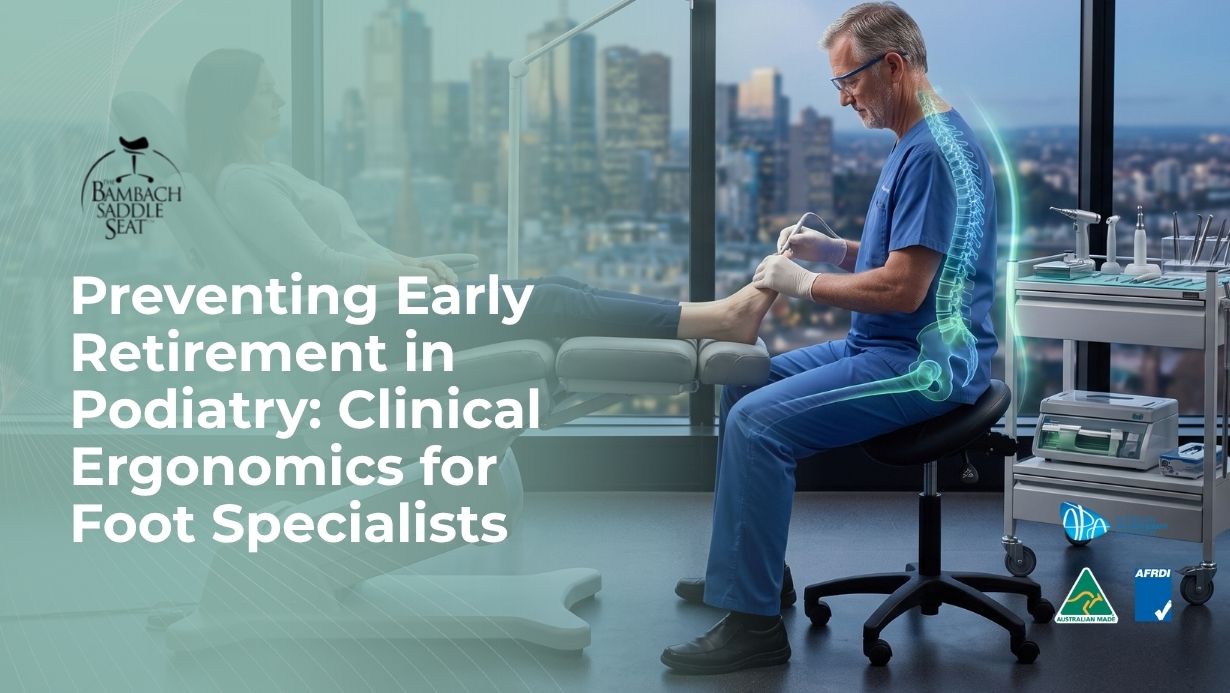
The High Occupational Cost of Podiatric Practice
Podiatry is a demanding clinical discipline requiring intense physical focus. Every day, podiatrists, podiatric surgeons, and orthotic specialists perform complex procedures at uniquely low operating heights.
While podiatrist focus entirely on restoring patient mobility, this work takes a devastating toll on their own bodies. In fact, research published by the Royal College of Podiatry reveals that 95% of practicing podiatrists experience work-related musculoskeletal pain.
Even more alarming, 46% of retired podiatrists left the profession prematurely due to musculoskeletal injuries. Consequently, chronic physical strain represents the single greatest threat to career longevity in podiatric medicine.
The Biomechanics of Low-Height Operating Hazards
Why do foot specialists suffer such severe spinal breakdown? The answer lies in the extreme mechanical stress created by low-height clinical procedures.
Podiatrists perform nail surgeries, callus debridements, and biomechanical assessments near floor level. Consequently, working on patient feet forces clinicians to lean forward at acute angles for extended periods.
Extreme Lumbar Shear Forces at Low Working Heights
When you lean forward on a standard flat stool, your pelvis tilts backward into a posterior pelvic tilt. As a result, this posture completely flattens your lower back into an unnatural “C” shape.
At low operating heights, this flattened alignment subjects your L4/L5 lumbar vertebrae to extreme shear forces. Biomechanically, these shear loads create several critical physical hazards:
- Accelerated Disc Degeneration: Extreme shear forces compress intervertebral discs asymmetrically, accelerating bulging and herniation.
- Chronic Muscle Fatigue: Lower back extensor muscles must contract continuously to prevent the torso from collapsing forward.
- Restricted Spinal Circulation: Static muscle loading restricts localized blood flow, causing rapid physical exhaustion during long clinic days.
To review national workplace safety protocols regarding static posture hazards, consult Safe Work Australia.
Why Standard Low Task Stools Fail Podiatrists
Most podiatry clinics rely on basic, flat-surfaced task stools with standard gas lifts. Unfortunately, these generic stools actively worsen occupational strain.
A flat seat pan forces a 90-degree angle between the torso and thighs. When operating near floor level, this closed angle pinches the hip flexors and forces the lower back to curve outward.
Furthermore, standard stool bases clash with podiatry chair footrests and patient leg supports. Consequently, clinicians cannot get close to the operating field. Therefore, podiatrists must reach even further forward, multiplying spinal torque.
Practitioners can review workforce standards and registration data via the Ahpra Podiatry Board of Australia.
Biomechanical Comparison: Standard Low Stool vs. Bambach Saddle Stool
| Biomechanical Criteria | Standard Low Task Stool | Bambach Low-Stem Ergonomic Saddle Stool |
| Hip Stance Angle | Closed 90° Angle Pinches hip flexors and forces the pelvis into a backward collapse. | Open 135° Angle Lowers thighs into a natural zero-gravity position of physical rest. |
| Lumbar Curve & Shear | Flattened “C” Curve Exposes L4/L5 vertebrae to extreme shear forces at low heights. | Natural “S” Curve Preserves lumbar lordosis and eliminates damaging spinal shear. |
| Low-Height Accessibility | Restricted Operating Range Standard gas stems cannot lower sufficiently for low foot procedures. | Tailored Low Gas Stems Custom low-height stems allow effortless proximity to patient feet. |
| Pelvic & Core Balance | Unstable Flat Base Sit bones slide backward, disengaging deep abdominal core stabilizers. | Continuous-Contour Lock Solid seat pan anchors sit bones, engaging core balance automatically. |
| Clinical Hygiene | Basic Commercial Vinyl Degrades rapidly when exposed to clinical disinfectants and fluids. | Surgical-Grade Seamless Vinyl Resists fluids, harsh chemicals, and clinical sanitisation protocols. |
The Science of Saddle Seating in Podiatric Surgery
Fortunately, Australian Occupational Therapist Mary Gale developed the ultimate ergonomic intervention: the original Bambach Saddle Seat. Inspired by equestrian posture, her design fundamentally alters sitting biomechanics.
Specifically, a low-stem Bambach saddle stool protects podiatrists through three primary mechanisms:
1. The 135-Degree Open Hip Stance
By dropping the knees below the hips, the saddle design creates an open 135-degree hip angle. This stance naturally rotates the pelvis forward into neutral balance (anterior pelvic tilt).
2. Elimination of Lumbar Shear
Because the pelvis remains locked in neutral balance, your spine automatically maintains its healthy “S” curve. Consequently, this alignment eliminates damaging shear forces on lower lumbar discs, even when working near floor level.
3. Unrestricted Low-Height Mobility
Bambach offers specialized short gas stems combined with a compact star base. Therefore, podiatrists roll right up to the patient’s footrest without clashing knees or tripping over wide chair legs.
For further clinical research on occupational health, consult the Australian Physiotherapy Association and studies indexed in the Journal of Foot and Ankle Research.
Buyer’s Checklist for Podiatry Clinical Stools
| Feature Category | Critical Evaluation Standard | Direct Podiatry Practice Benefit |
| Low Gas Stem Options | Short or extra-short gas lift mechanisms | Allows comfortable working height at low podiatry chair levels. |
| Anatomical Sizing | Choice of seat widths, including Cutaway and Small models | Fits individual pelvic dimensions without creating inner thigh pressure. |
| Infection Control | Seamless, fluid-resistant medical-grade vinyl upholstery | Withstands daily wiping with hospital-grade disinfectants and iodine. |
| Compact Star Base | Small footprint with heavy-duty, friction-free castors | Glides smoothly around podiatry drills, foot tubs, and light stands. |
| Quality Guarantee | AFRDI Level 6 Blue Tick certification with 5-year warranty | Ensures long-term commercial durability in high-volume clinics. |
Protect Your Spine and Extend Your Podiatry Career
Your body is your most valuable clinical asset. Ignoring persistent lower back pain can jeopardize your surgical precision and force an early retirement.
By upgrading to an authentic, OT-designed Bambach Saddle Seat, you eliminate destructive lumbar shear and safeguard your physical health.
Explore our complete range of Podiatry & Allied Health Ergonomic Chairs or read our Australian Clinical Case Studies to see how custom pelvic support extends practice longevity.
Are you ready to practice pain-free? Contact our Ergonomic Specialists today!
Podiatrists perform lengthy procedures at low operating heights near floor level. This position forces the pelvis into a backward slump, subjecting L4/L5 lumbar discs to extreme shear forces that cause chronic injury over time.
The saddle design opens the hip angle to 135 degrees and tilts the pelvis forward. Consequently, this alignment maintains your spine’s natural “S” curve, eliminating shear forces even when operating at low heights.
Bambach offers short and extra-short custom gas stems designed specifically for low-height clinical work. These stems allow clinicians to lower their seating height without compromising pelvic support.
Yes. Bambach stools feature seamless, medical-grade vinyl engineered specifically to resist fluid ingress, iodine, nail dust, and harsh hospital disinfectants without cracking.
Yes. Bambach saddle chairs hold official AFRDI Level 6 Blue Tick certification, guaranteeing severe commercial strength and long-term durability in demanding clinical environments.