How to Choose a Saddle Seat: An Evidence-Based Buyer’s Comparison Guide
Saddle Seats are no longer a niche clinical product. Search for one today and you’ll find dozens of options — split-seat designs, single-contour designs, budget imports, and premium clinically certified models — all claiming to fix your posture. They are not interchangeable, and the differences between them have real consequences for your spine, your comfort, and how long the chair lasts.
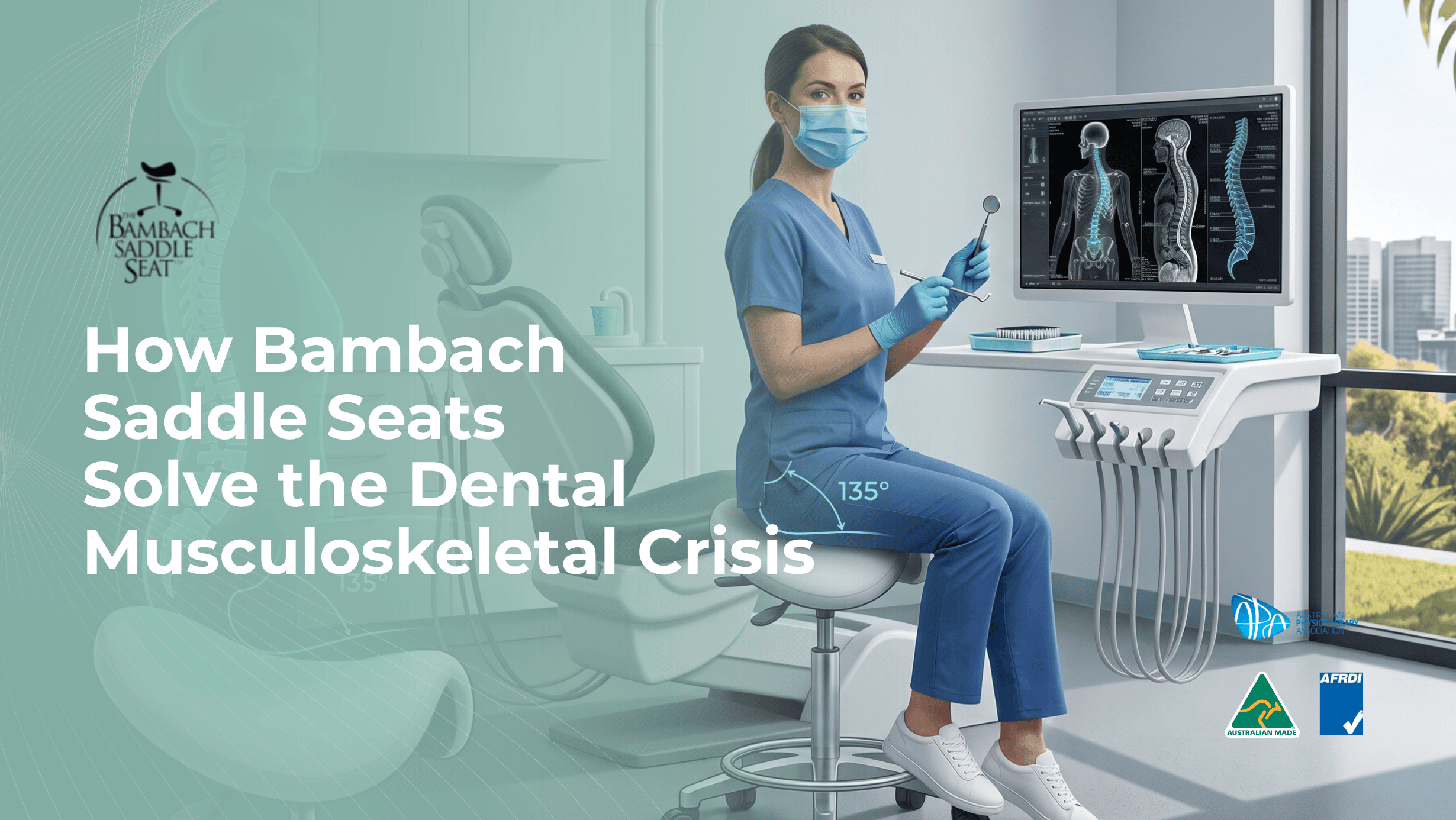
A genuine saddle seat opens the hip angle to roughly 135 degrees, tilting the pelvis forward and letting the lumbar spine hold its natural “S” curve without a backrest. Beyond that shared principle, saddle seats diverge sharply in seat geometry (continuous-contour vs. split-seat), sizing options, certification, and country of design and manufacture — and those differences are what actually determine whether a chair helps your posture or just looks like it should.
This guide breaks down exactly what to evaluate before you buy, using the same criteria a physiotherapist, occupational therapist, or workplace health and safety (WHS) manager would use to assess clinical seating.
Why Not All Saddle Seats Are Built the Same
The term “saddle seat” describes a category, not a single design. Two chairs can both be called saddle seats and behave completely differently under your body.
The most consequential design fork in the category is seat geometry: whether the seat pan is a single, unbroken contour or is split into two separate pads.
Continuous-Contour Seats vs. Split-Seat Designs
| Feature | Continuous-Contour Seat | Split-Seat Design |
| Pelvic stability | Locks the pelvis with one uniform, uninterrupted surface | Two separate pads can shift independently, reducing lateral stability |
| Weight distribution | Even distribution across both sit bones (ischial tuberosities) | Can concentrate pressure unevenly if pads aren’t perfectly aligned to the user |
| Mobility & rotation | Free rotation and side-to-side movement across one surface | Movement can be restricted by the gap between pads |
| Best suited for | Clinical, surgical, dental, and precision tasks requiring a stable base | Users who specifically want a divided seat for personal comfort reasons |
Neither geometry is inherently “wrong” — but they solve different problems, and a chair built for one purpose won’t necessarily suit another. If your priority is a rock-stable base for precision clinical work (dentistry, surgery, veterinary procedures, fine motor tasks), a continuous, unbroken saddle contour designed specifically for that purpose is the evidence-backed choice.
Read also : https://www.bambach.com.au/about-us/case-studies/
5 Criteria for Evaluating Any Saddle Seat
Cut through the marketing claims and assess a saddle seat against these five factors. This is the same framework a workplace health and safety manager or referring clinician would use.
1. Country of Design vs. Country of Manufacture
Ask two separate questions: who designed this chair, and who makes it? Many saddle chairs sold in Australia are designed overseas and imported by a local distributor. That’s not automatically a problem — but it does mean the clinical credibility behind the design, the supply chain for parts and warranty claims, and the speed of local support can vary significantly. A chair designed and manufactured in Australia by the original clinical inventor offers a shorter, more accountable chain between the person who understood the biomechanical problem and the product in your workplace.
2. Clinical Origin and Endorsement
Look for a genuine clinical originator — ideally a named occupational therapist, physiotherapist, or other allied health professional credited with the design — rather than a general “ergonomic” claim. Also check for third-party endorsement from a recognised professional body (in Australia, the Australian Physiotherapy Association is the relevant benchmark), not just self-description marketing language. “Ergonomic” is an unregulated term in Australia; anyone can put it on a product listing.
3. Independent Structural Certification
For commercial or clinical environments, structural certification matters more than most buyers realise. In Australia and New Zealand, AFRDI Level 6 is the relevant independent testing standard for severe commercial use — it verifies the chair can withstand extreme daily loads, sudden movement, and continuous heavy use in clinics and offices. If a chair doesn’t disclose an independent certification, ask for it directly before buying for a commercial or multi-user setting.
4. Sizing and Custom Fit
Pelvic width varies significantly between individuals, and a single “one-size-fits-all” saddle seat will not properly support every body. Multiple seat sizes, adjustable gas-lift heights, and stem height options are what allow a saddle chair to genuinely fit an individual rather than approximate a fit. A wide range of sizing options is a strong signal that the manufacturer understands the anatomy they’re designing for.
5. Warranty, Stock Availability, and Local Support
A saddle chair is a multi-year investment, not a disposable purchase. Check the warranty length (five years or more is the benchmark for commercial-grade seating), whether the model you want is actually in stock and ready to ship, and whether local fitting or adjustment support is available if the chair doesn’t feel right initially. A long warranty paired with a genuine money-back trial period signals a manufacturer confident in their product’s fit.
Comparison Checklist: What to Ask Before You Buy
Use this as a direct checklist when comparing saddle chair options:
- Is the seat a continuous contour, or a split/divided design?
- Where was this chair designed, and by whom?
- Where is it manufactured?
- Is it endorsed by a recognised clinical body (e.g. the Australian Physiotherapy Association)?
- Is it independently certified for commercial use (e.g. AFRDI Level 6)?
- How many seat sizes are available, and how is the right size determined?
- What is the warranty length, and does it cover the frame, gas lift, and upholstery?
- Is the model in stock, or is it on backorder/preorder?
- Is there a money-back trial period if the fit isn’t right?
- Is the upholstery available in surgical-grade or infection-control vinyl if needed for a clinical setting?
The Original, Australian-Designed Saddle Seat
The Bambach Saddle Seat was designed in 1989 by Mary Gale, an Australian occupational therapist, after observing that patients who could not sit upright unsupported on a standard chair could sit balanced and symmetrical on horseback. That clinical observation became the original contoured saddle seat — a single, unbroken contour engineered to open the hip angle to 135 degrees and let the spine self-support in its natural curve.
Nearly 36 years on, Bambach remains designed, manufactured, and hand-upholstered in Marrickville, Sydney — not imported and repackaged. It is endorsed by the Australian Physiotherapy Association, independently tested to AFRDI Level 6 for severe commercial use, and available in multiple seat sizes and stem heights to fit individual bodies rather than approximate them. Every chair carries a five-year warranty and a 30-day money-back trial.
If you’re comparing saddle chairs and want to see how the original, clinically designed model measures up against the checklist above, explore the Bambach range or take our two-minute quiz to find the right seat, size, and configuration for your profession and body.
Still comparing options?
Take the two-minute seat finder to see which model, size and configuration suits your work, or get in touch if you’d rather talk it through. Call +61 2 8966 4800.
Is "AFRDI Level 6" certification actually important, or just a marketing term?
AFRDI Level 6 is a genuine, independent structural testing standard administered by the Australasian Furnishing Research and Development Institute. It verifies a chair can withstand severe, continuous commercial use without structural failure. Unlike the word "ergonomic" — which is unregulated in Australia and can be used by any manufacturer — AFRDI certification is independently verified and should be disclosed by any manufacturer marketing a chair for commercial or clinical use.
Does it matter if a saddle chair is designed overseas but sold through an Australian distributor?
It can. A chair designed and manufactured locally by its original clinical inventor typically means a shorter supply chain for parts, warranty support, and stock availability, plus more direct accountability for the clinical claims behind the design. An imported chair isn't automatically inferior, but it's worth confirming local warranty support, stock lead times, and who is actually responsible for the clinical claims being made.
How many seat sizes should a genuine saddle chair offer?
Because pelvic width varies significantly between individuals, a single "one size fits all" saddle seat cannot properly support every body. Look for a manufacturer offering multiple distinct seat sizes plus adjustable stem heights, so the chair is fitted to your specific anatomy rather than approximated.
Check our products HERE
Are saddle chairs "AHPRA approved" in Australia?
No product or piece of furniture is "AHPRA approved." AHPRA (the Australian Health Practitioner Regulation Agency) registers and regulates individual healthcare practitioners — such as physiotherapists and dentists — not commercial furniture or medical devices. Genuine clinical credibility for a saddle chair comes from endorsement by a recognised professional body, such as the Australian Physiotherapy Association, and independent structural certification such as AFRDI Level 6.
How long does it take to adjust to sitting on a saddle chair?
Most users report a one- to two-week adjustment period. Because saddle seating actively engages core and postural muscles that are typically dormant on a standard flat chair, some mild muscle awareness during the first fortnight is normal and expected as your body adapts to active sitting.
What warranty length should I expect from a quality saddle chair?
Five years is the benchmark for a commercial-grade saddle chair, covering the frame, gas lift, and upholstery. Anything significantly shorter may indicate the manufacturer doesn't expect the chair to hold up under sustained daily commercial use.
Can I try a saddle chair before committing to buy it?
A genuine money-back trial period — typically around 30 days — is a strong signal of manufacturer confidence. Because fit and adjustment period both matter for saddle seating, a trial period lets you assess whether a specific model and size genuinely suits your body and workspace before you're locked into the purchase.