Author: bambach-admin

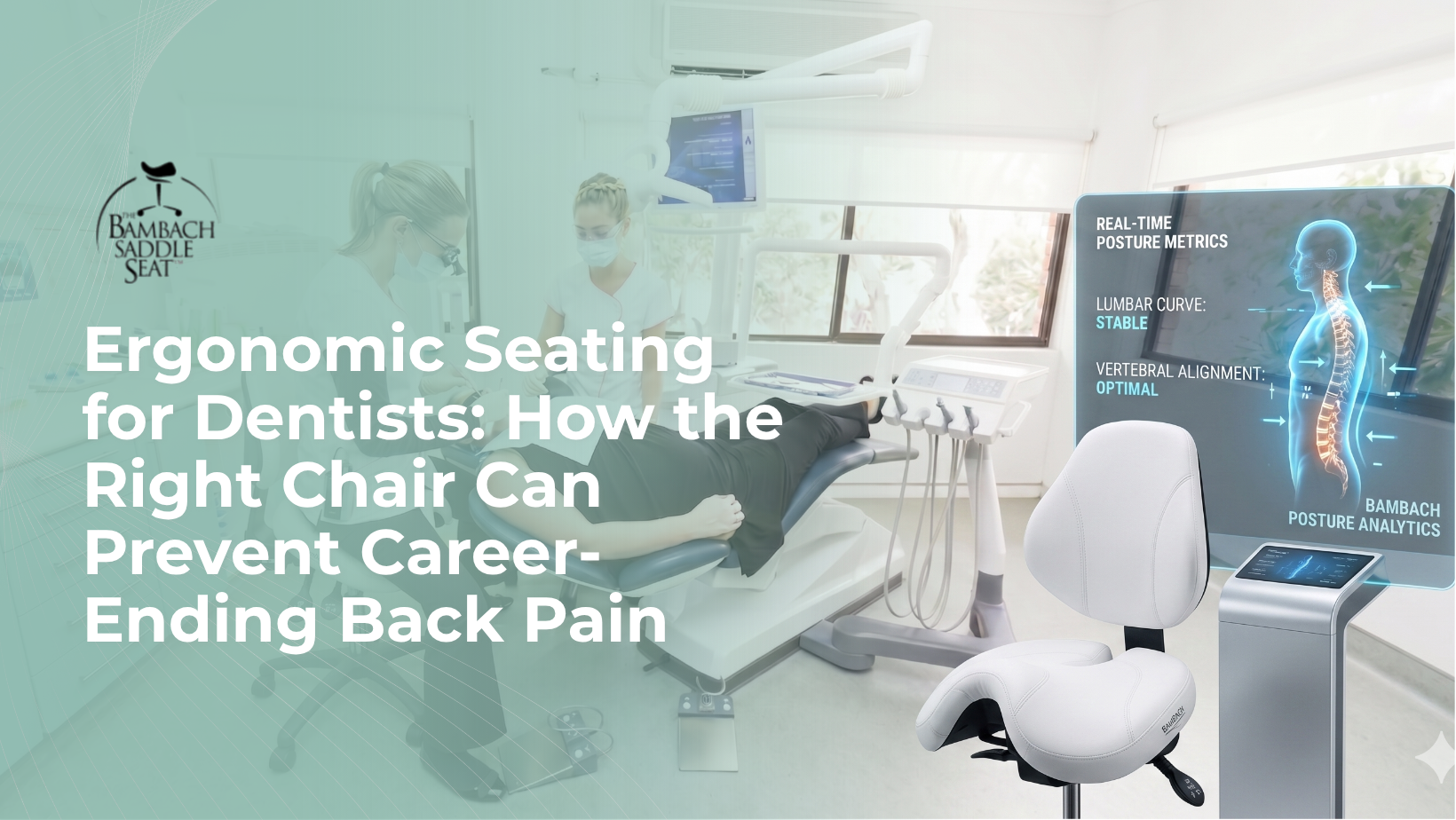
Ergonomic Seating for Dentists: How the Right Chair Can Prevent Career-Ending Back Pain

Key Takeaways:

  • Up to 80% of dental professionals experience musculoskeletal disorders (MSDs) during their careers, often leading to early retirement.
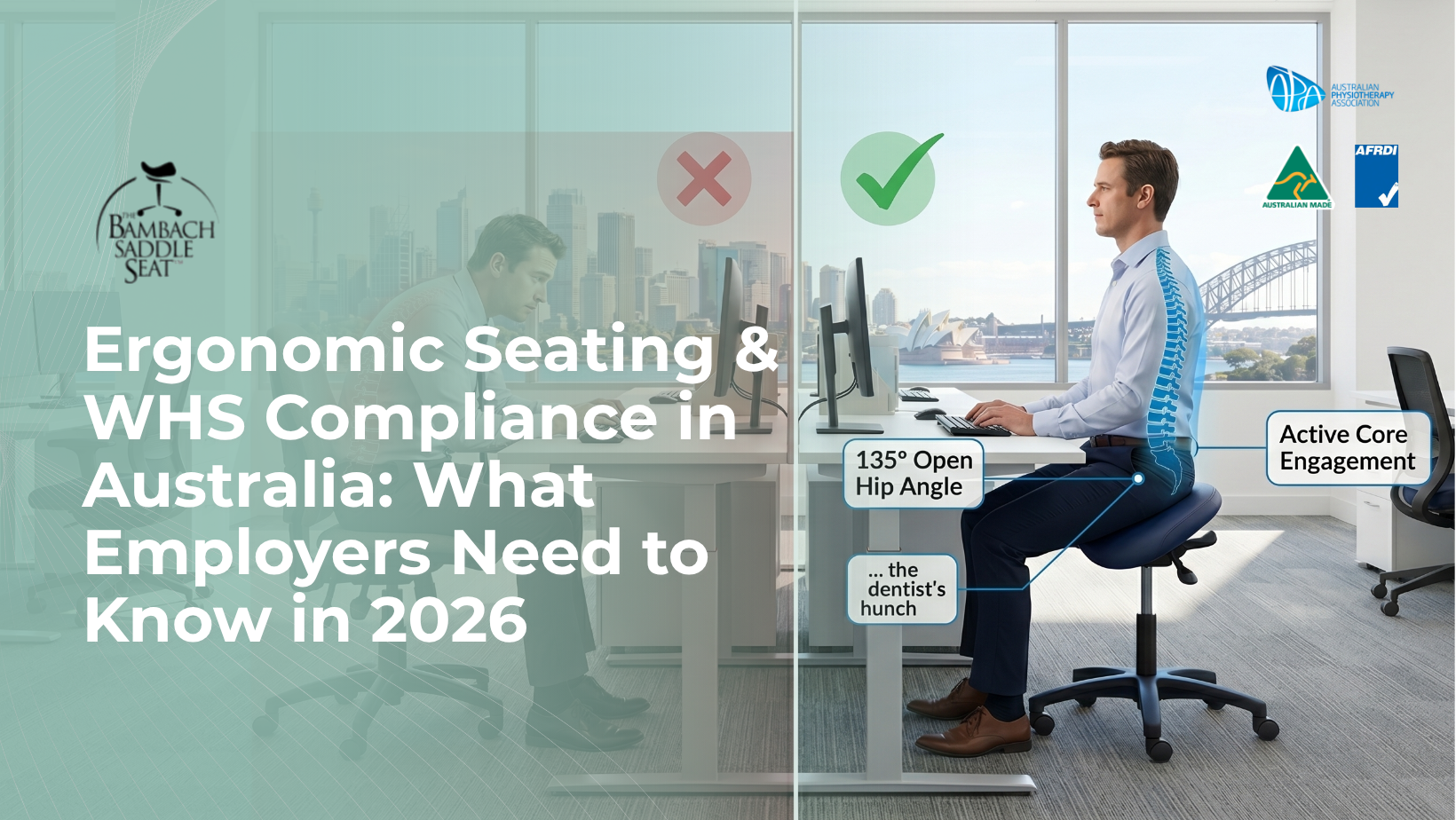
  • Traditional dental stools with a flat seat pan force a 90-degree hip angle, leading to posterior pelvic tilt and hazardous spinal compression. 
  • Saddle seating, operating on a 135-degree open hip angle, promotes an anterior pelvic tilt, preserving the spine’s natural “S” curve and drastically reducing disc load.
  • Investing in authentic, anatomically contoured saddle chairs enhances practitioner longevity, improves clinical precision, and reduces practice downtime.

Dentistry is a profession of millimetres. Every day, dentists, oral surgeons, and dental hygienists perform highly precise procedures within the confined space of the human mouth.

While practitioners focus entirely on patient care, this relentless precision takes a severe physical toll. For decades, clinicians accepted chronic back, neck, and shoulder pain as an unavoidable occupational hazard.

However, modern ergonomic science proves that career-ending pain is completely preventable. Specifically, practitioner longevity depends directly on the biomechanics of seated posture.

Therefore, this comprehensive guide explores the clinical evidence surrounding musculoskeletal disorders (MSDs), explains saddle seating anatomy, and delivers a definitive buyer’s guide for practice owners.

The Clinical Reality: Musculoskeletal Disorders (MSDs) in Dentistry

The prevalence of musculoskeletal disorders among dental professionals remains alarmingly high. In fact, clinical studies confirm that between 60% and 80% of dentists and hygienists suffer from chronic pain during their careers. Most frequently, this pain attacks the lumbar spine, cervical spine, and shoulder girdle.

Why does dentistry cause such severe physical damage? The answer lies in three distinct postural hazards:

  • Static Posturing: Clinicians hold fixed, rigid positions while executing fine-motor tasks. As a result, static muscle loading restricts blood circulation, causing rapid muscle fatigue and micro-trauma.

  • The “Dentist’s Hunch”: To gain clear visual access to the oral cavity, practitioners repeatedly lean forward, twist their torsos, and tilt their heads. Consequently, they pull their neck and back far out of neutral alignment.

  • Repetitive Strains: Constantly shifting between the patient, instrument tray, and curing light creates severe asymmetrical strain across the body.

Over time, these hazards cause repetitive strain injuries (RSIs), tension headaches, sciatica, and spinal disc degeneration. Furthermore, MSDs force practice owners to reduce clinical hours, cancel appointments, and process costly workers’ compensation claims. Ultimately, uncorrected postural strain prematurely ends skilled clinical careers.

The Biomechanics of Seating: Why Traditional Dental Stools Fail

To prevent occupational injuries, we must examine why traditional dental seating fails. Standard operator stools feature a flat seat pan that forces a 90-degree angle between the torso and thighs.

When you sit at 90 degrees, your thigh bones act as levers that pull the pelvis backwards. Biomechanically, experts call this movement a posterior pelvic tilt.

Consequently, this backward tilt flattens the natural, healthy curve of your lower back (lumbar lordosis). As a result, the spine collapses into an unnatural “C” shape. This posture creates three severe structural consequences:

  1. Increased Intervertebral Disc Pressure: The front portion of the spinal disc compresses tightly. Consequently, this compression pushes the inner disc material backward toward spinal nerves, causing painful disc bulges.

  2. Ligament Strain: The posture stretches supporting spinal ligaments beyond their neutral resting zone, triggering chronic inflammation and pain.

  3. Core Muscle Deactivation: The “C” slump completely disengages deep abdominal stabilizers. Therefore, superficial back muscles must work constantly to hold the body upright, causing severe fatigue and muscle spasms.

In addition, flat operator stools prevent clinicians from sitting close to the patient. Because your knees clash against the dental chair, you must lean even further forward. Thus, traditional seating actively compounds your spinal strain.

The Science of Saddle Seating: Transforming Pelvic Position and Spinal Load

Australian Occupational Therapist Mary Gale engineered the ultimate ergonomic solution: the original Bambach Saddle Seat. Inspired by equestrian posture, her design fundamentally transforms sitting biomechanics.

Specifically, a true saddle chair protects your spine through five key anatomical mechanisms:

1. The 135-Degree Open Hip Angle

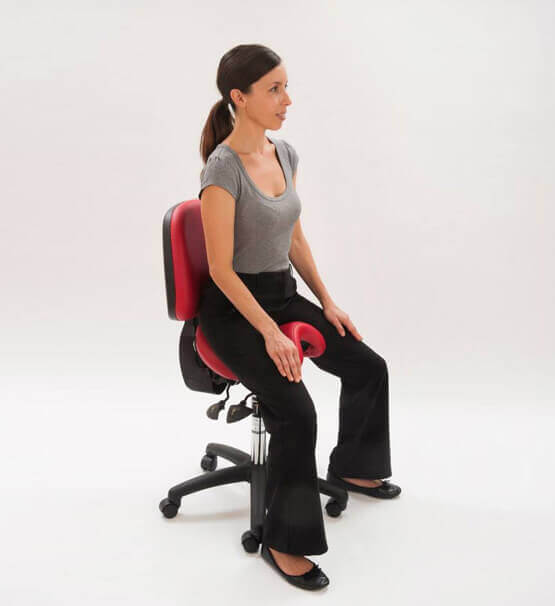
Instead of a flat 90-degree angle, a saddle chair lowers your thighs to create an open 135-degree hip stance. Biomechanically, this stance represents the body’s natural resting position in zero gravity.

2. Anterior Pelvic Tilt and the “S” Curve

By dropping the knees below the hips, the saddle naturally rotates the pelvis forward (anterior pelvic tilt). Consequently, this forward rotation automatically stacks your vertebrae into their natural “S” curve without conscious muscular effort.

3. Balanced Spinal Weight Distribution

With the “S” curve intact, your upper body weight rests evenly across the sit bones (ischial tuberosities) and spinal discs. As a result, this alignment dramatically reduces lumbar compression and prevents sciatica.

4. Close Proximity to the Patient

Because your legs straddle downward, your knees no longer hit the back of the patient chair. Therefore, you pull right up to the oral cavity without leaning or hunching your shoulders.

5. Active Core Activation

Saddle seating provides dynamic posture support. Specifically, it engages deep core muscles and opens the diaphragm, promoting deeper breathing and better brain oxygenation during complex procedures.

Biomechanical Comparison: Flat Stool vs. Bambach Saddle Chair

Biomechanical MetricTraditional Flat Operator StoolBambach Continuous-Contour Saddle Chair
Hip Stance Angle

Closed 90-Degree Angle


Forces thighs parallel to the floor, pulling the pelvis backward into a collapse.

Open 135-Degree Angle


Lowers thighs into a natural zero-gravity position of physical rest.

Pelvic & Spinal Position

Posterior Pelvic Tilt (“C” Curve)


Flattens the lumbar lordosis and multiplies pressure on intervertebral discs.

Anterior Pelvic Tilt (“S” Curve)


Rotates the pelvis forward, stacking vertebrae into natural, upright balance.

Lumbar Disc Pressure

High Compression Load


Compresses the anterior disc, pushing internal nucleus material toward spinal nerves.

Even Weight Distribution


Distributes upper body weight evenly across sit bones and discs to prevent bulges.

Patient Access & Reach

Restricted by Knee Clashing


Knees hit the dental chair, forcing the operator to lean forward and strain the back.

Unrestricted Close Access


Straddled legs point downward, allowing clinicians to sit close without leaning.

Muscle Engagement

Passive Core & Spasms


Disengages core stabilizers, forcing back muscles to overwork and fatigue rapidly.

Active Core Activation


Engages abdominal stabilizers and opens the diaphragm for deeper breathing.

The Dental Practice Buyer’s Guide to Ergonomic Seating

Not all stools marketed as saddle chairs deliver genuine clinical benefits. In fact, cheap imitation seats often lack proper anatomical design, causing severe nerve compression in the thighs and groin.

Therefore, practice owners should evaluate five essential criteria before buying:

1. Anatomical Contouring and Custom Sizing

Pelvic structures vary significantly between individuals. For this reason, a single seat size cannot fit all clinicians. Ensure you select a manufacturer that offers multiple contoured seat sizes (such as small, cutaway, medium, and large) to support the sit bones properly without inner thigh friction.

2. Height and Tilt Adjustability

Clinicians differ in height. Thus, the chair must feature customisable gas stems to achieve the crucial 135-degree stance. In addition, an adjustable seat tilt mechanism lets you fine-tune your pelvic balance to your exact comfort level.

3. Strict Infection Control and Upholstery

Hygiene is vital in modern dental surgeries. Therefore, select chairs upholstered in premium, medical-grade vinyl with seamless or sealed joins. Consequently, the upholstery resists fluids, bacteria, and harsh clinical disinfectants without cracking over time.

4. Compact Base Footprint and Manoeuvrability

Space around the dental chair is always limited. For this reason, choose a star base with a compact footprint to avoid tripping hazards and foot-pedal interference. Moreover, high-quality, free-rolling castors allow you to glide smoothly around the patient’s head without twisting your spine.

5. Commercial Certifications and Guarantees

Ergonomic seating represents a long-term investment in clinical productivity. Therefore, demand proven commercial durability. In Australia, insist on AFRDI Level 6 Certification to guarantee severe commercial strength, backed by a comprehensive 5-year warranty on all components.

Buyer’s Checklist for Clinical Saddle Chairs

Feature CategoryCritical Evaluation StandardWhy It Matters for Practice Owners
Anatomical SizingMultiple seat sizes (Small, Cutaway, Medium, Large)Prevents inner thigh pressure and guarantees proper sit bone support.
Height & Tilt MechanicsCustom gas stems with lockable seat-pan tilt controlsAllows clinicians to achieve the exact 135-degree open hip angle.
Hygiene StandardsMedical-grade, seamless, fluid-resistant vinyl upholsteryWithstands daily clinical sanitation without cracking or harbouring bacteria.
Base DesignCompact star base with heavy-duty, smooth castorsPrevents tripping hazards and avoids cluttering dental pedal controls.
Quality GuaranteeAFRDI Level 6 Severe Commercial Certification & 5-Yr WarrantyGuarantees structural durability and protects your business investment.

Conclusion: Invest in Your Long-Term Health

Your body is your most valuable clinical instrument. If you ignore early postural warnings, chronic back pain can jeopardize both your work quality and career longevity.

By upgrading to a scientifically validated, OT-designed Bambach Saddle Seat, you eliminate destructive pelvic tilting and restore your spine’s natural strength. Ultimately, dynamic seating protects your health, enhances your precision, and extends your professional career.

Explore our full range of Dental Ergonomic Saddle Chairs or read our Australian Clinical Case Studies to see how dynamic pelvic support transforms clinical endurance.

Ready to protect your spine and extend your career?

Explore our full range of customisable clinical seating and protect your posture today. Visit our dedicated hub: Discover the Bambach Dental Saddle Chair.


Ergonomic Seating for Dentists FAQs

Yes, there is typically a short acclimatisation period. Because a saddle chair promotes "active sitting," you will be engaging core and postural muscles that may have weakened from years of slumping in standard, flat-pan chairs. You might experience mild muscle fatigue or slight tenderness around the sit bones (ischial tuberosities) for the first one to two weeks. This is completely normal and is simply a sign that your body is adapting to a stronger, healthier posture.

For active dental work, a backrest is often unnecessary. The open hip angle and anterior pelvic tilt created by a true saddle chair naturally align and support the spine, meaning you don't need external bracing to sit upright. However, for practitioners who perform exceptionally long procedures or those who want the option to lean back and stretch between patients, a fully adjustable backrest can provide welcome intermittent relief.

Absolutely. Dental assistants face unique ergonomic challenges—they often need to sit higher than the dentist to gain a clear field of vision, which frequently leads to awkward leaning and severe spinal strain. A saddle chair equipped with an extended gas stem and a supportive footring allows the DA to sit safely at a higher elevation while maintaining a stable, neutral spine and keeping their hips comfortably open.

Unlike generic flat stools, a clinical-grade saddle chair must accommodate your specific pelvic anatomy. Size selection generally depends on your height, gender, and pelvic width to ensure your sit bones are supported correctly without causing friction or pressure on soft tissues. Using a one-size-fits-all chair can actually do more harm than good. It is highly recommended to use a tailored seat calculator or consult with an ergonomic seating specialist to find the exact contour and size for your body.

What Is a Saddle Chair? The Definitive Guide to Ergonomic Seating Science

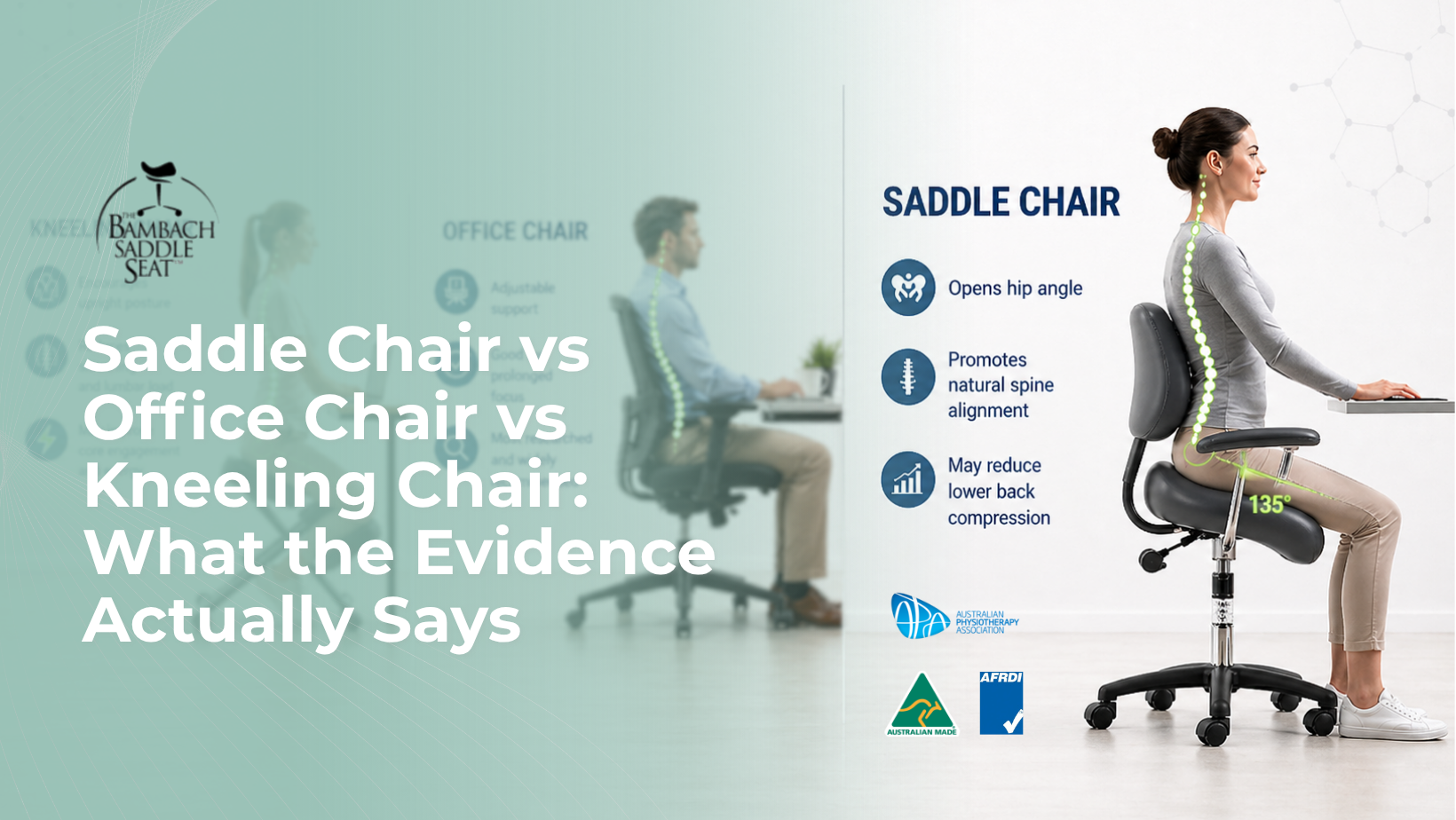
In the world of ergonomics, few innovations have transformed workplace health as profoundly as the saddle chair. While traditional office chairs have remained fundamentally unchanged for decades—relying on a 90-degree hip angle that often leads to “slumping”—the saddle chair introduced a radical, science-based alternative.

But what exactly is a saddle chair, and why has it become the “gold standard” for medical professionals, dentists, and office workers alike? This guide explores the history, the anatomical science, and the rigorous certifications that make the Bambach Saddle Seat a leader in musculoskeletal health.


Defining the Saddle Chair: More Than Just a Stool

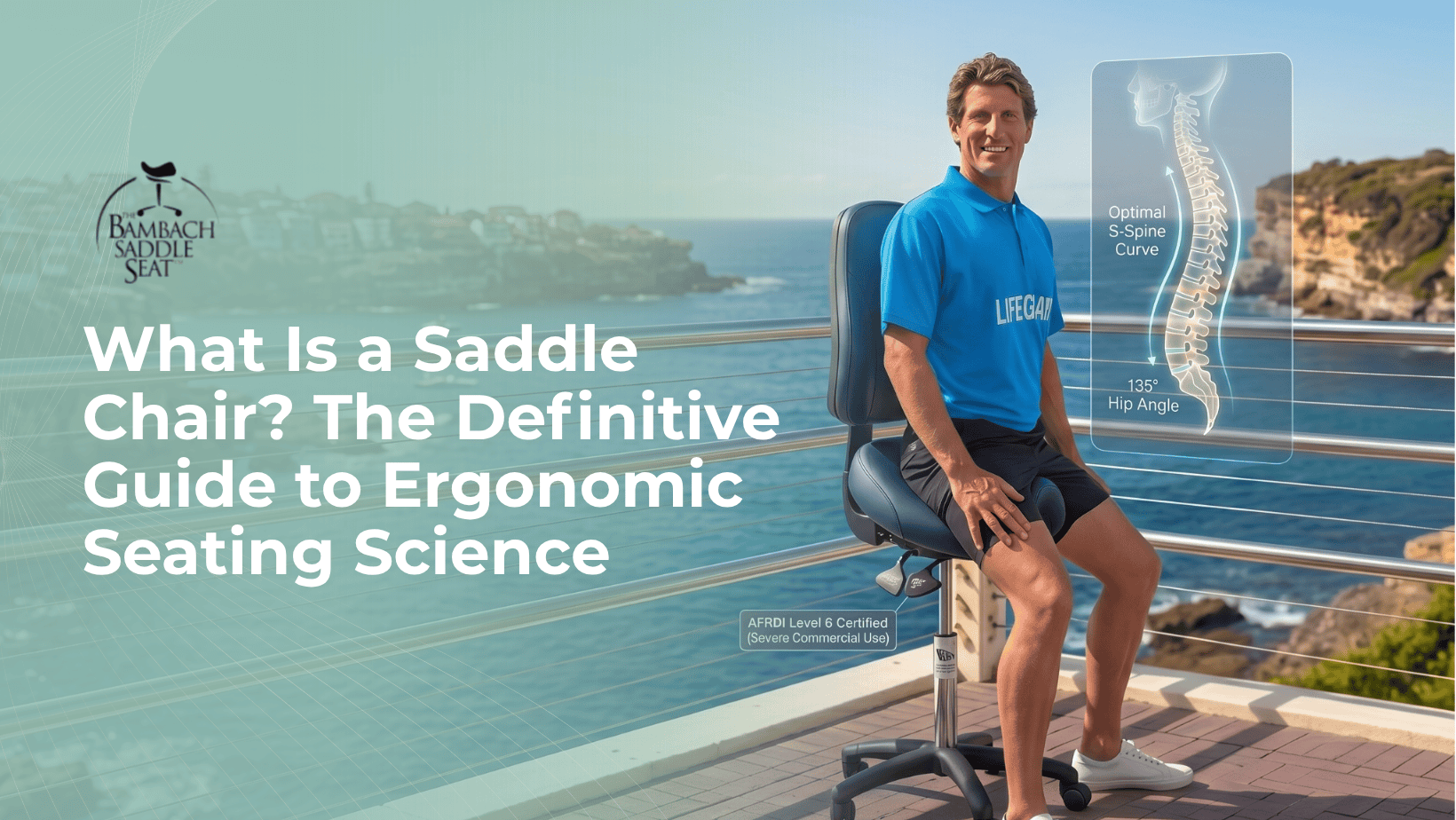
A saddle chair is a unique ergonomic seat designed to mimic the equestrian posture. Unlike a flat stool, it features a contoured “saddle” shape that promotes an open hip angle (typically 135 degrees) and tilts the pelvis forward into a neutral position.

By sitting in a saddle position, the spine is naturally encouraged to maintain its healthy “S” shape, rather than the forced “C” shape associated with traditional sitting.


The Origin Story: Mary Gale and the Birth of Bambach

The story of the saddle chair begins not in a corporate boardroom, but in a clinical setting. In the late 1980s, Mary Gale, an Australian Occupational Therapist and lifelong horse rider, made a pivotal observation.

She noticed that her patients with severe musculoskeletal disabilities, who struggled to sit upright in traditional chairs, regained remarkable trunk control and stability when placed on a horse. Gale realized that the saddle shape naturally stabilized the pelvis, which in turn supported the entire spine.

Determined to bring this benefit to the workplace, she developed the original Bambach Saddle Seat. Today, Bambach remains the only saddle chair designed by an Occupational Therapist, ensuring that every curve is anatomically justified.


The Science of Sitting: Why Your Back Prefers the Saddle

To understand why doctors and physiotherapists recommend saddle seating, we must look at the biomechanics of the human body.

1. The Pelvic Tilt and Lumbar Lordosis

When you sit in a standard chair, your pelvis tends to tilt backward (posterior tilt). This flattens the natural curve of your lower back (the lumbar lordosis), putting immense pressure on the intervertebral discs.

The Bambach Saddle Seat forces an anterior pelvic tilt. By rotating the pelvis forward, the spine is “stacked” correctly, reducing disc pressure and preventing the long-term degradation of spinal health.

2. The 135-Degree Hip Angle

Research has shown that a 90-degree hip angle (the standard office chair position) creates significant strain on the hip flexors and lower back. An open angle of approximately 135 degrees is the “neutral” position for human joints. The saddle seat achieves this naturally, improving hip joint health and reducing the risk of bursitis and tension.

3. Core Activation and Respiratory Health

Because a saddle chair requires a degree of “active sitting,” it engages the core muscles. Furthermore, by opening up the torso, it allows the diaphragm to move freely, increasing oxygen intake and reducing the fatigue often felt during a long workday.


Why Professionals Recommend Bambach

The Bambach Saddle Seat is not just a piece of furniture; it is a medical device endorsed by industry peak bodies.

APA (Australian Physiotherapy Association) Endorsement

The Australian Physiotherapy Association (APA) is the peak body representing the interests of Australian physiotherapists and their patients. Bambach is one of the few seating solutions to earn the APA partnership, a testament to its clinical efficacy in preventing and managing back pain.

AFRDI Level 6 Certification

When choosing a chair for high-pressure environments like hospitals or 24/7 offices, durability is non-negotiable. The Bambach Saddle Seat has achieved AFRDI Level 6 Certification (Severe Commercial Use). This means the chair has been rigorously tested for strength, durability, and stability, ensuring it can withstand the most demanding professional environments.


Tailored Ergonomics: A Solution for Every Body

One size does not fit all in ergonomics. Bambach is unique in offering a range of seat sizes tailored to individual anatomy and professional needs:

  • Small : For children or petite adults.
  • Medium : The most popular size, suits the majority of users.
  • Executive : Ideal for taller / larger users offering more support.

Industry Applications: Who Benefits Most?

While the saddle chair is excellent for general office work, certain “verticals” find it indispensable due to the precision and mobility it allows.

Dentistry

Dentists and hygienists spend hours leaning over patients. The Bambach allows them to get close to the patient while maintaining a neutral spine, eliminating the “dentist’s hunch.”

Healthcare and Surgery

In the operating theatre or pathology lab, precision is life-critical. The mobility provided by the Bambach’s high-quality castors, combined with spinal support, reduces surgeon fatigue.

Office and Home Workspace

With the rise of remote work, musculoskeletal issues are at an all-time high. A saddle chair transforms a home office into a health-conscious environment.

Industrial and Laboratory

Whether on a factory floor or at a lab bench, the ability to work at varying heights without sacrificing back support is essential.

Explore: Saddle Chairs for Laboratory & Industrial


Frequently Asked Questions (FAQs)


Like any new physical activity, there is an “acclimatization period.” Users may feel some tenderness in the “sit bones” (ischial tuberosities) for the first few days as their muscles adjust to the new, healthy posture.

Yes. Given our AFRDI Level 6 rating, we offer an industry-leading 5-year warranty on all components, ensuring your investment in health is protected.

Absolutely. From specialized gas stems for different desk heights to a wide variety of medical-grade vinyls and leathers, each chair is built to order.
See options: Bambach Accessories and Options

  1. Is a saddle chair better than an ergonomic office chair?

    For many, yes. Traditional ergonomic chairs focus on supporting a slumped posture with lumbar pads. A saddle chair prevents the slump entirely by correcting the position of the pelvis.

  2. How long does it take to get used to a saddle chair?

    Like any new physical activity, there is an “acclimatization period.” Users may feel some tenderness in the “sit bones” (ischial tuberosities) for the first few days as their muscles adjust to the new, healthy posture.

  3. Does the Bambach Saddle Seat come with a warranty?

    Yes. Given our AFRDI Level 6 rating, we offer an industry-leading 5-year warranty on all components, ensuring your investment in health is protected.

  4. Can I customize my Bambach?

    Absolutely. From specialized gas stems for different desk heights to a wide variety of medical-grade vinyls and leathers, each chair is built to order.
    See options: Bambach Accessories and Options


Conclusion: Invest in Your Long-Term Health

The science is clear: the way we sit dictates the health of our spine, the efficiency of our breathing, and our overall energy levels. The Bambach Saddle Seat, born from clinical observation and backed by the Australian Physiotherapy Association, offers a proven path away from chronic back pain.

Whether you are a dental surgeon requiring precision or an office professional seeking a pain-free workday, the original saddle chair is the solution designed with your anatomy in mind.

Ready to transform your posture?


Bambach: The original Occupational Therapist-designed saddle seat. Proudly Australian made and recommended by health professionals worldwide.

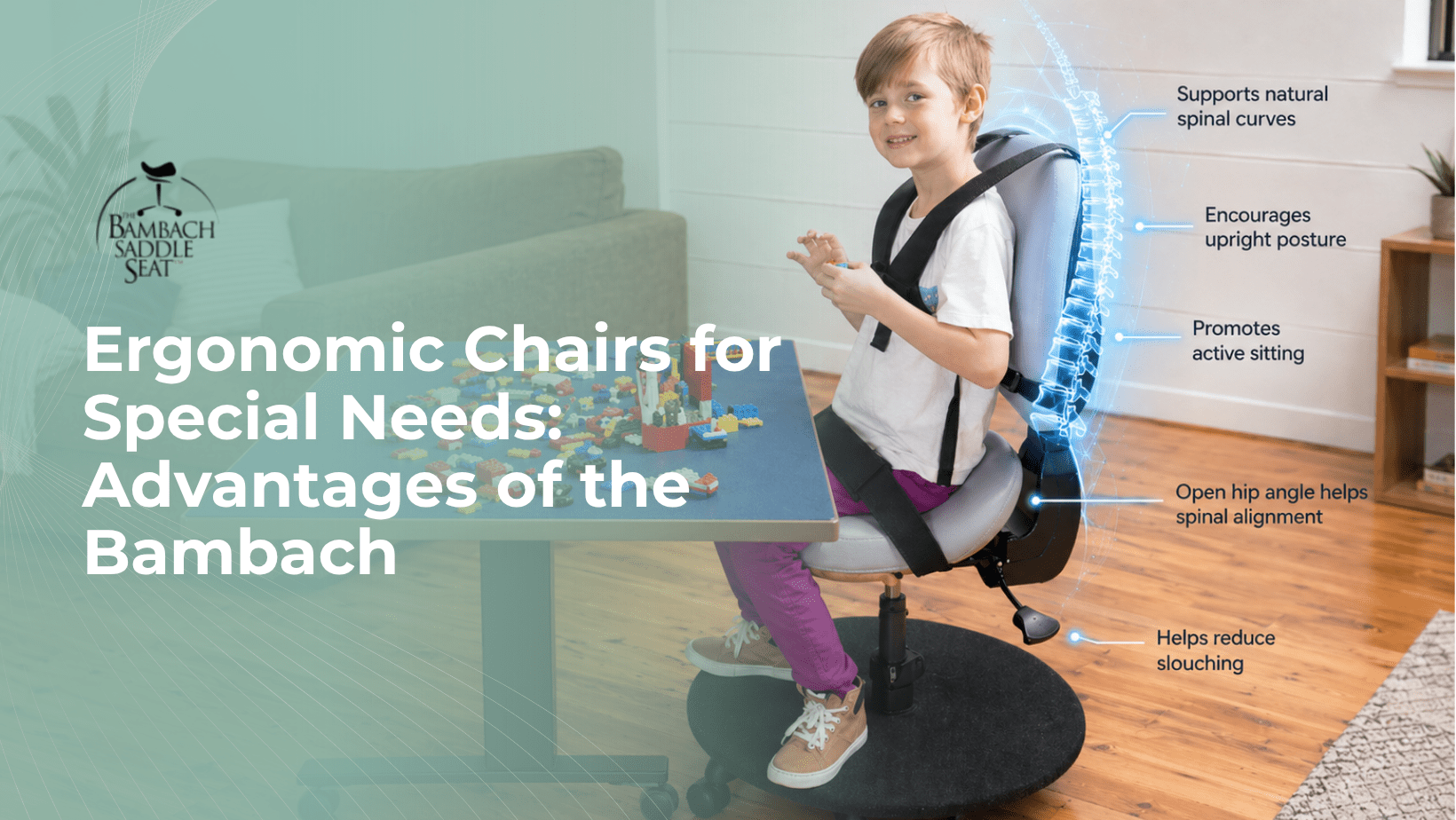
Ergonomic Chairs for Special Needs: Advantages of the Bambach

The Foundation of Healthy Postural Support

All individuals need optimal postural seating. This requirement is especially critical for people living with physical impairments. Correct seating actively prevents physical deformities from developing or deteriorating over time.

A secure, neutral pelvis forms the essential foundation of a healthy, balanced spine. Therefore, selecting the right ergonomic posture chair prevents secondary physical complications. Ultimately, proper seating transforms the quality of life for children and adults with special needs.

Health professionals and carers worldwide prescribe the Bambach Saddle Seat as an evidence-based posture chair. In fact, clinical case studies show dramatic physical improvements for individuals with mild to severe disabilities aged two to ninety years.

Today, we explore how the Bambach Saddle Seat delivers superior support for individuals with special needs.

Activating Natural Postural Control

First, the Bambach Saddle Seat provides exceptional postural control for users with disabilities.

Many custom-made disability seats are bulky and cumbersome to maneuver. Furthermore, these rigid seats often distort natural spinal alignment. As a result, traditional specialized seating impairs physical function and disempowers users.

In contrast, the Bambach saddle stool actively engages key postural muscles. These core muscles work in natural balance rather than staying inactive, as frequently occurs in standard wheelchairs.

We design our ergonomic posture chairs to stabilize the pelvis in an upright position. Consequently, this natural alignment places the hips in their optimal resting position of 45-degree flexion.

Special Needs Seating FeatureBiomechanical MechanismClinical & Functional Benefit

Pelvic & Core Activation


Stabilises the pelvis in an upright stance with 45° hip flexion.

Naturally engages core posture muscles instead of leaving them inactive.

Functional Improvements


Opens the chest and abdominal cavities to maximize internal space.

Enhances speech, swallowing, breathing, and digestion for daily activities.

Enhancing Daily Functional Activities

Additionally, an upright Bambach posture chair simplifies trunk and head control. As a direct result, users improve vital functional activities, including speech and swallowing.

Furthermore, this upright alignment opens the chest and abdomen to maximize internal space. Consequently, this position eases breathing and promotes healthy digestion.

Crucially, the saddle geometry allows individuals to bend forward from the hips rather than slumping at the waist. Therefore, both children and adults maintain effortless balance while reading and writing, even when leaning forward over a desk.

Read our case studies to learn more about how the Bambach ergonomic desk chair can improve postural control.

AFRDI Level 6 Certified Bambach saddle seat for special needs

Promoting Independent Sitting and Coordination

Furthermore, the Bambach saddle stool delivers major functional improvements for individuals living with special needs. Our range of saddle seats actively encourages independent sitting. In addition, this posture facilitates upper limb movement and hand coordination.

By promoting an upright stance, the chair actively engages core muscles. Consequently, it prevents the collapsed muscle state common in standard chairs or wheelchairs.

Enhancing Internal Organ Function and Circulation

Crucially, the Bambach Saddle Seat opens up thoracic, abdominal, and pelvic spaces. As a direct result, users experience marked improvements in internal organ function.

Specifically, maintaining an open torso posture enhances breathing, digestion, lung capacity, and blood circulation.

Optimising Balance, Symmetry, and Sensory Control

Additionally, our saddle stools position the body’s centre of gravity directly over the sit bones. Therefore, this natural alignment promotes balance, spinal symmetry, and fine-motor dexterity.

Furthermore, active sitting significantly reduces postural fatigue. It encourages ongoing muscle activity while enabling full plantar foot contact for partial weight bearing.

In addition, providing greater sensory input helps reduce involuntary motor responses. Ultimately, these combined functional benefits transform daily quality of life for individuals, families, and carers alike.

Each Bambach chair is tailored specifically to meet individual needs and requirements. Browse our range of ergonomic desk chairs to find the best saddle stool for you.

Bambach saddle chair for special needs

Positive Social and Psychological Impact

Another advantage of the Bambach is the way it can positively impact the self-esteem and independence of users. This is particularly important for the healthy psychological development of children. Most disabled children wish to be as much like other children as possible, participating in school activities, excursions, family outings and other activities like their peers. Wheelchairs can inhibit socialisation, with disabled children unable to easily see or communicate with others because of the bulk of the seat. With a Bambach posture chair, maintaining an upright posture, eye contact and speech all become easier, making socialising more natural. 

We pride ourselves on providing the best ergonomic office chair to facilitate enhanced functional ability and mobility. In conventional seating, poor posture can inhibit writing, drawing and the use of educational equipment, resulting in learning deficiencies. With a saddle stool, writing, schoolwork and performance in hobbies improve due to increased efficiency and the ability to control the upper body and arms in an upright, stable position. The Bambach Saddle Seat can also improve self-esteem in users, who are able to perform personal self-care tasks such as meal preparation, washing and dressing more easily than in a wheelchair. 

On our Bambach Accessories page, you will find a range of special needs accessories to increase mobility including the H-harness, which offers additional body stability, and the LAP Strap, for our customers who require the option of being clipped into their seat for safety or added pelvic support. 

AFRDI Level 6 Ergonomic Chairs for Special Needs

Growth In Children And Adolescents

Finally, using the Bambach Saddle Seat can stimulate normal bone growth in children and adolescents. In both children and teenagers, muscles and tendons often grow at unpredictably differing rates. Conventional seating and wheelchairs are not designed to allow for healthy growth, which can create deformities in the future. In a Bambach posture chair, muscle activity and movement is increased due to the dynamic sitting position, stimulating bone growth. Muscle length and range of movement in the joints are also maintained in our ergonomic desk chair because of the half-stand position of the Bambach, righting reactions as well as midline alignment.

The Bambach is the original saddle seat, designed and manufactured in Australia by occupational therapist Mary Gale. Our saddle stools are tested by AFRDI to the highest standards and are recommended by health professionals worldwide. 

Contact one of our experienced staff members today to discuss how the Bambach Saddle Seat can be customised to suit individuals and help a wide range of special needs conditions. It is also recommended that you contact your healthcare provider, as you may be eligible for funding and a trial of a posture chair in your home, workplace or school.


Yes. When a user slumps in a standard wheelchair, their chest cavity collapses onto their abdomen, physically compressing their internal organs. The Bambach's continuous saddle contour naturally lifts and lengthens the spine, which opens up the chest and abdomen. Maintaining these open thoracic and pelvic spaces has been clinically shown to improve circulation, make breathing deeper and less laborious, and aid in healthier digestion. 

Read more about the science behind this on our Research & Clinical Studies page.

Traditional wheelchairs, while necessary for transport, are often bulky and can inhibit natural socialization by keeping the user in a lower, slumped, and sometimes passive posture. The Bambach chair enables an active, upright, "half-stand" position that puts the user at eye level with their peers. This makes eye contact, speech, and classroom interaction much more natural. You can see the real-world impact of this independence in our Patient Case Studies.

Standard wheelchairs are generally static and do not accommodate or encourage healthy, active growth, which can sometimes lead to progressive joint deformities. The dynamic sitting position of the Bambach Saddle Seat increases healthy muscle activity and movement, which is essential for stimulating normal bone growth. The midline alignment also helps maintain proper joint range of movement and muscle length as the child grows. 

To find the perfect fit for a growing child, visit our Choose The Right Model guide.

Absolutely. We understand that every body is unique, so every Bambach chair can be tailored to meet specific individual requirements. We offer a comprehensive range of custom Bambach Accessories to increase mobility and safety. For instance, users can add an H-harness for extra thoracic stability, a customized backrest, or a LAP Strap to clip into the seat for secure, added pelvic support.

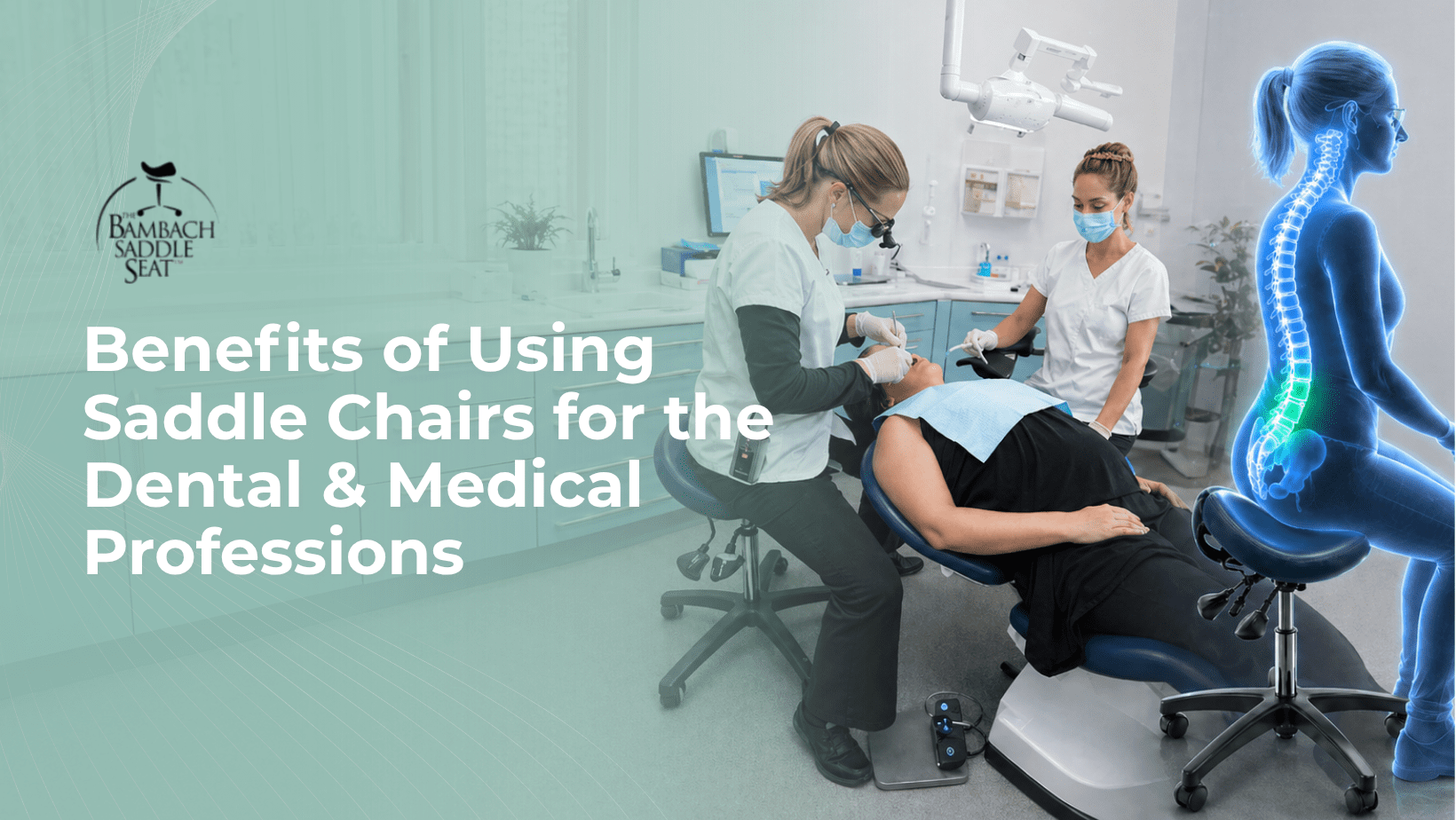
Benefits of Using Saddle Chairs for the Dental & Medical Professions

Healthcare professionals work under intense physical demands. Consequently, the medical and dental sectors report some of the highest back injury rates in Australia.

We engineer our saddle chairs specifically to protect your spine. Whether you work as a dentist, physiotherapist, sonographer, radiologist, or veterinarian, Bambach provides tailored ergonomic support.

Tailored Seating for Maximum Clinical Longevity

The Bambach Saddle Seat adapts to any clinical environment. We customize each chair to match your height, workstation, and daily tasks.

Choosing dynamic pelvic support boosts comfort and daily productivity. Crucially, correct seating prevents workplace injuries and protects your career against early retirement.

Today, we explore how Bambach seating transforms health outcomes in dental and medical practices.

Protecting Dental Professionals from Spinal Strain

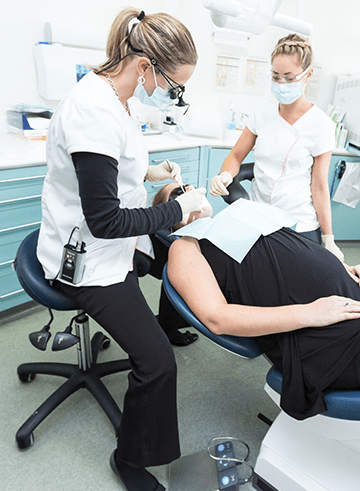
Dentistry demands absolute precision and deep focus. Clinicians perform lengthy procedures in static postures that strain spinal discs, joints, and muscles. Consequently, dentists frequently suffer from chronic pain in the lower back, neck, shoulders, and hands.

Dentists often lean toward patients to improve visual clarity. Unfortunately, standard dental chairs worsen this posture by collapsing the spine into a weak “C” curve.

Switching to a Bambach Saddle Seat restores natural spinal function and boosts daily efficiency. Dental hygienists enjoy close patient access with minimal bending.

The solid contour supports your pelvis in neutral balance even when leaning forward. As a result, upright posture enhances hand dexterity, precision, and clinical mobility.

Over 50,000 dental professionals worldwide rely on Bambach saddle seats every day.

Read our dental case studies to see how dynamic seating protects your practice.

Saddle stool for dental practice

Dynamic Seating for Medical Professionals

Medical work demands extreme physical flexibility. Healthcare teams often work at varying heights, stand for long hours, and move constantly between tasks.

Surgeons, nurses, podiatrists, and general practitioners frequently operate below standard desk levels. For example, clinicians bend low to operate dialysis equipment or treat bedbound patients.

Unfortunately, traditional task chairs restrict movement. This posture creates severe neck and lower back strain.

Hospitals frequently deploy the Bambach as a versatile medical stool. It excels in medical imaging, laboratories, bedside care, and neonatal units.

The straddle posture stabilizes your legs and feet. Consequently, clinicians reach safely and move freely around patient beds. Furthermore, active seating accelerates rehabilitation and supports injury recovery.

Today, over 200 hospitals trust Bambach across more than 20 medical departments. We offer specialized hospital accessories, including foot-rings, swing arms, lockable castors, and custom gas stems.

Precision Ergonomics for Optical Specialists

Opticians, optometrists, and ophthalmic surgeons frequently adopt poor ergonomic habits. Delicate eye procedures require absolute stability and fine hand coordination.

Standard office chairs fail during laser surgery or intricate eye examinations. They force your upper body to hunch, making precise positioning difficult.

The Bambach Saddle Seat provides the ideal seating solution for optical practices. The continuous contour positions your arms at a natural, comfortable angle. As a result, you eliminate strain across your shoulders, neck, and lower back.

A low Bambach stool also allows effortless movement around the consulting room. The wide straddle base keeps your body balanced during delicate procedures.

We offer the Bambach in four seat sizes and over 100 upholstery options. Practitioners can select surgical-grade vinyl to meet strict clinical sanitation standards.

Whether you work in surgery, consulting, or a busy dispensary, Bambach delivers superior spinal support. Find out more about the benefits of using our saddle chairs in this FAQ post.

Bambach original low saddle seat

Protecting Medical Imaging Specialists from Chronic Pain

Incredibly, over 95% of medical imaging workers suffer from workplace musculoskeletal injuries. Sonographers and radiologists routinely lean forward, reach, and hold awkward static postures. Consequently, these daily physical demands frequently cause debilitating chronic pain.

Biomechanical Advantage in Scanning Environments

The Bambach Saddle Seat serves as an ideal sonographer stool and radiologist chair. It restores healthy spinal alignment while expanding your reach during scans. Furthermore, dynamic sitting engages deep core muscles, actively improving muscle tone throughout the workday.

We engineer our saddle seats specifically to meet strict Australian WHS requirements. For example, we fit shorter adjustment paddles so you can maneuver right up to patient beds. Additionally, optional swing arms reduce spinal strain during prolonged forward leaning.

We also offer multiple height options and specialized castors for shared scanning rooms. Today, over 150 Australian medical imaging departments and private practices trust Bambach. You can choose models with or without backrests to suit your workflow.

Preventing Occupational Injuries in Veterinary Clinics

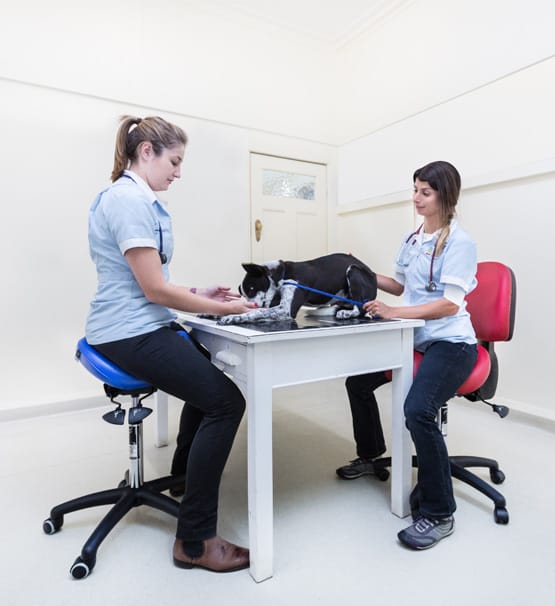
Veterinarians devote their lives to animal care, often putting patient health ahead of their own. As a result, 67% of veterinary surgeons suffer workplace musculoskeletal injuries. Holding static postures during lengthy clinical procedures primarily drives this injury rate.

Preserving Spinal Function and Clinical Stability

Upgrading to an ergonomic saddle stool prevents neck, shoulder, and lower back strain. Consequently, clinicians boost daily efficiency and safeguard their physical wellbeing.

The Bambach Saddle Seat supports your pelvis and maintains your spine’s natural “S” curve. It keeps your joints in neutral balance, significantly reducing physical fatigue during surgery.

Furthermore, an open hip posture promotes healthy blood circulation and increases physical stability when handling patients. Currently, over 300 veterinary practices across Australia rely on Bambach ergonomic seating.

Ergonomic Saddle Stool

The Bambach is the original saddle seat, designed and manufactured in Australia by occupational therapist Mary Gale.

Bambach chairs are tested by AFRDI to the highest standards and are recommended by health professionals worldwide. To find the best Bambach seating solution for you, use our online seat calculator to choose a chair model or Contact Us today.


An incredible 95% of professionals in medical imaging suffer from musculoskeletal injuries due to leaning, reaching, and holding unnatural postures. The Bambach Saddle Seat engages your core muscles for active sitting, allowing for balanced scanning and increased reach without strain. It can be customized with a swing arm, shorter adjustment paddles to get closer to beds, and specialized castors to meet Australian WHS requirements. 

Use our Choose The Right Model guide to find the perfect fit for your scanning room.

Yes. Traditional seating is often poorly suited for delicate procedures like eye or laser surgery. The Bambach Saddle Seat allows ophthalmic surgeons and opticians to work with their arms at a natural angle and height, heavily reducing neck, shoulder, and lower back strain. Additionally, the wide straddle stance provides excellent balance and mobility. Our seats are available in over 100 variations, including surgical-grade vinyl. 

Explore our Colours and Fabrics to match your clinic's aesthetics.

Around 67% of veterinary surgeons experience workplace musculoskeletal injuries due to holding static postures while treating animals. The Bambach saddle stool allows your spine to easily maintain its natural 'S' shape and keeps your joints in balance, significantly reducing fatigue. The open hip position also promotes healthy blood circulation and increases your stability during animal care. 

Discover more about our specialized solutions on our Veterinary Professions page.

Absolutely. The Bambach Saddle Seat is currently trusted in over 200 hospitals across more than 20 different departments. Because medical work requires varying heights—from low bedside chairs to neo-natal stools—we offer a comprehensive range of Bambach Accessories. This includes foot-rings, swing arms, specialized castors, and multiple height options to ensure safe, easy reaching and total mobility in any fast-paced medical setting.

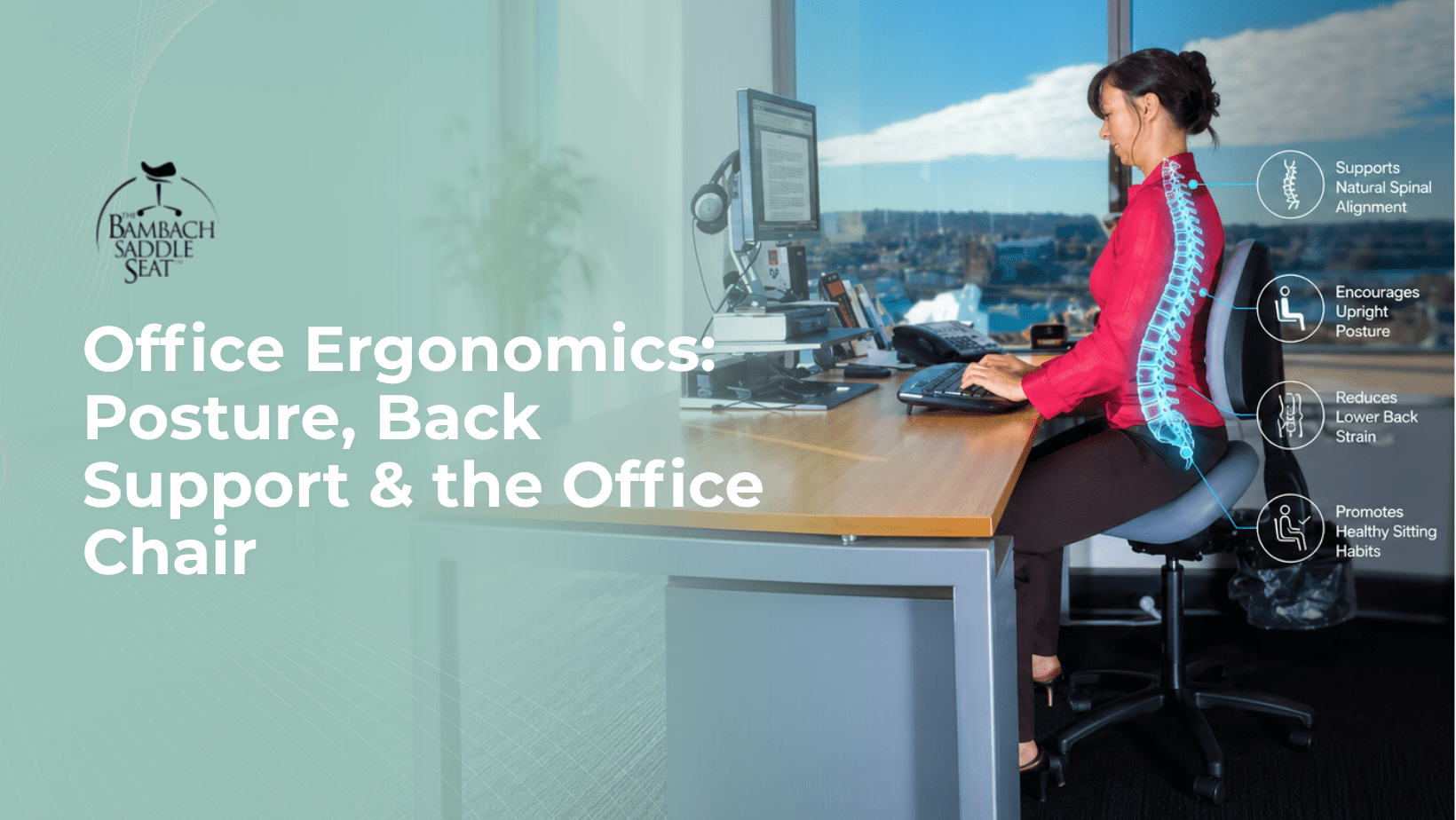
Office Ergonomics: Posture, Back Support & the Office Chair

In the modern workplace, people can spend up to 70% of their day sitting at their desk in front of a computer. This shift in the way we work has resulted in an increase in posture-related injuries, as well as a heightened awareness of the importance of ergonomics for office workers. The use of ergonomic office furniture, including an ergonomic office chair such as the Bambach Saddle Seat, is more important than ever before to maintain good health during our working lives. Whether you work in a corporate, SME or home office environment, poor ergonomics can impact on your productivity, quality of life and overall health, leaving you with mild to debilitating chronic pain.

This month, we discuss how to improve ergonomics in the office, including posture, back support and the best office chair for lower back pain:


Conventional vs Ergonomic Office Chairs

Ergonomic experts agree that although conventional office chairs are useful to relieve the fatigue of standing, they are a potential cause of back pain and trauma due to an increase in intradiscal pressure on the spine. This can in turn result in disc displacement, disc prolapse and damage to the sciatic nerve. When sitting on a conventional office chair for a long period of time we tend to slouch or hunch forwards, which overstretches the spinal ligaments, and strain the discs and surrounding structures of the spine. Over time, this can cause damage to the spine and significantly contribute to back, neck and shoulder pain. In comparison, an ergonomic office chair like the Bambach Saddle Seat supports the natural curve of the spine, improving your posture and reducing back pain.To learn more, see our post on the benefits of using ergonomic office chairs.


Body-Conscious Seat Design

It seems like common sense that people should not hold unnatural positions for long periods of time. The price of postural stress on the body is often paid for by not being able to perform activities that we want to do outside of work, like picking up a child, travelling, enjoying leisure activities or even just being able to relax watching TV. However, the majority of ergonomic office chairs available can actually end up increasing postural stress. Some ‘ergonomic’ chairs support the lumbar curve by pushing into your back, while alternative ergonomic seating such as kneeling chairs and bicycle seats can put sustained pressure on your joints and become uncomfortable to use over the working day. At Bambach, we are interested in body-conscious seat design. Our saddle seats are designed to improve the productivity, mobility and health of workers across a range of industries by creating the ideal sitting posture. 

Bambach saddle seat for back support


Improving Seated Posture at Work

Although standing desks are becoming more popular across workplaces, there are a number of advantages to sitting down to work. Sitting relieves the joints of the lower limbs from load bearing, reduces energy consumption which in turn lowers demands on the respiratory and vascular systems, provides greater stability and a better range of movement, and prevents you from working in unnatural positions. The design of our saddle seat allows you to sit naturally and comfortably, while improving your seated posture and even enhancing muscle tone due to the active seating position. In a saddle stool, your spine maintains its natural ‘S’ shape, with all your major joints in a neutral, stress-free position. Our philosophy is to give people a sound ergonomic seating solution with the Bambach Saddle Seat, which encourages correct seating posture instead of the slouching and hunching caused by conventional office seating.


Avoiding Lower Back Pain

In the office, one of the worst things you can do is end up in a prolonged static posture. The body can only tolerate staying in the same position for a short amount of time before stress begins to build in the muscles, tendons and ligaments of the back, eventually turning into discomfort and then pain. Investing in an ergonomic office chair will help you avoid postural stress and back pain, as will adopting the habit of taking frequent breaks to stand, stretch, walk and change positions during your work day. The best chair for lower back pain is one which is customised for your individual use. Every saddle seat created by Bambach is tailored to its user, with multiple stem heights, four seat sizes and a range of accessories available. We ensure that your seat fits all your personal attributes and applications, including gender, height, occupation, environment and workstation. 

Bambach original saddle chair for corporate


Back Support and the Office Chair

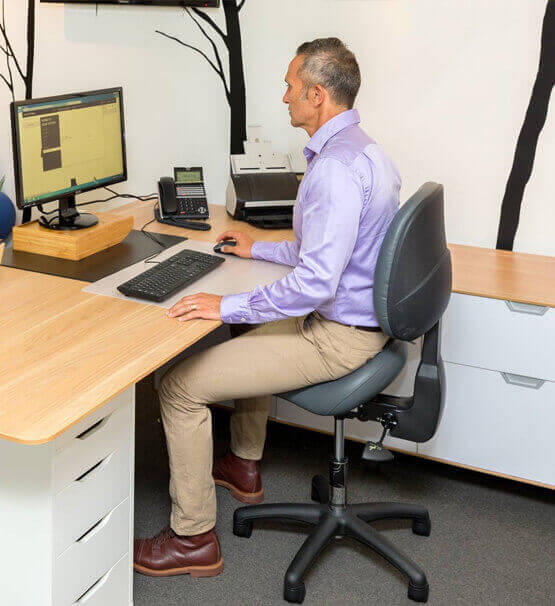
When choosing an office chair, back support is another important consideration. Unlike other ergonomic chairs, the groundbreaking design of the Bambach Saddle Seat supports the lumbar curve of the spine through the straddle posture and open hip angle of the seat. Purpose-designed to position the pelvis in an upright, neutral position and keep it there, back support is provided by the saddle stool and your upright posture on the seat. Therefore for most work which involves sitting or leaning forward, you should not need a backrest. We supply saddle seats both with and without backs to accommodate different requirements. In order to get used to the new seating position, we recommend a period of a few weeks to adjust to using your saddle stool. You can also choose a saddle seat with a backrest, to use as a rest point during the day when thinking or in a meeting.   


Increasing Comfort and Productivity at Work

Improving the ergonomics of your office can have a range of benefits, including increasing your comfort, focus and productivity at work. Bambach Saddle Seats can help improve work performance in three significant ways. Firstly, using a saddle stool helps to reduce fatigue, opening up the chest to improve breathing and circulation. As a result of the muscles and joints being in balance, a saddle seat also helps increase dexterity for those undertaking task work or procedures requiring a high level of precision. Finally, our ergonomic office chairs improve your mobility and reach no matter what your profession is, ensuring free movement around your workspace while maintaining stability.

Bambach saddle chair with back support


The Bambach is the original saddle seat, designed and manufactured in Australia by occupational therapist Mary Gale. Our ergonomic office chairs are tested by AFRDI to the highest standards and are recommended by health professionals worldwide. To find the best saddle seat for you, use our online seat calculator to choose a chair model or Contact Us today.


The Bambach Saddle Seat directly counters postural collapse by allowing the knees to drop lower than the hips, establishing a highly stable and balanced pelvic position. This biomechanical shift naturally maintains the spine in its healthy, original "S" shape, keeping all major joints in a neutral, stress-free alignment. It prevents hunching and slouching. Furthermore, long-term use actively strengthens your back and core muscles. 

Discover exactly how this alignment works on our Office Seating Solutions page.

While passive, slumped sitting is detrimental, sitting with correct alignment provides critical ergonomic benefits.

  • It relieves the joints of the lower limbs from continuous, heavy load-bearing.
  • It prevents workers from having to adopt unnatural positions.
  • Sitting reduces overall energy consumption, which lowers the physical demands placed on the respiratory and vascular systems.
  • It provides the worker with far greater core stability and an improved range of movement for desk-based tasks.

Yes, every Bambach ergonomic office chair can be tailored to lead to a more productive and pain-free work environment. The seat is fully customized to suit the individual user by offering four different seat sizes alongside multiple stem heights. Whether you are outfitting a large corporate organisation, a small business, or a home setup, you can personalize the chair with hundreds of colours, varying fabric options, and a huge variety of accessories to suit your needs. 

Use our Choose The Right Model guide to build the exact chair your body and workspace require.

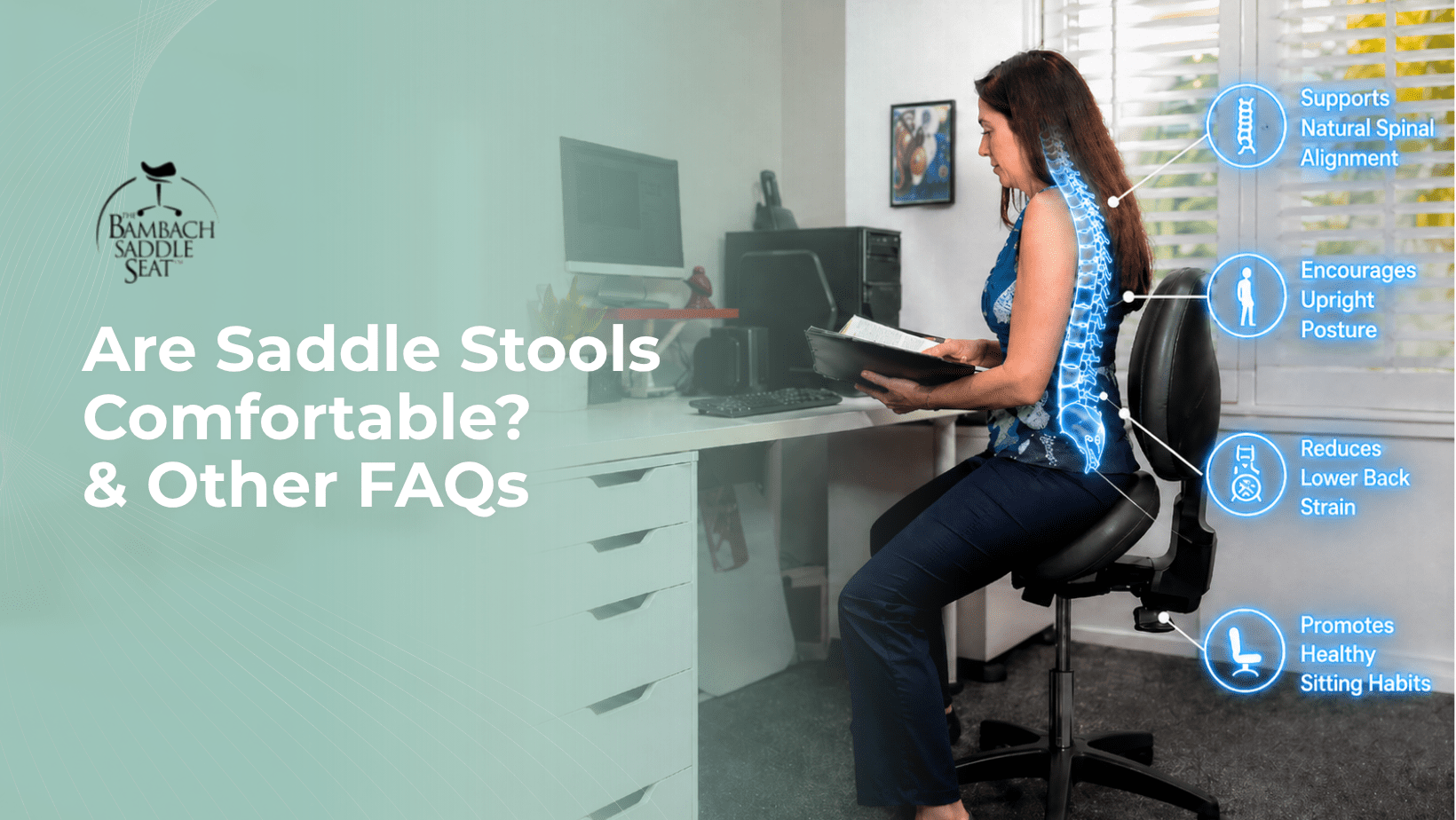
Are Saddle Stools Comfortable? & Other FAQ

The Bambach Saddle Seat was the first of its kind in the world, and experts agree that it continues to lead the way in seating practice today. The Bambach is customised specifically for the needs of our customers, made to support your body, health and profession. Guaranteed for quality assurance, our range of saddle stools are ergonomically sound, tough, durable and safe. With or without a back, the Bambach range provides the right seat for any environment or purpose.

This month, we answer some frequently answered questions about the Bambach Saddle Seat:


Are saddle seats good for your back?

Bambach Saddle Seats support and encourage correct seating posture, making it a sound ergonomic seating solution for both children and adults. If you suffer from pain in your back, neck or upper limbs, then you could benefit from switching to a saddle seat. Our saddle seats are ideal for people whose work requires frequent reaching, varying work heights, close and accurate task work, long periods of standing, or has their work spread over a large area. A saddle seat will give you perfect posture along with the ability to use your hands for task work, and is suitable for a wide range of professionals including dentists, surgeons, lab workers, hairdressers, artists, therapists, veterinarians and teachers.


Are saddle stools comfortable?

Our customers find our saddle stools very comfortable, because of the way the Bambach helps improve posture, and minimises back and upper body pain. If you have been sitting with poor posture for many years, your body will need time to adjust, and it may take a few weeks to get used to your new saddle stool. We recommend an adjustment period of two weeks, using the saddle chair no more than one hour a day, and alternating between the Bambach and a flat seat. Explore all seat tilt and height variations to find what suits you, and consider investing in the sheepskin seat cover, which will both soften the seat and widen the support surface. You may feel tight in the hips and thighs at first, but these muscles and ligaments will stretch out and relax as your body adjusts. We also recommend not using the backrest of your saddle stool for the first few weeks, in order to help you adjust to your Bambach.


How do you sit on a saddle stool?

Bambach Saddle Seats differ from conventional seating in several ways. On a saddle stool, you sit higher than in a standard office chair, with your knee joints at a 45 degree angle. This ensures that your pelvis is supported in a neutral upright position. You may need to raise your computer screen or office desk to benefit from your saddle chair. If you usually work standing or on a high drafting stool, you can use your Bambach with a foot ring. If your work height is lower than recommended, you may need to tuck your feet under your saddle stool. As long as the knees are positioned lower than the hips, the benefits of using a saddle seat will still be achieved. To learn more, see our previous blog post on the benefits of using an ergonomic office chair.


How can I sit without back support?

The groundbreaking design of the Bambach Saddle Seat allows our customers to sit supported in comfort without back support. Unlike traditional ‘ergonomic’ chairs, which supports the lumbar curve by pushing into your back, the saddle seat supports the lumbar curve through the open hip angle and straddle posture. This position rotates the pelvis upright, keeping the spinal column in its neutral curves, opening up the chest and abdomen to allow full function of the lungs, and assisting in blood and lymphatic circulation. The active position of the saddle chair will also help enhance your muscle tone. Although you should not need a backrest for most upright and forward work, you can choose a Bambach with a backrest to use as a rest point while you think, listen or talk.

Bambach low saddle stool for home office


Are kneeling chairs bad for you?

Alternative ergonomic seating, including kneeling chairs and bicycle seats, do not support as many correct postures as the Bambach Saddle Seat. A kneeling chair puts sustained pressure on the knees, and locks your feet in underneath you. Getting in and out of a kneeling chair is difficult as your feet can become entangled in the kneeling pad. Similarly, bicycle seats can be uncomfortable over a long period and do not provide adequate stability. However, using a saddle seat puts no pressure on the knees, leaves your feet free to operate equipment or move around your work area, and supports and stabilises your body with its high, saddle posture. The hip joints rest in a relaxed, open position, and the spine is in perfect balance. The unique seat contour of the saddle chair will ensure that you bend forward from the hips, not from your back, creating the ideal sitting posture.


Are there different saddle stool sizes?

The Bambach range is available in four different saddle stool sizes, to fit everyone from small children to large adults. The Executive size seat is our most male-friendly seat, which is more anatomically comfortable for some men. To ensure that you benefit from your Bambach Saddle Seat, make sure that your clothing does not interfere with your hip abduction (leg spread). It is your hip abduction that stabilizes the pelvis and allows the spine to rest in a natural posture, ensuring your hip joints are in their ideal alignment in their sockets. As hip abduction decreases, the spine becomes less stable, the pelvis tilts backwards and the hip joints move out of ideal close contact. To benefit from your saddle stool, it is best to wear loose trousers or a wide skirt. For more tips on choosing the best saddle chair for you, see our helpful video guide.

Bambach original saddle chair for corporate


The Bambach is the original saddle seat, designed and manufactured in Australia by occupational therapist Mary Gale. Bambach chairs are tested by AFRDI to the highest standards and are recommended by health professionals worldwide.

To find the best Bambach seating solution for you, use our online seat calculator to choose a chair model or Contact Us today.

Benefits of Using Ergonomic Office Chairs

As modern work lives become increasingly sedentary, establishing a healthy ergonomic environment becomes vital. At Bambach Saddle Seat, we deliver proven ergonomic solutions that encourage natural seating posture.

Furthermore, we customise each saddle seat to match your height, gender, occupation, and workstation layout. Consequently, professionals trust Bambach chairs across offices, dental surgeries, hospitals, veterinary clinics, and art studios.

In this opening guide, we explore the primary workplace health benefits of dynamic ergonomic seating.

Dramatically Improves Daily Posture

First and foremost, sitting on a Bambach chair significantly improves your posture. Traditional “ergonomic” chairs attempt to support your lower back by pushing directly into your spine. Instead, the Bambach saddle seat allows your spine to function naturally without restrictive back pads.

Effective task seating must position your centre of gravity directly over your sit bones. Consequently, this stance rotates your pelvis into an upright, neutral balance. As a result, your spine maintains its healthy “S” curve instead of collapsing into a crunched “C” shape.

In addition, dynamic seating places your joints in a stress-free position throughout the workday. Furthermore, the active sitting posture keeps your stabilizer muscles engaged, helping you build core muscle tone while you work.


Enhances Productivity

Another benefit which comes with using the Bambach Saddle Seat is enhanced productivity. Because the spine is held in a neutral position, breathing and circulation improves, reducing fatigue and allowing you to concentrate on your work. Our chairs also ensure that you can function optimally, with major joints at minimum stress enabling you to easily perform tasks. If your work involves a lot of reaching, varying work heights, long periods of standing, getting up and down from your seat or close work requiring accuracy and excellent hand-eye coordination, then you will especially benefit from our range of ergonomic office chairs.

Bambach low saddle seat for SME


Reduces Back Pain

Most of us spend up to 70% of their day at work sitting, which has resulted in a large increase in posture-related injuries and more people requiring an office chair with back support. Our tendency to slouch or hunch over when sitting for long periods can cause damage to the spine over time. This poor posture also contributes to shoulder, neck and back pain, as well as impacting on our productivity, overall health and quality of life. If you are looking for the best office chair for lower back pain, then you could benefit from using the Bambach Saddle Seat. The ergonomic design of our saddle seats allows your body to sit naturally and comfortably, providing a solution to poor posture and back problems.


Increases Dexterity and Mobility

For a range of professionals including dentists, vets, opticians, radiologists, chiropractors, general practitioners, massage therapists and hospital workers, mobility and dexterity are crucial. The Bambach Saddle Seat is the best ergonomic office chair to help increase your dexterity and precision in the workplace, as a result of muscles and joints being in balance. Our chairs support and stabilise your body, freeing your hands and feet for work and movement. The straddle posture improves hand accuracy and power as well as improving sitting balance, making it easy to move about your workspace, reach equipment or operate a foot switch as needed.


Provides Greater Stability

Bambach chairs also provide you with greater stability compared to conventional office chairs. Although standing desks are currently popular, ergonomic experts argue that sitting down to work has a range of benefits including relieving the lower limb joints from load bearing, reducing energy consumption, providing a better range of movement and stability for the worker, and preventing you from working for an extended amount of time in unnatural positions. Unlike alternative ergonomic seating options such as kneeling chairs, which are difficult to use and put pressure on the knees, or bicycle seats which tilt the pelvis back into an unstable position, the Bambach Saddle Seat is an office chair which provides back support while keeping your legs stable, ensuring free movement as well as safe and easy reaching.

Tattooist using Bambach saddle seat


Customisable to Suit Your Workplace

The final benefit of using the Bambach Saddle Seat is its ability to be easily customised to suit your workplace.The contemporary design of our saddle seats can be easily integrated into any office and customised to suit innovative fit-outs. Bambach is the only saddle seat which is custom-made to suit your individual needs and requirements, available in four different sizes, seven different stem heights, and a wide variety of colours, fabrics and accessories. Whether you are looking for the best office chair for lower back pain, an ergonomic office chair which will improve your posture and productivity, or a saddle seat which will give you the dexterity and mobility you need in the workplace, there is a Bambach to suit you.

The Bambach is the original saddle seat, designed and manufactured in Australia by occupational therapist Mary Gale. Bambach chairs are tested by AFRDI to the highest standards and are recommended by health professionals worldwide. To find the best Bambach seating solution for you, use our online seat calculator to choose a chair model or Contact Us today!


  • Yes, enhanced productivity is a major benefit of the Bambach Saddle Seat.
  • By holding your spine in a neutral position, the chair naturally improves both breathing and circulation.
  • This reduces daily fatigue and allows you to concentrate fully on your tasks.
  • It is especially beneficial if your work involves a lot of reaching, varying work heights, or close tasks requiring accuracy and excellent hand-eye coordination.

  • Most office workers spend up to 70% of their day sitting, which often leads to slouching and long-term spinal damage.
  • This poor posture contributes significantly to shoulder, neck, and lower back pain.
  • The ergonomic design of the Bambach provides a direct solution to this by allowing the body to sit naturally and comfortably, making it one of the best choices for lower back pain relief. Discover our complete range of Office Seating Solutions.

  • By keeping your muscles and joints perfectly in balance, the chair supports your body while completely freeing your hands and feet for movement.
  • The unique straddle posture improves your overall sitting balance, as well as hand accuracy and power.
  • This makes it effortless to reach equipment, operate foot switches, and move about your workspace, which is crucial for professionals like dentists, vets, and massage therapists.

  • Absolutely. While standing desks are popular, sitting down to work relieves your lower limb joints from heavy load-bearing and reduces overall energy consumption.
  • Unlike kneeling chairs, which are notoriously difficult to use and put damaging pressure on the knees, the Bambach Saddle Seat provides incredible stability.
  • It also outperforms bicycle-style seats, which tend to tilt the pelvis backward into an unstable position. The Bambach provides full back support while keeping your legs grounded and stable. Use our Choose The Right Model guide to find the perfect fit for your body type.

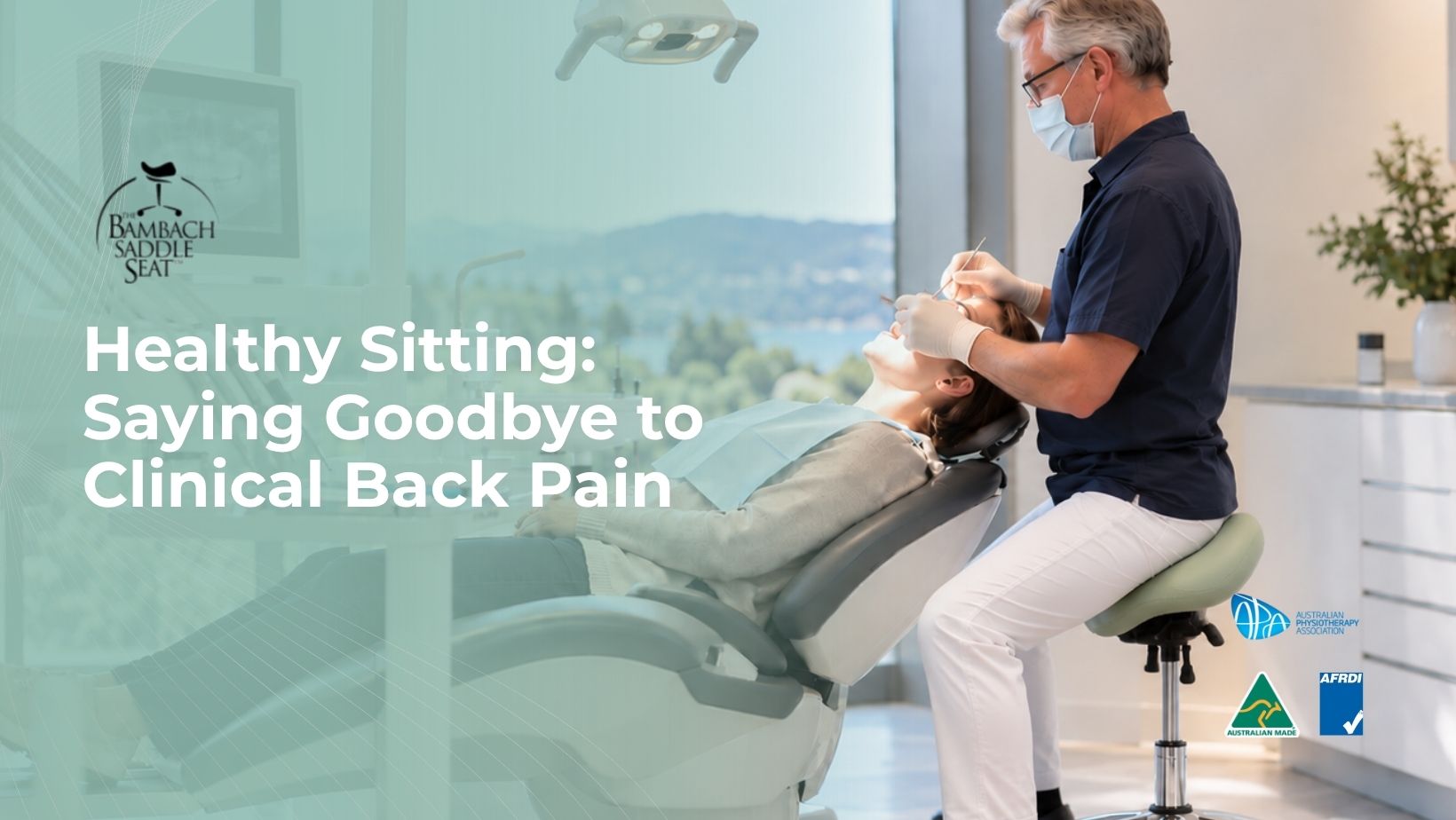
Healthy Sitting – Goodbye to Back Pain

Article by Dr. Hans H. Sellmann, Marl, Germany. August 2015

The Hidden Toll of 30 Years in Dental Practice

Clinical practice places severe physical strain on the human body. Consequently, dentists, hygienists, and dental assistants frequently suffer from chronic lower back and neck pain.

In fact, three decades in dental practice left permanent physical marks on my posture. My right shoulder sloped significantly from slumping over patients. Furthermore, traditional operator chairs exacerbated my spinal strain.

However, I finally found a permanent solution in the Bambach Saddle Seat. This revolutionary chair actively restores upright posture and eliminates daily fatigue.

The Equestrian Secret to Postural Alignment

Equestrians demonstrate exceptional posture while riding horses. Specifically, horse riders sit perfectly upright without conscious effort.

The secret lies entirely in the saddle shape. The saddle naturally rotates the rider’s pelvis forward. Consequently, this position preserves the spine’s natural “S” curve without muscular strain.

Australian Occupational Therapist Mary Gale researched this exact phenomenon. She noticed that individuals with severe physical disabilities could sit unassisted on horseback.

Therefore, Mary Gale engineered the Bambach Saddle Seat. She replicated equestrian geometry to support the human spine in clinical environments.

Posture & Biomechanical Factor

Flat Office Chair (90° Angle)

Bambach Saddle Seat (135° Stance)

Pelvic Positioning

Pelvis tilts backward into an unhealthy “C” curve.

Pelvis rotates forward into neutral balance.

Spinal Alignment & Disc Load

Compresses L4/L5 lumbar discs under high structural pressure.

Preserves the healthy, upright “S” curve of the spine.


How the Bambach Saddle Seat Transforms Clinical Health

The Bambach Saddle Seat delivers immediate biomechanical relief. It supports the natural position of your pelvis and spine while seated.

Crucially, dynamic saddle seating significantly reduces intervertebral disc pressure. It prevents the slumping posture that drives daily back pain.

During long surgical procedures, the Bambach maintains comfortable spinal support. As a result, clinicians finish demanding treatment days without lower back fatigue.

“The Bambach Saddle Seat provides elimination and prevention of back pain and decreases the pressure on the intervertebral disc significantly.” — Dr. med. dent. Hans H. Sellmann

Customising the Bambach Stool for Your Practice

Bambach Model Variant

Key Ergonomic Feature

Ideal Clinical Application

Classic Model

Unbroken continuous saddle contour with rock-solid pelvic support.

General dentists, hygienists, and office workers seeking core stability.

Cutaway Model

Narrower seat curvature designed specifically for smaller frames.

Slender practitioners, female dental staff, and compact workstations.

Surgical Model

Integrated foot-control ring for hands-free height adjustment.

Operating theatres, sterile procedures, and dental surgery suites.

Backrest Option

Optional lumbar backrest or swing arm support for added relief.

Extended procedures, rehabilitation, and custom task support.

Furthermore, Bambach offers various gas stem heights and premium upholstery options. You can select surgical-grade, non-porous vinyl or high-grade leather in custom colours.

The Economic Cost of Poor Workplace Seating

Inadequate seating causes massive economic losses worldwide. For example, European healthcare systems spend billions annually treating posture-induced back problems.

Furthermore, poor seating leads to frequent sick leave and premature retirement. Investing in ergonomic seating protects both your physical health and business revenue.

Reclaim Your Spinal Health Today

Do not let improper operator chairs compromise your clinical career. Upgrade your dental practice with a scientifically proven seating intervention.

Explore our full range of Dental Ergonomic Saddle Chairs or read our Australian Case Studies to see how dynamic seating protects practice longevity.

Are you ready to eliminate clinical back pain? Contact our team today!

Read More

Why do dental professionals experience high rates of back pain?

Dentists subconsciously lean forward and twist their posture to view patient mouths. Standard flat chairs worsen this posture by collapsing the lower back into a weak “C” shape.

How does equestrian saddle geometry benefit human posture?

A saddle rotates the pelvis forward, opening the hip angle to 135 degrees. This naturally holds the spine in its upright “S” curve without requiring conscious muscular effort.

What is the difference between the Classic and Cutaway Bambach models?

The Classic model features our original continuous saddle contour. The Cutaway model features a narrower seat curvature tailored specifically for slender individuals or shorter frames.

Can I adjust the Bambach chair height without using my hands in surgery?

Yes. The Surgical Bambach model includes an integrated foot-control ring. This allows clinicians to adjust seat height while maintaining strict sterile conditions.

How does dynamic sitting reduce pressure on spinal discs?

By holding your pelvis in neutral balance, the saddle seat distributes body weight evenly through your sit bones. This removes peak compression loads from your L4/L5 lumbar discs.

Who invented the Bambach Saddle Seat?

Australian Occupational Therapist Mary Gale invented the Bambach Saddle Seat. She designed the chair after observing how horseback riding restored posture in patients with spinal conditions.

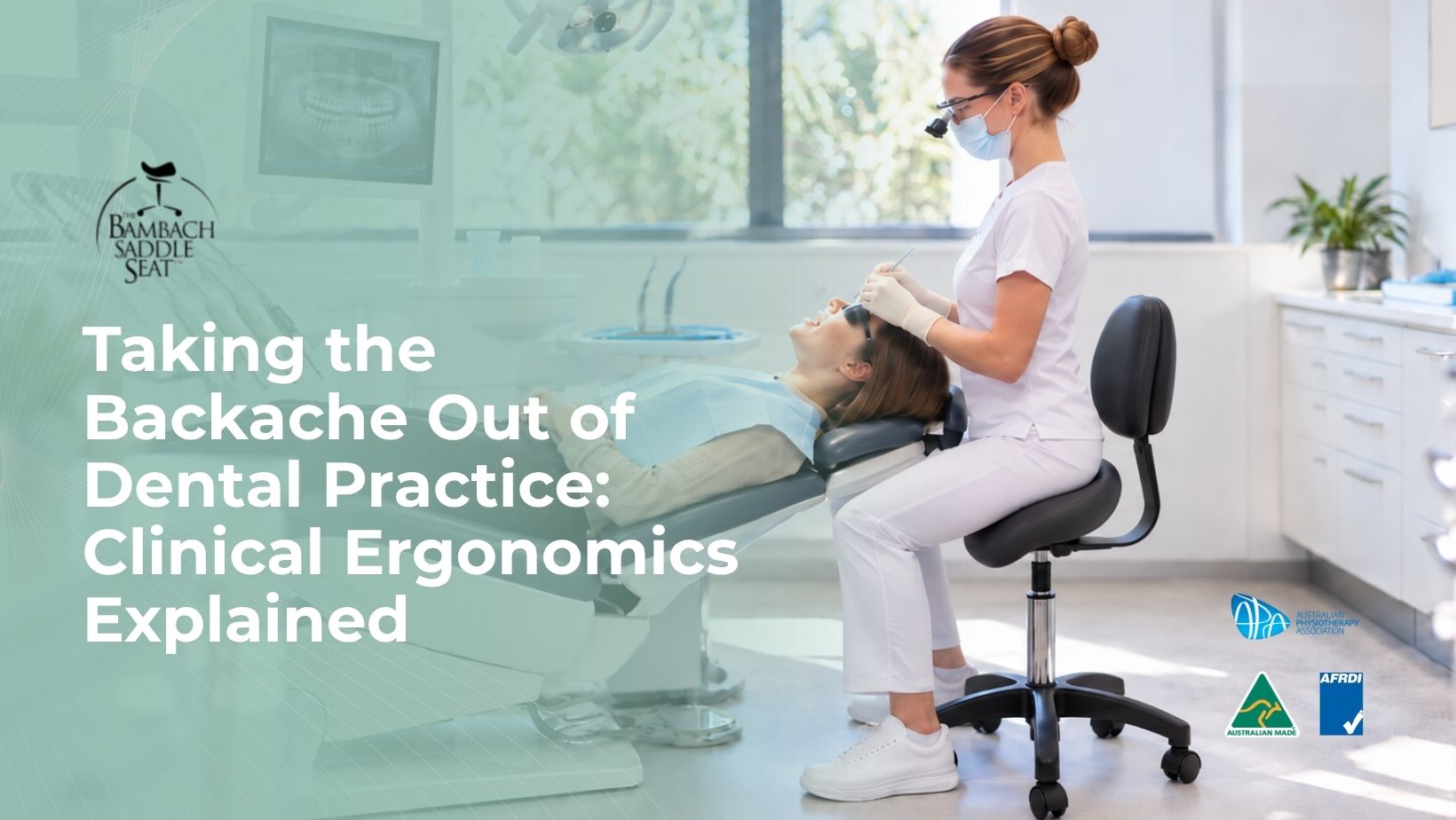
Taking the Backache Out of Dental Practice: Clinical Ergonomics Explained

Article from Dentaleconomics.com. USA. May 2015

The High Cost of Postural Stress in Dentistry

Dental practice is inherently demanding on the practitioner’s body. Dental surgeons, hygienists, and clinical assistants frequently suffer from back, neck, and shoulder injuries.

A systematic review published by Hayes revealed that back pain affects between 36.3% and 60.1% of dentists. Furthermore, neck pain afflicts up to 85% of dental practitioners.

Additionally, a comprehensive meta-analysis reported severe regional pain prevalence across the profession:

  • Thoracic-Lumbar Pain: 53.90% combined prevalence.
  • Lower Back Pain: 41.23% combined prevalence.
  • Neck Pain: 41.39% combined prevalence.

Consequently, work-related musculoskeletal disorders (MSDs) remain the leading threat to clinical longevity. Therefore, understanding ergonomic working postures is vital for every practitioner.

Why Dental Professionals Experience Chronic Pain

Practitioners subconsciously lean toward the patient to improve visualization during procedures. In addition, clinicians rotate and bend their heads to view the maxilla rather than adjusting the patient or using indirect mirror vision.

As visual acuity declines with age, practitioners lean forward even further. Consequently, this increases strain on the delicate cervical spine and lumbar region.

While dental loupes force practitioners into an upright posture due to fixed focal distances, leaning forward blurs the field of view. Unfortunately, traditional flat operator chairs fail to support this upright stance.

Standard flat chairs force the spine to collapse into an unnatural “C” shape. As a result, this posture multiplies strain on the fourth and fifth lumbar discs (L4/L5), creating chronic pain.

Clinical Case Study: From Injury to Enduring Pain Relief

Prominent clinician Dr Gregori M. Kurtzman, DDS, experienced severe cumulative spinal damage following auto accidents. Consequently, traditional flat dental chairs placed intense pressure on his coccyx, making long clinical days painful.

After testing the Bambach Saddle Chair at a dental conference, Dr Kurtzman experienced immediate clinical benefits:

“As with most things in life, there was an adaptation process. In my case, it took about a week. But at the end of the first day, I noticed my back felt less strained, and I had less pressure in the lumbar area. Now, after using my new chair for several months, my back feels almost like new.” — Dr Gregori M. Kurtzman, DDS.

Biomechanical Comparison: Traditional Flat Chair vs. Bambach Saddle Chair

Biomechanical Metric

Traditional Flat Operator Chair

Bambach Saddle Chair

Spinal Alignment

Collapsed “C” Shape


Forces the lumbar spine into excessive flexion, increasing disc compression.

Natural “S” Curve


Preserves natural spinal curves and removes strain from the lumbar region.

Spine-to-Hip Angle

90-Degree Closed Angle


Creates severe lower back strain and Coccyx compression.

Optimal 45° Angle Below Horizontal


Keeps back and thigh muscles relaxed in neutral balance.

Shoulder & Neck Load

Elevated Elbows


Forcing elbows outward increases shoulder tension and transmits strain to the neck.

Relaxed Elbows


Positions elbows closer to the body, significantly lowering upper-body fatigue.

Lower Limb Positioning

Horizontal Knees


Knees sit parallel to hips, preventing proper pelvic forward rotation.

Knees Lower Than Hips


Knees rest below hips, unloading the lumbar spine effortlessly.

Clinical Evidence

High MSD Rates


Linked to high rates of thoracic, lumbar, and cervical pain.

RULA Validated


Proven in RULA studies to maintain acceptable working posture.

Practical Setup for Maximum Ergonomic Relief

To achieve optimal clinical relief on a Bambach Saddle Chair, follow these practical setup steps:

  1. Lower the Knees Below Hips: Position the seat height so your knees rest lower than your hips. This creates the ideal 45-degree angle off horizontal to unload the lumbar spine.
  2. Keep Elbows Near the Torso: Maintain an upright stance so your arms hang naturally. This position relieves tension in the shoulders and upper neck.
  3. Calibrate Loupes Focal Distance: Measure your loupes working distance while seated on the Bambach chair with the patient positioned properly. This step ensures crisp vision without slumping.

Furthermore, the Bambach is available in versatile configurations, including doctor/hygienist models, front desk versions, and assistant chairs featuring supportive armrests and foot rings.

Protect Your Spine and Career

Dental professionals spend decades seated in treatment rooms. Over time, uncorrected spinal stress causes degenerative changes that jeopardize clinical careers.

By anchoring the pelvis and restoring the natural “S” curve, the Bambach Saddle Chair relieves physical stress and safeguards your career.

Explore our full range of Dental Ergonomic Saddle Chairs or read our Clinical Case Studies to see how custom pelvic support extends practice longevity.

Ready to eliminate clinical backache? Contact us today!

Read More »


How common is back and neck pain among dental practitioners?

Research shows that back pain affects up to 60.1% of dentists, while neck pain afflicts up to 85% of clinical personnel due to poor working posture.

Why do traditional flat dental chairs cause lower back pain?

Flat chairs force the hips into a 90-degree angle, causing the lower back to collapse into a “C” curve. This places excessive pressure on the L4 and L5 lumbar discs.

How does the Bambach Saddle Chair restore the natural “S” curve?

The saddle design allows your knees to rest lower than your hips, creating an optimal pelvic angle that maintains the natural “S” curve of your spine without muscle strain.

How long does it take to adapt to a Bambach saddle chair?

As noted in clinical trials by Dr Gregori Kurtzman, most practitioners undergo an adaptation period of approximately one week before experiencing complete postural comfort.

How does proper saddle seating reduce shoulder and neck fatigue?

By holding your spine upright, the Bambach allows your elbows to rest close to your body. This eliminates shoulder elevation, reducing strain transferred to the neck.

Should I calibrate my dental loupes while sitting on a saddle chair?

Yes. You should measure your loupes working distance while seated on the saddle chair with your patient positioned correctly to ensure clear focal vision without forward slumping.

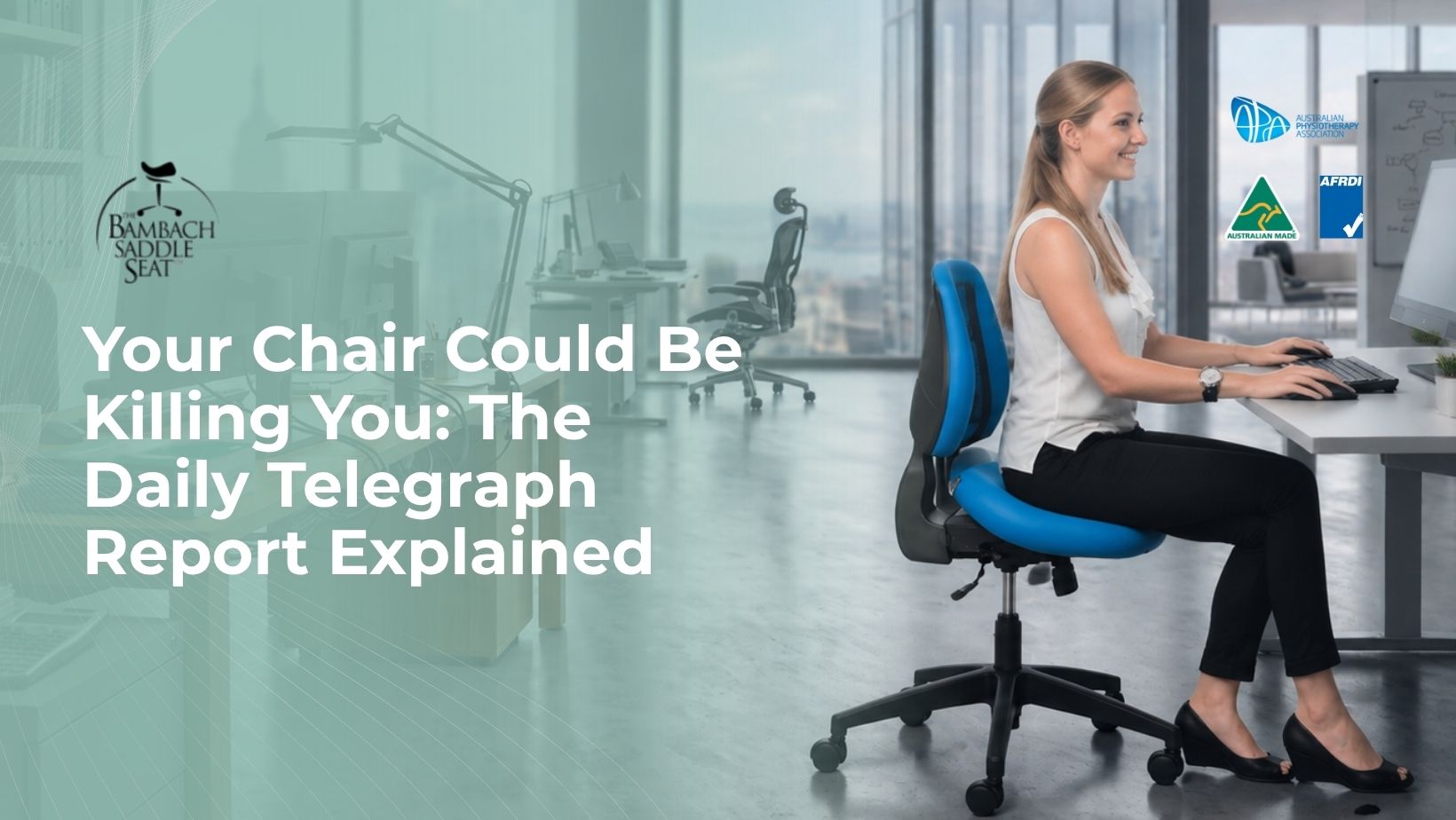
Your Chair Could Be Killing You: The Daily Telegraph Report Explained

In a national health feature titled “Your chair could be killing you”, The Daily Telegraph highlighted a silent epidemic affecting millions of workers across Australia. The investigative report revealed that traditional office seating is not merely uncomfortable. Instead, prolonged sitting directly contributes to preventable chronic illness and long-term spinal degeneration.

At Bambach, we believe that understanding these clinical risks is the first step toward reclaiming your health. Here is what the research tells us and how dynamic seating provides a clear solution.

The Daily Telegraph Warning: A 24% Spike in Preventable Disease Risk

The investigative report from The Daily Telegraph cited alarming clinical findings regarding workplace sitting habits. Specifically, research links prolonged sitting to a 24 per cent increase in the likelihood of succumbing to preventable diseases, including heart disease and certain forms of cancer.

Furthermore, data from the Baker IDI Heart and Diabetes Institute revealed a concerning paradox in public health:

  • High Concern, Low Action: Australians report being more worried about dying from preventable lifestyle diseases than from accidental injuries. However, very few take proactive steps to change their daily habits.
  • Extreme Daily Sitting Hours: Australian adults sit for an average of up to nine hours every day.
  • Lack of Prevention: Despite clear medical warnings, only one in five Australians prioritise reducing their daily chair time to protect their health.

Consequently, millions of office workers, healthcare professionals, and studio artists remain locked in static, unsupportive seating for most of their waking hours.

According to workplace health surveys conducted by the Baker Heart and Diabetes Institute and reported in The Daily Telegraph, prolonged sitting creates a 24% increase in the risk of preventable chronic diseases, with Australian adults averaging up to nine hours of chair time daily. 

Why Conventional Chairs Accelerate Physical Breakdown

Standard office chairs force your hips into a closed 90-degree stance. As a result, your pelvis tilts backward, flattening the natural “S” curve of your lower back into a slumped “C” shape.

When you sit in a collapsed position for up to nine hours daily, several physiological breakdowns occur:

  1. Intra-Discal Spinal Pressure: Slumping on a flat seat increases pressure on your lumbar discs by up to 180%, accelerating disc wear and spinal degeneration.
  2. Metabolic Slowdown: Inactive leg and core muscles slow down enzyme production, impairing your body’s ability to regulate blood glucose and break down blood fats.
  3. Abdominal Compression: Slumping collapses your chest cavity, restricting deep diaphragmatic breathing and reducing blood oxygen levels during the workday.

Daily Telegraph Sitting Risk Breakdown

Sitting Health Metric

Daily Telegraph & Baker IDI Findings

Mechanical Impact on Body

Bambach Active Seating Solution

Daily Chair Time

Up to 9 Hours Daily


Average sitting time for Australian adults.

Creates static muscle fatigue and continuous lumbar pressure.

135° Open Hip Stance


Restores natural “S” spinal curve without static strain.

Chronic Disease Risk

24% Risk Increase


Higher incidence of heart disease & cancer.

Inactive leg muscles impair metabolic fat and sugar processing.

Active Muscle Engagement


Keeps core and leg stabilizers active throughout the workday.

Public Action Gap

Only 1 in 5 Prioritise Change


Most Australians ignore sitting hazards.

Unchecked spinal slumping causes chronic back and neck pain.

Evidence-Based Ergonomics


OT-designed, AFRDI Level 6 certified pelvic support.

How Bambach Converts Passive Sitting into Active Health

You cannot always eliminate desk work, but you can change how your chair supports your body. Engineered in Sydney by Occupational Therapist Mary Gale, the Bambach Saddle Seat eliminates the postural collapse inherent in standard office chairs.

135-Degree Open Pelvic Angle

By opening your hip stance to 135 degrees, the Bambach naturally tilts your pelvis forward. This restores your spine’s natural, upright “S” curve, taking structural pressure off your lumbar discs.

Open Torso & Unrestricted Respiration

An upright posture opens your chest and abdominal cavities. Consequently, your diaphragm moves freely, boosting blood oxygenation and keeping you alert without slumping.

Australian Made & AFRDI Level 6 Certified

Built to withstand severe commercial use, Bambach chairs are independently tested to Australia’s highest structural standard. Therefore, you receive reliable, long-term spinal support backed by Australian clinical expertise.

Reclaim Your Health and Spine Today

Do not let standard office seating compromise your physical health. Take control of your daily workplace posture with a scientifically proven seating intervention.

Explore our complete range of Ergonomic Saddle Chairs or read our Australian Clinical Case Studies to discover how dynamic seating transforms daily endurance.

Ready to eliminate sitting hazards in your workplace? Contact us today for a personalised trial or visit our Sydney showroom.

Read More »


What did The Daily Telegraph report reveal about sitting risks in Australia?

The report highlighted that prolonged sitting is linked to a 24% increase in preventable diseases like heart disease and cancer. It also revealed that Australian adults sit for up to nine hours daily, yet only 20% prioritise cutting down chair time.

How does prolonged sitting affect heart health and metabolism?

Sitting passively deactivates major leg and core muscles. This slows down metabolic enzyme activity, making it harder for your body to regulate blood sugar and process blood fats effectively.

Why do standard office chairs cause back pain during long workdays?

Standard chairs force your hips into a 90-degree angle, causing your pelvis to tilt backward. This slumps your spine into a weak “C” curve, multiplying pressure on your lower lumbar discs and tiring your back muscles.

How does an open 135-degree hip angle protect your spine?

An open 135-degree hip angle rotates your pelvis forward into a neutral position. This naturally restores your spine’s upright “S” curve, taking structural load off lumbar discs without requiring a restrictive backrest.

What is the difference between passive and active sitting?

Passive sitting on flat chairs causes your core muscles to turn off, leading to slumping and fatigue. Active sitting on a Bambach saddle seat lightly engages your core and leg muscles, promoting healthy circulation and balanced spinal support.

How can I start reducing sitting hazards at work?

Switch to an open-hip saddle seat to maintain natural pelvic balance. Additionally, take brief one-to-two-minute movement breaks every 30 minutes to keep your metabolic enzymes active.