
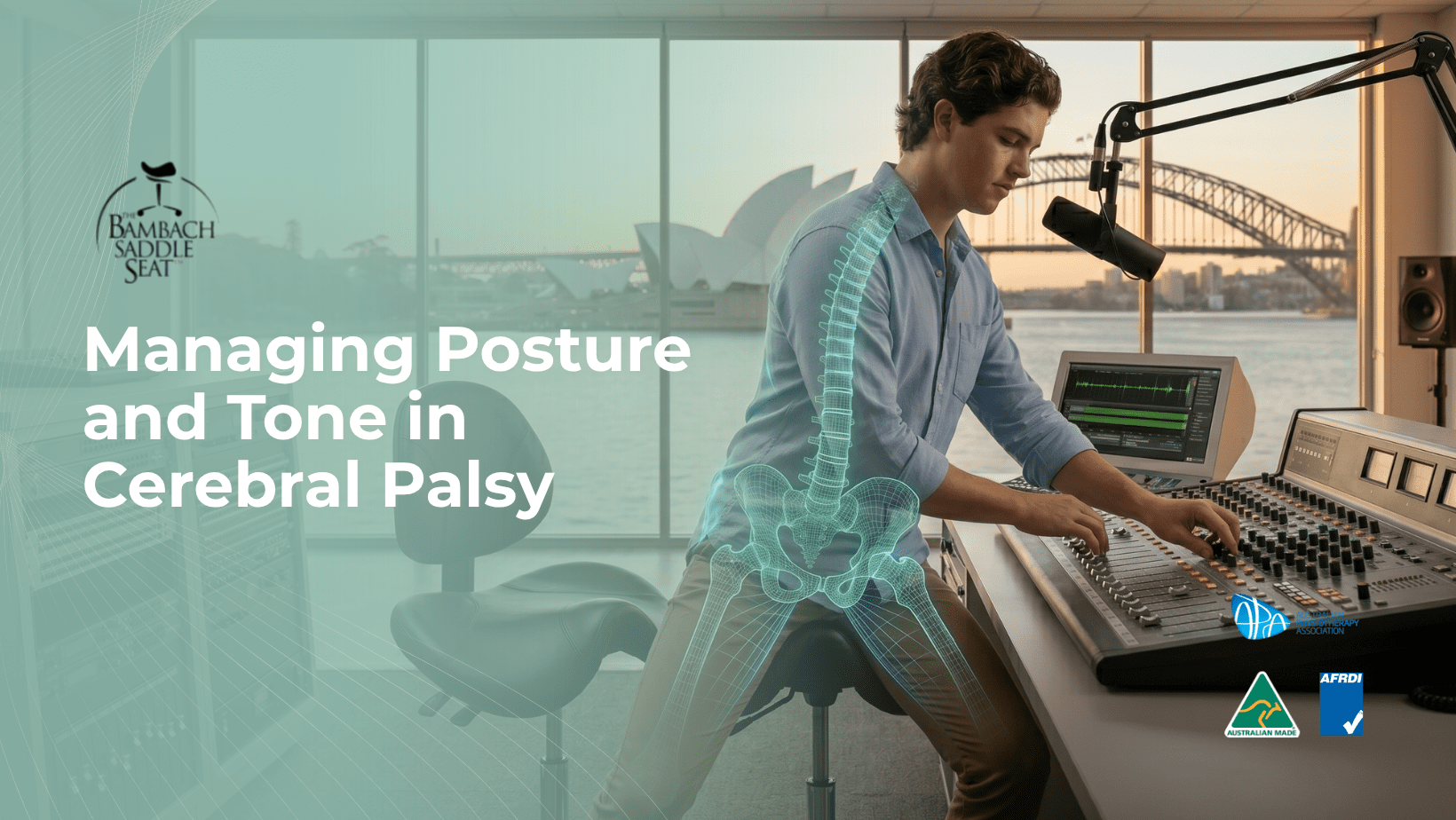
Case Study: Managing Posture and Tone in Cerebral Palsy
Special Needs: Cerebral Palsy
Name: David Boyle; Occupation: Student; part-time radio presenter (rock music)
The Problem
David Boyle, a student and part-time rock music radio presenter, lives with Cerebral Palsy characterized by increased muscle tone, particularly on his right side. His condition includes tight hip adductors, making walking extremely difficult and necessitating the use of a wheelchair for mobility.
When sitting in his wheelchair or a conventional seat, David tends to sit “sacrally” (slumped back on his tailbone). This posterior pelvic tilt causes a chain reaction of poor postural habits: his shoulders hunch forward, his shoulder blades become “winged,” his chin protrudes, and his cervical spine falls into excessive lordosis (inward curvature). Furthermore, the asymmetrical muscle tone causes his pelvis to pull obliquely to the right. This poor seating posture severely impacted his comfort, upper body mobility, and his ability to work effectively at his radio broadcasting desk.
The Intervention
To address these complex seating challenges, David was introduced to a custom-fitted Bambach Saddle Seat.
The unique saddle shape provided an immediate structural intervention. The seat’s contour naturally forced David’s tight hip adductors into an abducted (open and apart) position. By straddling the seat, his pelvis was actively prevented from slipping into a sacral slump and was instead guided into a neutral, anterior tilt. This foundation automatically stabilized his core and broke the pattern of asymmetrical pulling, correcting the oblique shift of his pelvis.
The Outcome
Corrected Spinal Alignment: By anchoring the pelvis in a neutral position, the Bambach seat naturally stacked David’s spine. His hunched shoulders dropped back, his shoulder blades flattened, and his excessive cervical lordosis was corrected, allowing his head to balance easily over his neck.
Improved Upper Limb Function: With his core stabilized and his shoulders properly aligned, David gained much better control and reach with his arms—a critical improvement for operating the mixing desks and equipment during his radio broadcasts.
Tone Management: The abducted hip position helped to stretch his tight adductors and inhibit the increased muscle tone on his right side, providing therapeutic value even while he was simply sitting at his desk or presenting his show.
Can a saddle seat improve arm and hand control for special needs users?
Yes. Upper limb function is heavily dependent on core and shoulder stability. When a conventional chair allows the spine to slump, the shoulder blades wing out, making fine motor tasks difficult. The Bambach Saddle Seat stabilizes the pelvis and spine, giving the arms a solid base of support to operate from, which significantly improves reach and dexterity.
Is the Bambach Saddle Seat a replacement for a wheelchair?
No. A wheelchair is essential for mobility and transport. However, for task-specific activities—such as studying at a desk, eating at a table, or working in a studio—transferring to a Bambach Saddle Seat provides an active, therapeutic seating environment that counters the negative postural effects of prolonged wheelchair use.