
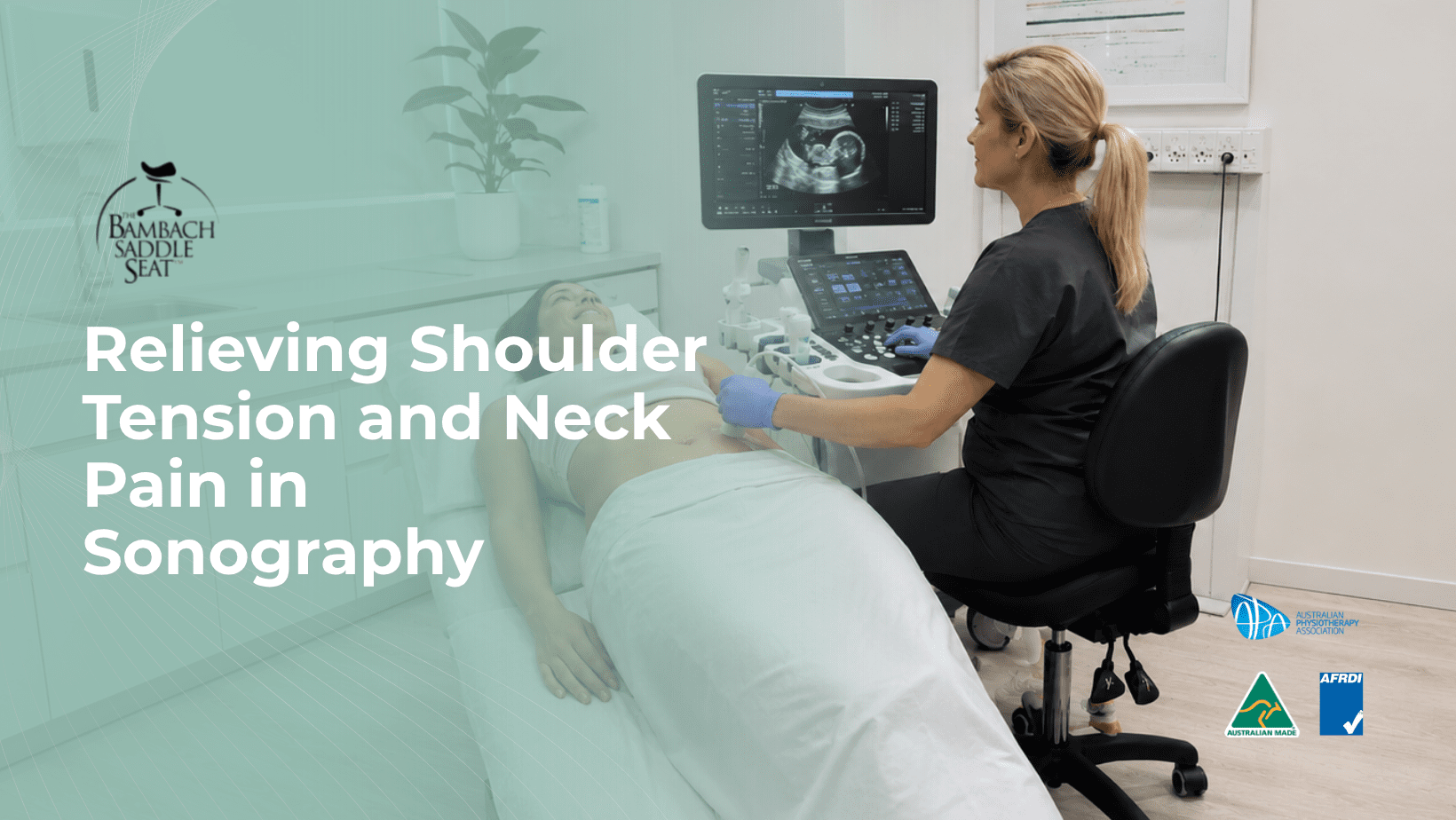
Case Study: Relieving Shoulder Tension and Neck Pain in Sonography
Sonographer: Shoulder Tension & Pain
Name: Samantha Everett, Occupation: Sonographer
The Problem
Samantha Everett, a Sonographer at Rosie Maternity Hospital, spends her shifts performing a high volume of ultrasound scans. Her daily routine requires greeting patients, discussing real-time ultrasound imaging on a screen, and following up with written computer reports.
Crucially, the physical act of scanning requires prolonged sitting while simultaneously twisting, turning, and manipulating the ultrasound probe with one arm. Maintaining this static, asymmetrical posture on a standard clinical stool caused Samantha to develop severe muscle tension in the shoulder of her scanning arm, alongside chronic, radiating pain through her neck and bilateral shoulders. The severity of her discomfort prompted a referral to Occupational Health for a comprehensive ergonomic intervention.
The Intervention
Following the ergonomic review by Occupational Health, Samantha was prescribed a Bambach Saddle Seat to address the specific biomechanical hazards of sonography.
Because sonographers must lean sideways and twist to reach the patient while looking at a monitor, a standard flat stool provides zero pelvic stability, forcing the shoulder and back muscles to bear the entire twisting load. The Bambach Saddle Seat fundamentally changed Samantha’s base of support. By opening her hip angle to 135 degrees and stabilizing her pelvis in a straddle stance, the seat locked her spine into its natural “S” curve. This allowed her to pivot and reach safely from her core, rather than twisting and straining her shoulder girdle.
The Outcome
Relief of Shoulder Tension: By stabilizing her core and perfectly balancing her upper spine, the Bambach took the strain off the overworked muscles in her scanning arm and shoulder, providing immense relief from chronic tension.
Supported Mobility: The straddle position allowed Samantha to easily roll around the examination room—from the patient bed to the computer workstation—without compromising her posture.
Occupational Health Endorsement: Samantha’s case demonstrates why standard flat stools fail in active clinical environments, proving that task-specific ergonomic seating is a critical necessity for ultrasound professionals.
How does a saddle chair help with twisting and reaching?
On a normal flat stool, twisting comes from the lower back and shoulders, which causes immediate strain. A saddle chair anchors the pelvis in a secure straddle position. This allows the sonographer to move closer to the patient bed and pivot their entire torso as a single, stable unit, preventing hazardous spinal twisting and shoulder overextension.
Can a saddle chair be used for both scanning and computer work?
Yes. The Bambach Saddle Seat is designed to support the spine perfectly regardless of the task. Because it maintains an upright, chest-open posture, it is just as effective for typing up post-scan reports at a desk as it is for performing dynamic ultrasound procedures.