
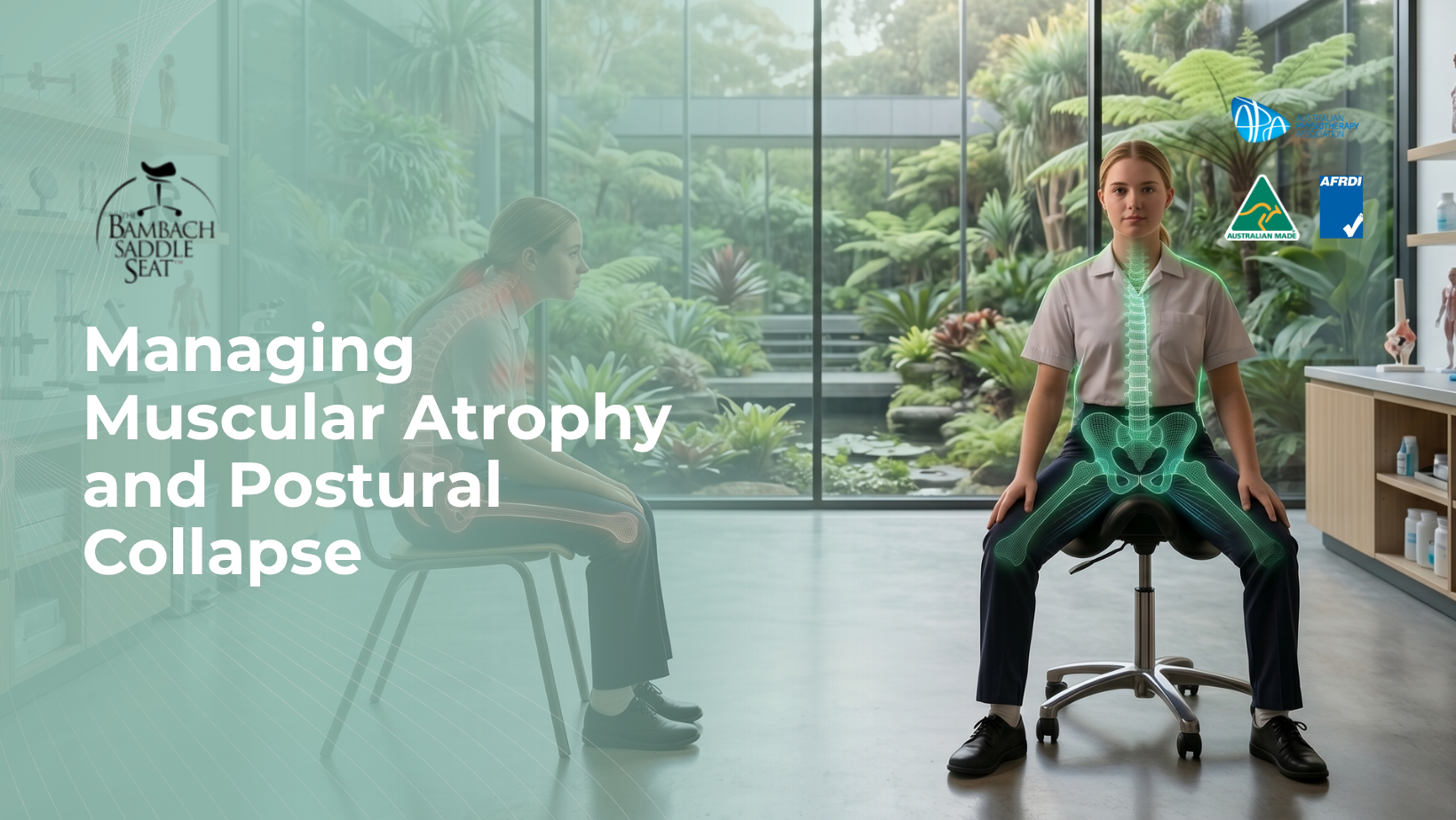
Case Study: Managing Muscular Atrophy and Postural Collapse
Special Needs: Muscular Atrophy
Name: Ruby Neale; Occupation: Student
The Problem
Ruby Neale, a student living with muscular atrophy, faces significant challenges maintaining functional posture, particularly over long periods in a standard classroom chair. The conventional seat forces her into a severe, C-shaped postural collapse that flattens her natural lumbar curve. This places her at a high risk of developing permanent kyphotic or spinal deformities. To compensate for this slump and see her desk work, Ruby’s shoulders hunch forward, her neck severely hyperextends, and her chin protrudes.
Furthermore, this postural collapse has secondary systemic effects. Her chest caves down onto her abdomen, mechanically restricting the action of her diaphragm and ribs. This impaired thoracic function drastically accelerates her physical fatigue and makes performing standard, functional classroom tasks incredibly difficult.
The Intervention
To counter the profound gravitational pull and lack of muscular support, Ruby was assessed for and provided with a custom-fitted Bambach Saddle Seat. The continuous, equestrian-inspired contour of the seat intervened structurally at the pelvis. By naturally abducting her legs and securely holding her pelvis in an upright, neutral tilt, the seat provided the skeletal foundation her muscles were struggling to maintain.
The Outcome
Spinal Deformity Prevention: By locking the pelvis in an anterior tilt, the Bambach seat naturally restored Ruby’s healthy lumbar curve, immediately breaking the dangerous C-shaped slump and mitigating the risk of kyphotic progression.
Restored Thoracic Function: Lifting the spine out of its collapsed state opened Ruby’s chest cavity. This removed the physical compression on her abdomen, allowing her diaphragm and ribs to move freely and significantly reducing her daily physical fatigue.
Functional Alignment: With her torso safely anchored, Ruby’s shoulders naturally dropped back. Her head could now balance effortlessly over her spine without requiring painful neck hyperextension, granting her the stable, comfortable base needed to focus on her education.
Can a specific chair actually help with breathing and daily fatigue?
Yes. When a person slumps, their ribcage collapses down onto their abdomen, physically restricting the diaphragm and making breathing incredibly labor-intensive. By naturally holding the user upright, the Bambach seat opens the thoracic cavity, allowing the lungs and diaphragm to expand fully. This deeper, easier breathing significantly reduces daily physical fatigue.
How does this seating intervention help students like Ruby in a classroom environment?
Beyond preventing long-term spinal deformities, the seat stabilizes the torso, which naturally aligns the head and neck. Instead of jutting her chin forward and hyperextending her neck just to see the whiteboard or her desk, Ruby can look forward comfortably. This core stability also frees up her arms and hands, making writing and functional classroom tasks much easier to perform.