
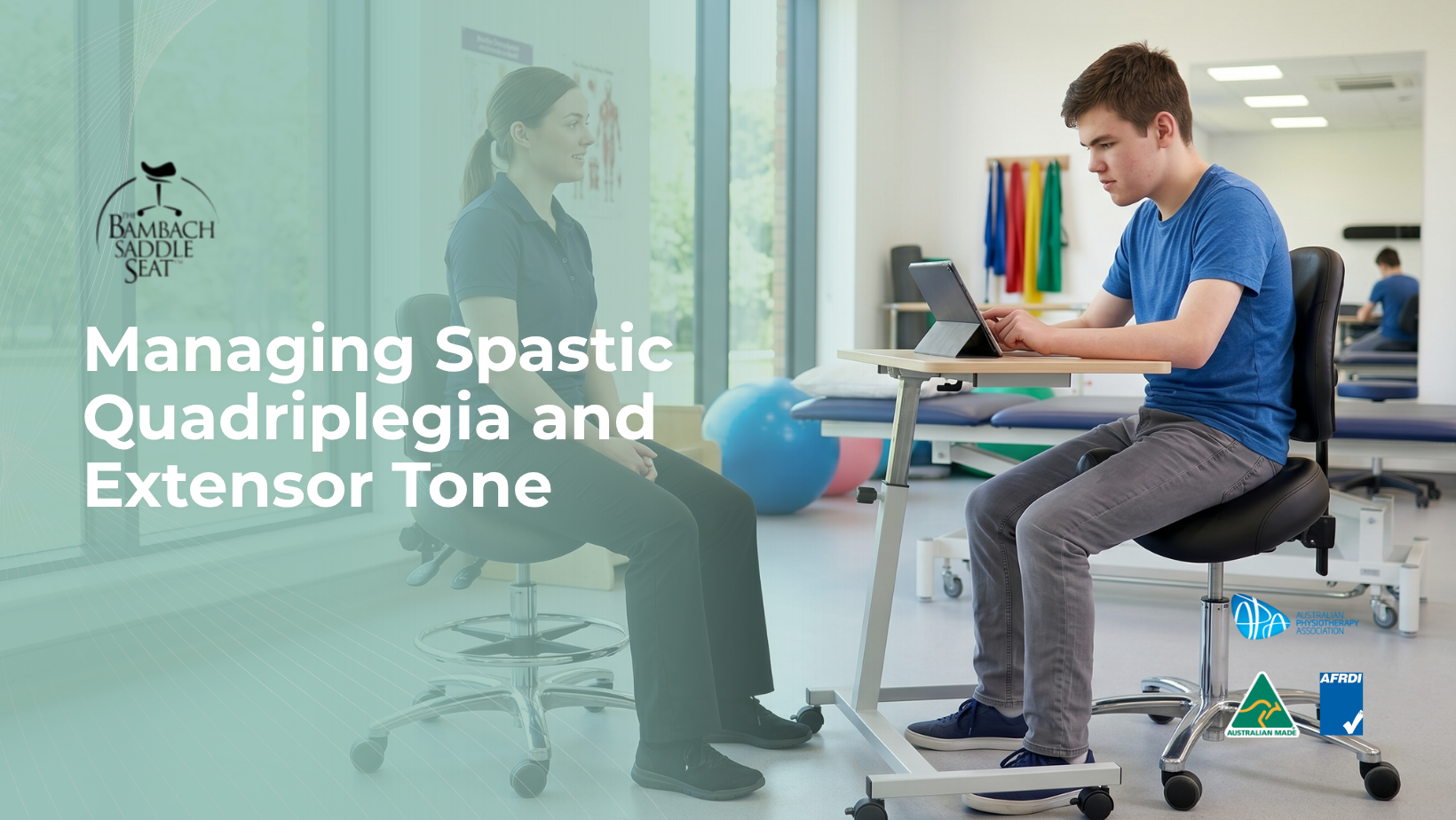
Case Study: Managing Spastic Quadriplegia and Extensor Tone
Special Needs: Spastic Quadriplegia Cerebral Palsy
Name: Eamon Hohn, Occupation: School student
The Problem
Eamon lives with moderate to severe spastic quadriplegia cerebral palsy. His condition is characterized by high spasticity and increased extensor tone, causing involuntary muscle tightness and thrusting. When sitting in a conventional flat seat, Eamon lacks the foundational support needed to manage this tone. Consequently, his pelvis and trunk tend to rotate obliquely, accompanied by a physical drop to his left side. This rotational instability, combined with his extensor thrust, causes him to continuously slide off standard chairs.
Despite experiencing physical restrictions in the activities he wishes to undertake, Eamon is fiercely determined. He rightly views himself as normal, noting that his primary obstacle is often “other peoples’ attitudes” rather than just his physical limitations. However, inadequate seating actively hinders his independence by forcing him to constantly battle gravity and his own muscle tone just to stay seated.
The Intervention
To address his complex postural instability, Eamon was fitted with a custom Bambach Saddle Seat. The continuous, unbroken contour of the saddle provided an immediate biomechanical intervention. By naturally abducting his hips (separating the legs) and securely cradling his pelvis, the seat’s design actively broke up his severe extensor thrust. The pommel and cantle system of the saddle locked his pelvis into a neutral, symmetrical position, physically preventing the oblique rotation and the left-sided drop that conventional flat seats allowed.
The Outcome
Elimination of Sliding: With his pelvis securely anchored by the saddle’s anatomical geometry, Eamon no longer slides out of his chair. He is safely and comfortably supported without the need for restrictive strapping that often accompanies conventional seating.
Tone Reduction: The abducted hip position naturally inhibited his high extensor tone, reducing the spasticity in his trunk and legs. This provided therapeutic relief and allowed his body to relax into the seat.
Empowered Independence: By removing the exhausting physical battle of simply trying to stay upright, Eamon gained the stability required to focus on functional tasks. The seat bridged the gap between his physical restrictions and his personal determination, giving him the secure foundation needed to engage in his desired activities with confidence.
Can the Bambach seat prevent oblique pelvic rotation and leaning?
Yes. Conventional chairs offer a flat surface, which provides no lateral or rotational control for the pelvis. The continuous, contoured design of the Bambach seat physically cradles the user's anatomy. The front pommel and the overall saddle shape lock the pelvis into a symmetrical, neutral alignment, actively preventing the hips from twisting obliquely or dropping to one side.
Why is foundational stability important for users with severe cerebral palsy?
For individuals like Eamon, a lack of core stability means all their energy is spent just trying not to fall or slide. By anchoring the pelvis and managing involuntary spasticity, the Bambach seat frees up the upper body. This provides the stable platform necessary to improve arm control, breathing, and the ability to independently participate in daily activities.