
Case Study: Enhancing Classroom Mobility and Posture for Spondyloepiphyseal Dysplasia Congenita
Special Needs: S. E. Dysplasia Cogenita
Name: Patrick Tinney, Occupation: Student
The Problem
Patrick is a student living with spondyloepiphyseal dysplasia congenita, a condition that significantly impacts his daily physical function. His anatomy is characterized by malformed joints, alongside a shortening of both his limbs and his spine. Physically, this manifests as a severe limitation in his shoulder movement and marked upper thoracic restriction.
In the classroom, Patrick is usually confined to his electric wheelchair. While necessary for long-distance transport, the wheelchair is incredibly cumbersome in a standard schoolroom environment. Because of its bulk and his restricted upper body mobility, Patrick cannot simply turn his body to look at the whiteboard or interact with peers. Once his wheelchair is parked, he is effectively trapped in that single, forward-facing orientation, severely limiting his educational independence and social engagement.
The Intervention
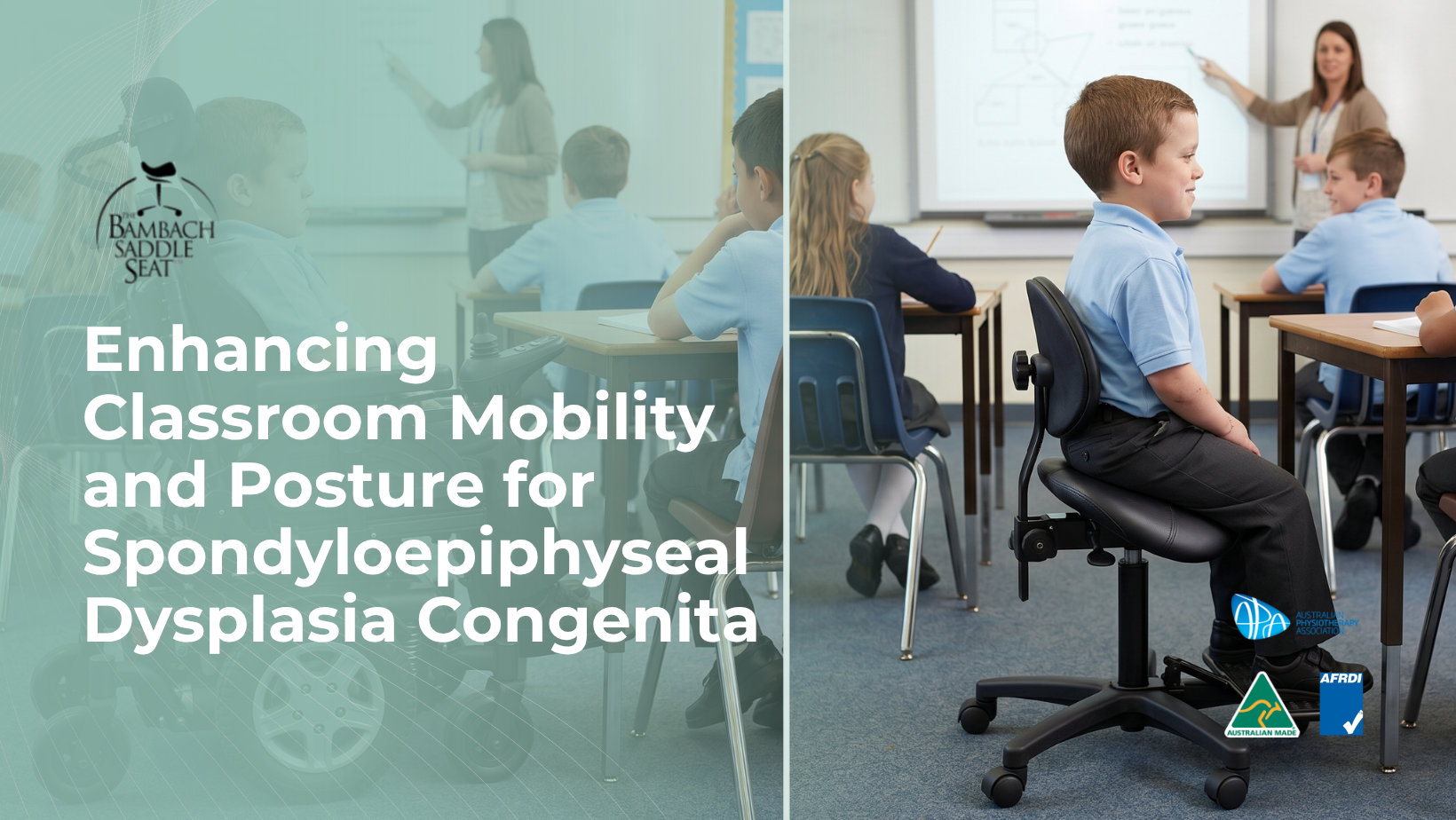
To liberate Patrick from the confines of his heavy wheelchair during class time, he was introduced to a custom-configured Bambach Saddle Seat. Because standard chairs cannot accommodate his shortened limbs, the Bambach was fitted with a customized stem and foot-support system, allowing him to safely mount and anchor himself. The continuous saddle contour naturally cradled his pelvis, providing an ultra-stable core foundation that his malformed joints previously struggled to establish on flat surfaces.
The Outcome
Classroom Independence: By transferring to the Bambach seat, Patrick immediately reduced his spatial footprint in the classroom. The seat’s compact design and castors allowed him to navigate between desks freely, giving him an unprecedented level of independence.
Restored Field of Vision: The secure pelvic anchor provided by the saddle allowed Patrick to use his core to pivot his entire body as a single unit. He was finally able to rotate his seat to face the whiteboard, the teacher, or his classmates without needing to maneuver a heavy electric wheelchair.
Optimized Thoracic Function: By stabilizing his lower body in an upright, neutral posture, the seat alleviated the compensatory strain on his upper body. Lifting his shortened spine out of a slumped wheelchair posture maximized his available thoracic space, reducing restriction and allowing him to utilize his limited shoulder movement more efficiently.
Why is a saddle seat a better option than a wheelchair in a classroom setting?
While electric wheelchairs are vital for overall mobility, their bulk often creates physical barriers in tight environments like classrooms. The Bambach seat provides a much smaller footprint, allowing the student to sit at standard desks with their peers. Furthermore, the seat's swivel function and castors allow the user to easily rotate to see the teacher or the board—a movement that is often impossible when parked in a heavy wheelchair.
Can this seating intervention help with upper thoracic restriction?
Yes. When a user is confined to a standard flat chair or a wheelchair, they often slump forward, which physically compresses the ribcage and restricts the shoulders. By locking the pelvis into a natural, upright tilt, the Bambach seat lifts and lengthens the spine. This naturally opens the thoracic cavity, maximizing the user's available range of motion in their shoulders and upper back.