
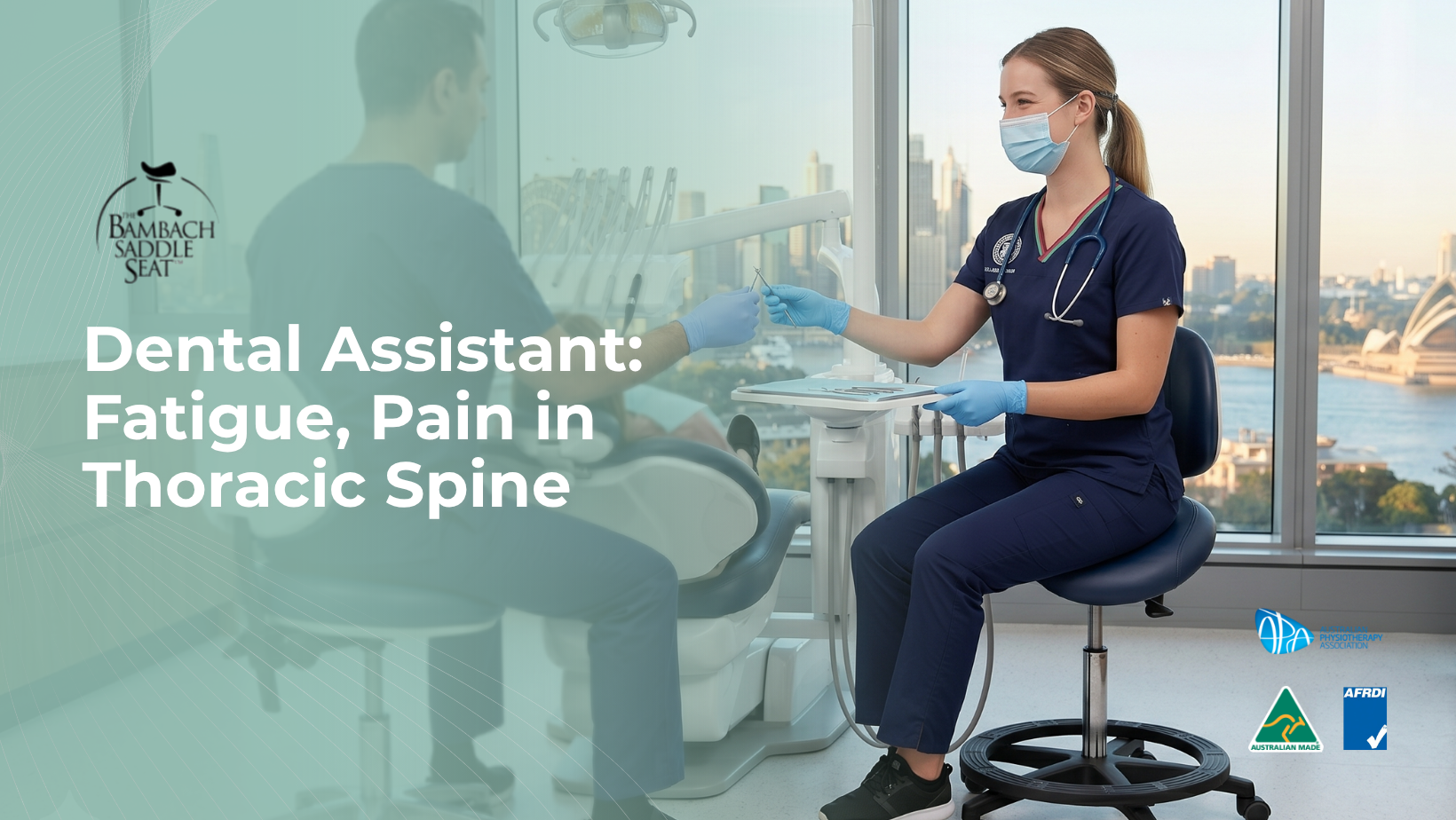
Case Study: Overcoming Dental Assistant Fatigue & Thoracic Spine Pain
Dental Assistant: Fatigue, Pain in Thoracic Spine
Name: F.B, Occupation: Dental Assistant
The Problem
Despite being a competitive triathlete in peak physical condition, dental assistant F.B. developed severe upper thoracic (back) pain and crushing fatigue just one month into her clinical career.
To see into the patient’s mouth over the dentist’s shoulder, F.B. had to sit 10 to 15 centimetres higher than the operator. On a standard flat stool, this elevated position forced her pelvis to tilt backward, collapsing her spine into a slumped “C” shape. Holding this twisted, forward-leaning position starved her upper back muscles of oxygen (static ischemia), causing severe burning pain and intense physical exhaustion that her athletic fitness could not prevent.
The Intervention
F.B. swapped her traditional flat stool for an authentic Bambach Saddle Seat customized with an extended gas stem and a structural foot-ring.
The contoured saddle dropped her thighs into a 135-degree open hip angle, naturally rotating her pelvis forward. This automatically restored her spine’s healthy “S” curve without requiring active muscle straining. The mechanical foot-ring provided full foot contact, giving her a wide, perfectly stable base of support closer to the patient.
The Outcome
Zero Thoracic Pain: Transferring her upper body weight onto her skeletal structure—rather than forcing her muscles to hold it up—completely eliminated her upper back pain.
Vastly Reduced Fatigue: The upright posture opened her chest cavity, maximizing lung capacity and circulation, which wiped out her afternoon brain fog and fatigue.
The Clinical Lesson: F.B.’s case proves that athletic conditioning cannot protect against static clinical loading. Task-appropriate, active ergonomic seating is the only definitive preventative solution.
Why do dental assistants require a foot-ring on their saddle chairs?
Dental assistants must sit 10 to 15 centimetres higher than the dentist to see into the patient's mouth clearly over the dentist's arm. Because the chair must be elevated, the assistant's feet cannot reach the floor. A mechanical foot-ring provides an elevated platform for full foot contact, establishing the wide, stable base of support necessary to anchor the pelvis and maintain a healthy posture.
How does a saddle chair specifically relieve upper back (thoracic) pain?
Upper back pain occurs when a flat chair causes the lower back to slump, forcing the upper thoracic muscles to work overtime to keep the chest and head upright. A saddle chair opens the hip angle to 135 degrees, which automatically rotates the pelvis forward and aligns the entire spine into a natural, self-supporting "S" curve. This unloads the burden from the thoracic muscles, allowing them to relax.
How long does it take a dental professional to adjust to a Bambach Saddle Seat?
Most dental professionals experience an acclimatisation period of approximately 1 to 2 weeks. Because standard dental stools allow the core and postural muscles to completely switch off, the dynamic posture of a saddle chair reactivates these dormant muscle groups. Users may feel mild muscle awareness or slight tiredness for the first few days, which quickly fades as core endurance improves.