
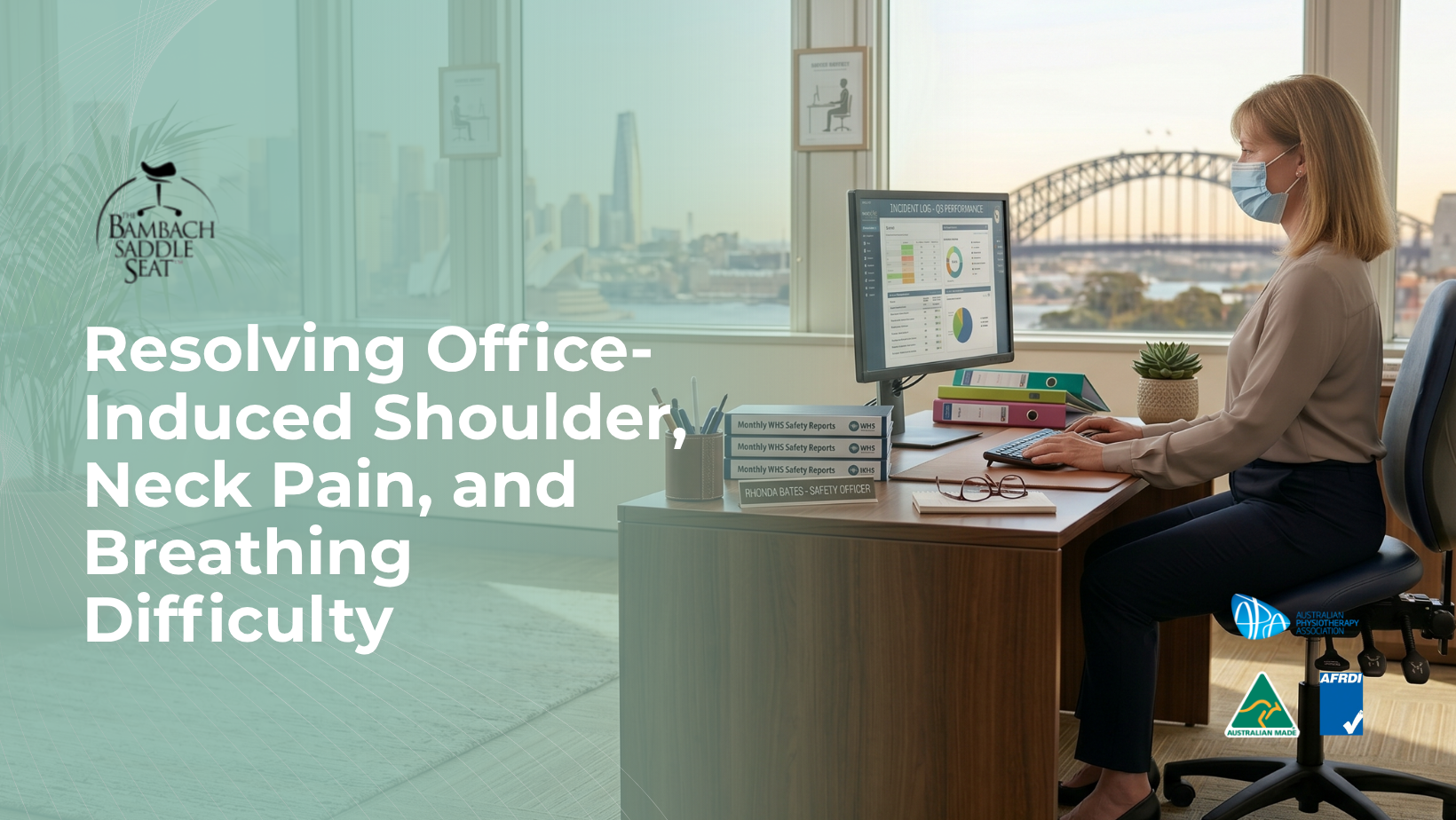
Case Study: Resolving Office-Induced Shoulder, Neck Pain, and Breathing Difficulty
Office: Shoulder and Neck pain
Name: Rhonda Bates, Occupation: Supervisor, Safety Officer
The Problem
Rhonda Bates, a Supervisor and Safety Officer, spent long hours at her desk performing computer-based office work. Four years into her role, she developed severe, chronic pain in her shoulders and neck. The condition escalated to the point where her slumped, forward-leaning posture actively compressed her chest cavity, causing alarming breathing difficulties even when relaxing on a lounge at home.
Standard office chairs failed to support her properly. The flat seat pan encouraged her pelvis to roll backward, flattening her lower back and forcing her upper spine and neck to crane forward toward the screen. This static, unnatural posture overworked her cervical and shoulder muscles and restricted her diaphragm.
The Intervention
As a Safety Officer understanding the importance of workplace ergonomics, Rhonda transitioned from a conventional office chair to a Bambach Saddle Seat.
The Bambach fundamentally changed her seated posture. By placing her in an upright, straddled stance with a 135-degree open hip angle, the seat naturally rotated her pelvis forward. This effortless alignment restored the natural “S” curve of her spine, directly balancing her heavy head over her shoulders and completely removing the need to actively strain her neck and upper back.
The Outcome
Elimination of Shoulder & Neck Pain: By letting her skeletal structure support her body weight rather than her muscles, the Bambach eliminated the static loading that caused her severe upper body pain.
Restored Breathing Capacity: The upright, chest-open posture released the compression on her diaphragm and lungs. Her breathing difficulties were completely resolved, both at work and while resting at home.
Safety First: Rhonda’s case perfectly illustrates the systemic health impact of poor seating. A true ergonomic intervention doesn’t just fix back pain; it improves overall physiological function.
Why do office workers get so much neck and shoulder pain?
Office workers frequently crane their necks forward to read monitors ("tech neck"). When the spine isn't properly supported at the base (the pelvis), the muscles in the neck and shoulders have to work overtime to hold the head up. Over time, this constant static tension causes severe muscle fatigue and chronic pain.
How does a saddle chair fix neck pain if it doesn't have a headrest?
A saddle chair fixes the root cause of neck pain, which originates in the lower back and pelvis. By locking the pelvis upright, the spine stack naturally aligns. When your spine is perfectly upright, your head balances effortlessly on top of your shoulders, removing the need for external headrests or constant muscular straining.